
The cheapest supplement packaging is not the packaging with the lowest unit cost. It is the packaging that requires the fewest redesigns before it earns distribution.
Why Supplement Packaging Cost Is Difficult to Quote
When a supplement founder asks "how much does supplement packaging cost," the answer depends on five variables that are usually undefined at the time of asking: the packaging format, the minimum order quantity (MOQ), the label printing specification, the design investment, and the compliance requirements of the target market.
A supplement in a stock HDPE bottle with a paper label at 1,000 units can be packaged for under $1.00 per unit. The same formula in a custom glass jar with a embossed lid, a foil-printed label, and a kraft outer box at 500 units will cost $4.00 to $8.00 per unit for the packaging alone, plus design fees that may exceed the entire first production run cost.
Most supplement founders compare quotes at the packaging component level without understanding that the total packaging cost includes design, compliance review, label printing setup, and any tooling or mold costs for custom components. This guide breaks down each component and provides the ranges founders should be planning around.
Supplement Packaging Cost by Format
The packaging format is the single largest driver of cost variation. Different formats have different material costs, different minimum order quantities, and different complexity levels for label design and compliance.
Format | Unit Cost Range (1,000 MOQ) | Min. MOQ Typical | Design Complexity | Best For |
|---|---|---|---|---|
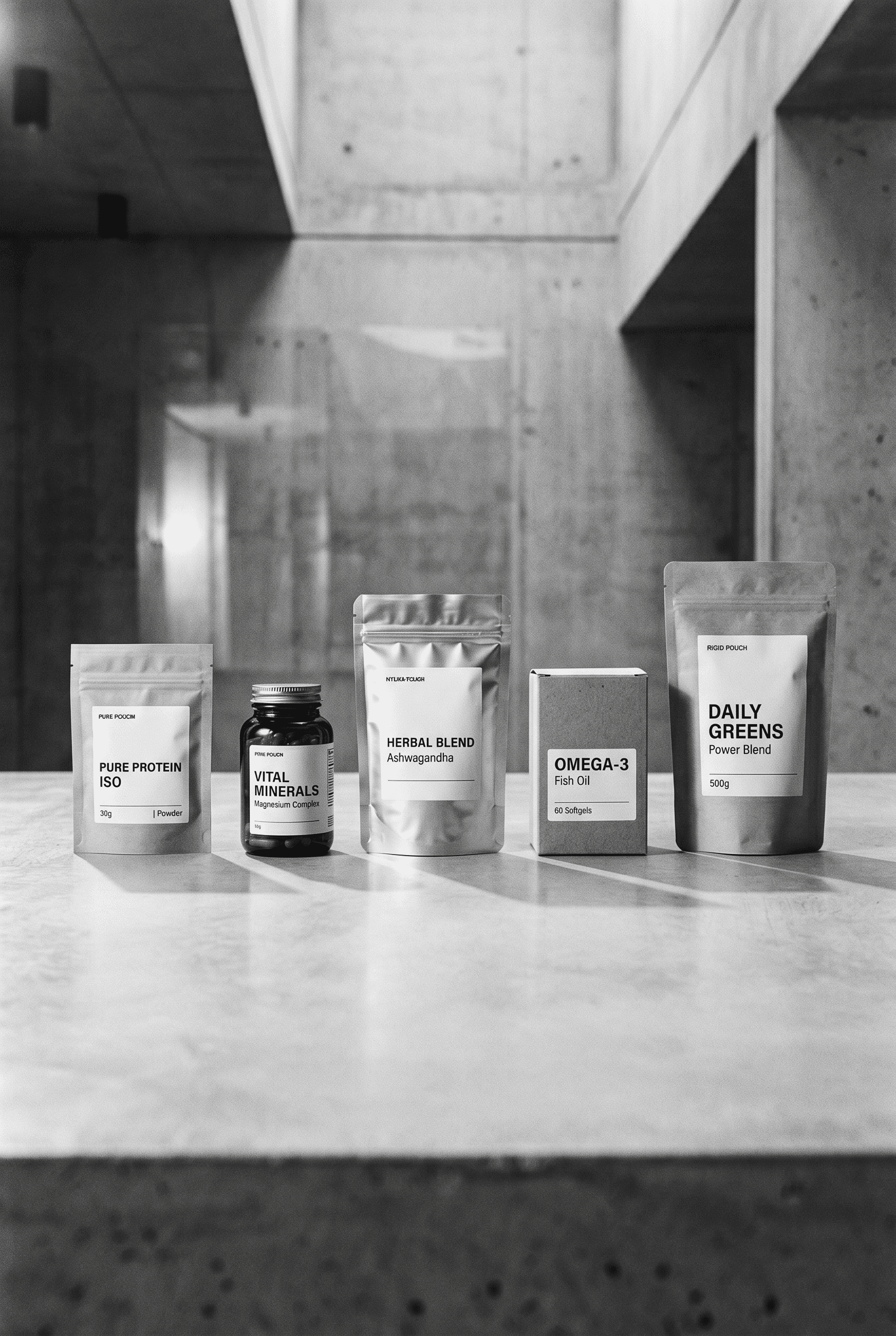
Stock HDPE bottle + stock cap | $0.20 – $0.60 | 100 – 500 | Low | Entry-level, practitioner brands |
Stock glass jar + metal lid | $0.60 – $1.40 | 500 | Medium | Premium DTC, clean beauty crossover |
Mylar stand-up pouch | $0.30 – $0.90 | 500 | Medium | Powders, gummies, snack formats |
Custom HDPE or PET bottle | $0.80 – $2.00 | 5,000 – 10,000 | High | Established brands, retail |
Cardboard box (outer carton) | $0.40 – $1.20 | 1,000 | Medium-High | Retail shelf presence, sachets |
Custom glass with proprietary closure | $2.00 – $6.00 | 1,000 – 5,000 | High | Ultra-premium positioning |
Sachets / stick packs | $0.15 – $0.50 per stick | 5,000 | High (per stick) | On-the-go, sampling, DTC subscription |
These unit costs cover the packaging component only. They do not include the label, the label printing, design fees, freight, or tooling costs for custom components.
Label Costs: The Most Underestimated Line Item
Labels are frequently treated as a minor cost, but for premium supplement brands, label specification is where cost differentials are largest and where brand quality is most visible to the consumer.
Label material
Paper labels cost the least and look the least expensive. White or kraft paper labels can be produced for $0.05 to $0.20 per label at 1,000 units. Polypropylene (PP) labels are more durable, moisture resistant, and premium in finish. BOPP labels with matte or gloss laminate, spot UV, or foil stamping cost $0.30 to $1.50 per label depending on specification and quantity.
Label printing setup
Digital printing has low setup costs and suits short runs. Flexographic printing has higher setup costs ($500 to $2,000 for plate production) but lower per-unit costs at scale. Brands launching at 1,000 to 2,000 units should budget for digital printing. Brands at 5,000+ units should evaluate flexo for unit cost savings.
Special finishes
Foil stamping, embossing, debossing, and spot UV coatings add $0.15 to $0.80 per label and require specific label stock and printing processes. These finishes are what differentiate premium supplement packaging visually and they are significant cost items that are frequently added to a brief without accounting for the per-unit impact.
For a guide to what supplement packaging design must accomplish beyond aesthetics, see my guide to nutraceutical packaging design.
Design Costs: Where Founders Underspend and Then Overpay
Design is the investment that determines whether the packaging cost is well spent or wasted. Packaging that is designed without a strategic brief, without compliance review, or without channel-specific requirements will require revision, and revision means reprinting, which means paying for packaging twice.
The spectrum of supplement packaging design investment:
Fiverr / offshore freelancer: $200 to $800. Produces a label layout. Does not produce a strategic brand identity. Does not account for FDA label compliance. Frequently needs significant revision before a manufacturer will accept it for printing. Mid-tier generalist designer: $1,500 to $4,000. Produces better visual output but typically lacks supplement-specific compliance knowledge. Founders spend as much time briefing the designer on regulatory requirements as the designer spends on design. Supplement-specialist designer or studio: $4,000 to $12,000 for a single SKU full identity and label. Knows FDA Supplement Facts panel requirements, DSHEA mandatory elements, and the design conventions of the retail and DTC channels. Requires less revision. Produces work that retailers and e-commerce platforms accept without compliance queries.
For a complete guide to writing the brief that gets supplement packaging design right the first time, see my guide to supplement packaging design brief.
Compliance Costs That Most Founders Do Not Budget For
Supplement packaging compliance is not optional and is not free. The costs below are consistently underestimated.
FDA Supplement Facts panel review
The Supplement Facts panel is a mandatory element of all US dietary supplement labels. It must meet specific formatting requirements: exact label claim language, nutrient reference values, serving size declaration, and the mandatory disclaimer ("This statement has not been evaluated by the Food and Drug Administration..."). Having this reviewed by a regulatory consultant or attorney before printing costs $500 to $2,000. Not having it reviewed before printing costs considerably more when the label needs to be reprinted.
EU/UK compliance
Brands selling into European markets face different mandatory labeling requirements under EU Food Supplements Directive and UK post-Brexit regulations. EU-compliant label design adds cost at the design stage and requires additional regulatory review. Plan for an additional $1,500 to $4,000 per SKU for EU label adaptation.
For the complete breakdown of what supplement packaging compliance requires in each major market, see my guide to supplement packaging compliance.
Total Supplement Packaging Cost: A Realistic Budget Range
Pulling all cost components together, here is a realistic total packaging cost range for a first-time supplement launch:
Launch Scale | Components + Label | Design | Compliance Review | Total Per-SKU Budget |
|---|---|---|---|---|
DTC soft launch (500 units, stock packaging) | $500 – $1,200 | $1,500 – $3,000 | $500 – $1,000 | $2,500 – $5,200 |
DTC launch (1,000 units, branded packaging) | $800 – $2,500 | $4,000 – $8,000 | $800 – $1,500 | $5,600 – $12,000 |
Retail-ready launch (2,500 units, premium spec) | $2,500 – $6,000 | $6,000 – $12,000 | $1,500 – $3,000 | $10,000 – $21,000 |
These ranges represent the total investment to go from no packaging to a compliant, market-ready packaged product. They do not include the formula, the contract manufacturer's fill and finish fees, or the product cost.
For context on how packaging cost fits within the total supplement branding budget, see my guide to supplement branding cost.
Where Supplement Founders Consistently Overspend
Custom components on a first launch
Custom bottles, custom closures, and custom boxes require tooling investment and high minimum order quantities. For a first-time launch where the formula and market positioning have not yet been validated, this investment is premature. Use stock components for the first launch. Invest in custom components once the formula is proven and the MOQ makes financial sense.
Premium finishes before channel validation
Foil, spot UV, and embossing are right for premium retail and DTC positioning. They are wrong for pharmacy, value retail, or practitioner channels. Investing in premium finishes before the channel strategy is confirmed is a cost that may need to be reversed entirely.
Multi-SKU launches
Launching with six SKUs instead of two doubles the design cost, the compliance review cost, and the inventory risk. Focus on one to two hero products for the first launch and extend the range once the brand has demonstrated market traction.
For a complete guide to supplement packaging designed specifically for the Amazon channel, see my guide to supplement packaging for Amazon and DTC.
FAQ: Supplement Packaging Cost
How much does it cost to package a supplement?
The total cost to go from no packaging to a market-ready supplement product is $2,500 to $21,000 per SKU depending on launch scale, packaging specification, design investment, and compliance requirements. The ranges are wide because the format choice (stock vs. custom), the label specification (digital print vs. foil-stamped BOPP), and the design investment vary dramatically between founders.
What is the minimum MOQ for supplement packaging?
Most packaging suppliers have MOQs of 500 to 1,000 units for stock packaging and 3,000 to 10,000 units for custom packaging. Label printers typically have MOQs of 500 to 1,000 labels. For very small first runs (under 500 units), options include using contract packers who source packaging components at their own MOQs, or using stock components from domestic suppliers with no minimum orders.
Is supplement packaging cheaper in Asia?
Sourcing packaging components from China, India, or Southeast Asia can reduce unit costs by 30 to 60% compared to North American or European suppliers. The tradeoffs include longer lead times (12 to 16 weeks vs. 4 to 6 weeks for domestic), higher minimum order quantities, quality control complexity, and import duties. For brands at scale, offshore sourcing makes financial sense. For small first runs, domestic or domestic-sourced components are usually more practical.
How do I reduce supplement packaging costs without compromising brand quality?
Use stock packaging formats with premium label specification rather than custom components with standard labels. Premium label finishes (matte laminate, selective UV, high-resolution printing) cost less than custom bottles and deliver significant visual differentiation. Invest in design quality rather than component complexity.
Does supplement packaging design affect retail acceptance?
Yes, directly. Major US natural food retailers have informal design standards that buyers apply when evaluating new brands. Packaging that looks generic, that has poor label hierarchy, or that does not communicate the supplement's benefit clearly in the three seconds a buyer scans a shelf will be passed over regardless of product quality. Investing in professional supplement packaging design is a distribution investment, not just an aesthetic one.
I'm Tambi Haşpak, a brand strategist and creative director with an unfair advantage: I'm a pharmacist. I run a creative studio for life sciences, cosmetics, and supplements. 17 years. Exclusively. The supplement brands I design are built to meet compliance standards and retail requirements from the first version. Book a call or send me an email.