
Compliance does not constrain your brand. It defines the canvas your brand works within — and the brands that understand that distinction design better labels than those who treat regulations as an afterthought.
Why Supplement Packaging Compliance Matters Before You Brief a Designer
Most supplement founders treat regulatory compliance as something that happens after the creative work. They hire a designer, fall in love with a label, and then send it to a regulatory consultant who comes back with a list of required changes that break the layout. The designer has to start over. The launch timeline slips. The budget takes a second hit.
I have seen this happen more times than I can count, and as a pharmacist who has spent 17 years designing packaging for supplement brands, I can tell you that it is entirely avoidable. Compliance requirements are not obstacles bolted onto the outside of good design. They are structural parameters that determine the size of your Supplement Facts panel, the minimum font sizes you can use, the mandatory warning statements that must appear, and the hierarchy of information the regulator expects to find on your label.
When you understand those parameters before the first design conversation, you produce better briefs, shorter revision cycles, and labels that work in every market you plan to sell in.
This guide compares the three regulatory frameworks supplement brands most commonly encounter: the US FDA under DSHEA, the European Food Safety Authority under EU Directive 2002/46/EC and its national implementations, and the Australian Therapeutic Goods Administration under the Therapeutic Goods Act. I will cover what each requires, where they differ in ways that matter to design, and how to use this knowledge to make packaging decisions that are both compliant and commercially strong.
According to the Global Dietary Supplements Market Report, the global supplement market was valued at approximately $177 billion in 2023 and is projected to reach $327 billion by 2030, with brands increasingly launching across multiple regulatory jurisdictions simultaneously.
US FDA Requirements Under DSHEA: The Supplement Facts Panel and Beyond
The US regulatory framework for dietary supplements is governed primarily by the Dietary Supplement Health and Education Act of 1994 (DSHEA), with labeling requirements codified in 21 CFR Part 101. The FDA does not approve dietary supplements before they go to market, but it enforces strict labeling rules that every brand selling in the United States must follow.
The Supplement Facts Panel
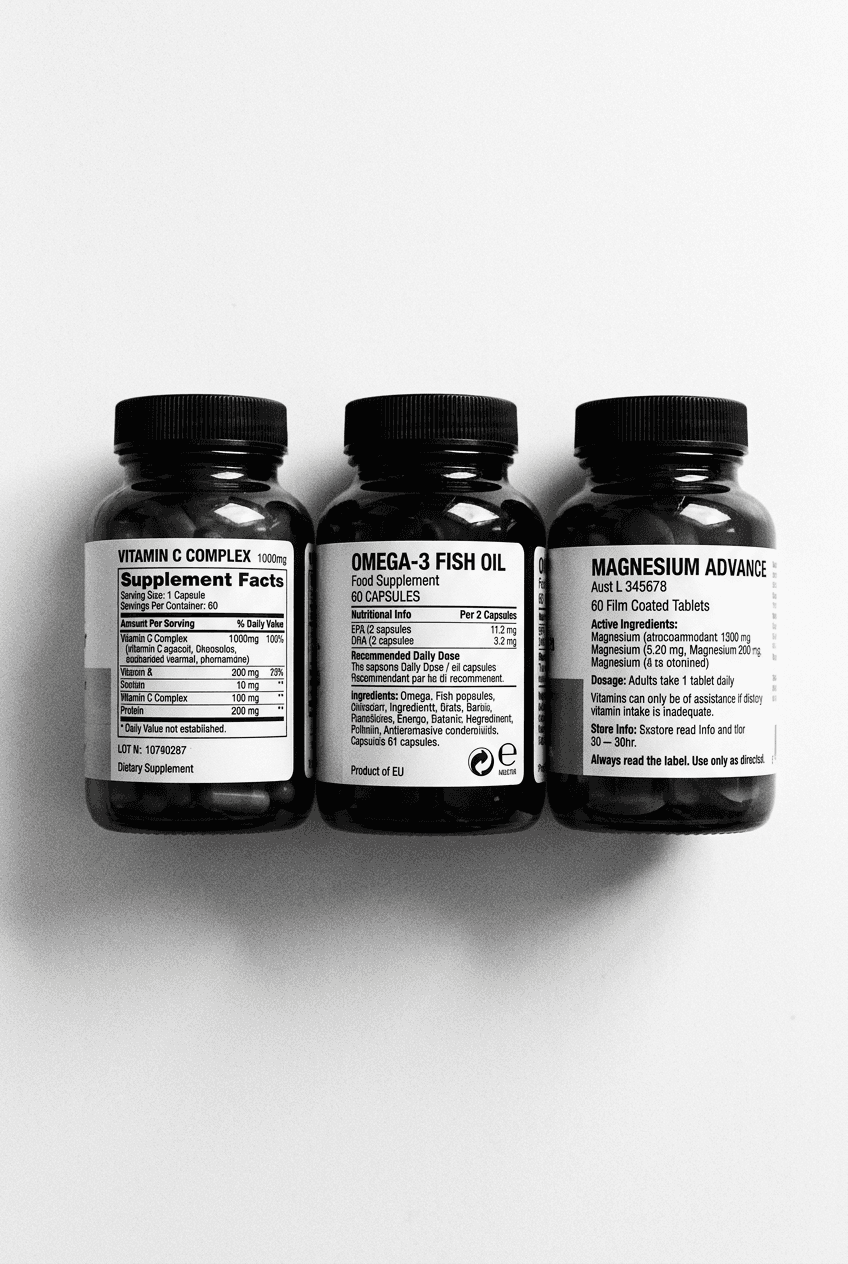
The most recognizable compliance element on a US supplement label is the Supplement Facts panel, which is the mandatory nutritional information box. The FDA prescribes the exact format, including the box border, the header font size, the type hierarchy for serving size, servings per container, and each ingredient listing. The minimum type size for most text within the panel is 6 point, though the header "Supplement Facts" itself must appear in a larger size.
From a design perspective, the Supplement Facts panel cannot be ignored or minimized. It must be placed on the principal display panel or the information panel (the label panel immediately to the right of the principal display panel), must be fully legible, and must not be obscured by design elements. Brands that try to make the panel invisible by printing it in light gray on white, or by sizing the panel too small, face enforcement action.
The required elements inside the panel include: serving size, servings per container, each dietary ingredient that is present in a significant amount, the amount per serving, and the percent daily value where established. Proprietary blends require disclosure of the total blend weight, though individual ingredient quantities within the blend need not be disclosed.
Label Statement of Identity and Net Quantity
Every US supplement label must include a statement of identity on the principal display panel — a name that identifies the product as a dietary supplement. This is not optional, and it must appear prominently. The net quantity of contents must also appear on the principal display panel, expressed in appropriate units (count for capsules, weight for powders, volume for liquids).
Mandatory Disclaimer
Any structure/function claim on a US supplement label — statements like "supports immune health" or "promotes restful sleep" — must be accompanied by the FDA disclaimer: "This statement has not been evaluated by the Food and Drug Administration. This product is not intended to diagnose, treat, cure, or prevent any disease." This disclaimer must appear in a box, in bold type, in a size no smaller than one-sixteenth of an inch.
This is a design constraint that many first-time founders underestimate. The disclaimer box takes meaningful space on the label, and it must be visible and legible. Brands that try to hide it in tiny type or print it in a low-contrast color will be flagged on inspection.
Distributor and Manufacturer Information
The label must include the name and place of business of the manufacturer, packer, or distributor. This is frequently the cause of label reprints for brands that change their distribution arrangements after the initial label run.
A 2022 FDA survey of dietary supplement labels found that approximately 20% of sampled products had at least one labeling violation, with the most common issues being incomplete Supplement Facts panels, missing or improperly formatted disclaimers, and unauthorized disease claims.
EU Requirements: A Framework Built on Member State Implementation
The European Union regulates food supplements through Directive 2002/46/EC, which was implemented into national law by each EU member state. Unlike the US system, which has a single federal authority, the EU framework means that while the baseline requirements are harmonized, some member states have additional national requirements on top of the directive.
What the EU Directive Covers
EU Directive 2002/46/EC covers vitamins and minerals in food supplements. For other categories (herbs, botanicals, amino acids, enzymes), regulation varies by member state, which creates complexity for brands launching across multiple European markets simultaneously.
For vitamins and minerals, the directive establishes a positive list of permitted substances and their chemical forms (set out in Annex I and II of the directive), sets maximum and minimum amounts through member state implementation, and requires specific labeling information on all food supplement packaging sold in the EU.
Mandatory EU Label Elements
Every food supplement sold in the EU must include the following on its label. The designation "food supplement" must appear clearly — this is the EU equivalent of the US "dietary supplement" statement of identity. The names of the categories of nutrients or substances that characterize the product must be listed. The recommended daily portion must be stated. A warning not to exceed the recommended daily dose must appear. Food supplements must not be used as a substitute for a varied diet, and this statement must appear on the label. Products must be kept out of reach of young children.
For vitamins and minerals specifically, the amount per recommended daily portion must be declared as a percentage of the nutrient reference values (NRVs) established in EU Regulation 1169/2011. This is the EU equivalent of the percent daily value in the US Supplement Facts panel.
Claims Regulation in the EU: A Different Regime
One of the most significant differences between US and EU supplement packaging compliance is the claims framework. In the EU, health claims are pre-approved and listed in the EU Register of authorized health claims maintained by the European Commission. A brand selling in the EU can only use health claims that appear on this list.
This is fundamentally different from the US structure/function claim system, where a brand can make a structure/function claim without pre-approval as long as it is truthful, not misleading, and accompanied by the mandatory disclaimer. In the EU, if a claim is not on the authorized list, it cannot appear on the label. Full stop.
This has significant design implications. The EU authorized claims list contains specific, precisely worded statements, and brands must use the exact authorized wording. Creative paraphrasing of approved claims is not permitted.
According to the European Food Safety Authority, as of 2024 there are over 2,300 authorized health claims in the EU register, covering vitamins, minerals, and a limited number of other substances. However, many botanical claims remain in a legal gray zone, pending EFSA opinion.
Country-Specific Notifications
Many EU member states require brands to notify the relevant national authority before placing a food supplement on the market. In France, for example, the DGCCRF requires notification. In Italy, the Ministry of Health maintains a register of food supplements. Brands expanding into Europe must research the notification requirements for each target market, as these vary.
TGA Requirements: Australia's Stricter Pre-Market Framework
The Australian Therapeutic Goods Administration operates a fundamentally different regulatory model from both the US FDA and the EU framework. In Australia, many supplements that would be self-marketed as food supplements in the US or EU are classified as Listed Medicines or Registered Medicines under the Therapeutic Goods Act 1989 and must be included on the Australian Register of Therapeutic Goods (ARTG) before they can be sold.
Listed Medicines vs Registered Medicines
The TGA classifies therapeutic goods on a risk-based scale. Listed medicines (ARTG-L) are low-risk products that the sponsor (brand owner) self-certifies for compliance with TGA requirements. They include most vitamins, minerals, herbal preparations, and other low-risk supplements. Registered medicines (ARTG-R) are higher-risk products assessed by the TGA before approval.
For most supplement brands entering the Australian market, the relevant pathway is Listed medicines. The brand owner must hold an ARTG listing number, which appears on the label as "AUST L [number]" or "AUST L(A) [number]" for listed assessed medicines. This ARTG number is a mandatory label element that has no direct equivalent in US or EU labeling.
Permitted Indications for Listed Medicines
The TGA publishes a list of permitted indications for listed medicines. These are the only statements of therapeutic purpose that may appear on a listed medicine label. Like the EU authorized claims list, brands may not use indications that are not on the permitted list. The TGA permitted indications are structured differently from EU authorized health claims, but the principle is the same: pre-approved language only.
Mandatory TGA Label Elements
A listed medicine label must include the ARTG listing number, the product name, the statement of the dosage form, the directions for use, the warnings required for the specific ingredients, the name and address of the sponsor (the Australian entity responsible for the product), the lot number and expiry date, and the quantity of active ingredients per dosage unit.
The TGA also has specific requirements for certain ingredients. Products containing melatonin, for example, must carry specific warning statements. Products containing herbal ingredients must list the common name and the plant part used.
According to the TGA's annual compliance report, labeling deficiencies are one of the most common reasons for compliance action against listed medicines, with missing or incorrect ARTG numbers, incorrect ingredient listings, and unauthorized indications being the most frequent issues.
Side-by-Side Comparison: FDA vs EU vs TGA
Requirement | US FDA (DSHEA) | EU (Directive 2002/46/EC) | Australia (TGA) |
|---|---|---|---|
Pre-market approval required | No | No (notification in some states) | Yes (ARTG listing) |
Mandatory panel name | "Supplement Facts" | No equivalent panel format | "Directions for use" section |
Claims system | Self-certified structure/function + disclaimer | Pre-approved authorized claims list | Pre-approved permitted indications list |
Claims disclaimer required | Yes ("This statement has not been evaluated...") | No (but claims must be on authorized list) | No (but indications must be on permitted list) |
Mandatory registration number on label | No | No | Yes (AUST L number) |
Sponsor/distributor address required | Yes | Yes | Yes (Australian sponsor) |
Keep out of reach of children warning | Recommended for some products | Mandatory | Mandatory |
Nutrient reference values | % Daily Value | % Nutrient Reference Value (NRV) | % Recommended Dietary Intake (RDI) |
How Compliance Requirements Shape Label Design
Understanding the regulatory requirements across markets does more than keep you out of trouble. It directly informs the design decisions you and your designer make from the first briefing conversation. Here is how the key compliance constraints translate into practical design parameters.
Space Allocation and Panel Architecture
The US Supplement Facts panel, the EU nutrition declaration, and the TGA directions/ingredients section all require dedicated, legible space on the label. Before any creative work begins, you need to know what label size you are working with and how much of the available surface area these mandatory elements will consume. On a small bottle (30 ml dropper, 60-capsule bottle), mandatory compliance elements can account for 40 to 60 percent of the total label surface.
This means that the "design space" — the area available for brand expression, imagery, and marketing copy — is what remains after compliance elements are placed. Knowing this upfront prevents the common mistake of designing a label that looks beautiful but physically cannot accommodate all required compliance content at legible type sizes.
Typography Minimums
The FDA specifies minimum type sizes for Supplement Facts panel content. The TGA has minimum type size requirements for certain label elements. The EU requires that mandatory information be clearly legible. These constraints set a floor for your typographic decisions and effectively rule out certain decorative typefaces for compliance sections of the label.
Warning Statement Placement
Warning statements — the FDA disclaimer, TGA-specific ingredient warnings, EU "do not exceed the recommended daily dose" language — must be legible and placed where a consumer will reasonably encounter them. This limits how these elements can be positioned on the label and means that designs which push all the small print to an extreme edge or bottom panel may not meet the visibility standard.
Multi-Market Label Strategy
If you are launching in more than one market, you have three broad design strategies for label compliance: separate country-specific labels, a common label that satisfies the most restrictive requirements of all target markets, or a base label with a compliance sticker applied per market.
The common label approach is the most brand-coherent but requires careful analysis of which requirements are additive (you can include both the US disclaimer and the EU "food supplement" designation without conflict) and which are contradictory (a US structure/function claim may not be permitted as an EU authorized claim).
I typically recommend mapping out all required elements for each target market into a single master label specification document before any design work begins. This document becomes the brief for both the designer and the regulatory consultant, and it prevents the expensive divergence of creative work from compliance reality.
Common Compliance Mistakes and How to Avoid Them
Treating the disclaimer as an afterthought. The US FDA disclaimer box is a mandatory, prominent, boxed element. It needs to be in the layout from the first draft, sized correctly, and placed where it will actually be read. Designing a label and then trying to squeeze the disclaimer in at the end produces cramped, non-compliant labels. Using claim language from your home market on an export label. A structure/function claim that is perfectly legal in the US ("supports healthy joints") may not appear on an EU label unless that exact claim is on the authorized health claims register. Always verify each claim against the target market's approved list before finalizing copy. Forgetting the ARTG number for Australian SKUs. It sounds basic, but the ARTG listing number must be obtained and confirmed before the label goes to print. Reprinting labels after production because the listing number was missing or incorrect is a real cost that hits brands regularly. Underestimating ingredient disclosure requirements. Each market has different requirements for how ingredients are listed, in what order, with what specific nomenclature. The EU requires ingredients to be listed using recognized INCI or chemical names. The TGA requires specific plant part disclosure for herbal ingredients. The US requires the full ingredient list in descending order of predominance by weight in the Other Ingredients section below the Supplement Facts panel. Using the wrong nutrient reference values. Percent daily values differ between markets. The US uses FDA Daily Values. The EU uses Nutrient Reference Values from Regulation 1169/2011. Australia uses Recommended Dietary Intakes. Putting US percent daily values on a label sold in the EU is a labeling error.
A 2023 study published in Nutrients journal found that of 150 supplement products sampled from online retailers across three markets, 34% had at least one labeling inconsistency when evaluated against the regulatory requirements of the market where they were sold.
Building a Compliance-Ready Design Brief
The most practical thing you can do before briefing a designer for a supplement label is to build a compliance specification document. This is not a legal document — it is a design parameter document that tells the designer exactly what must be on the label, what it must say, what minimum sizes apply, and where flexibility exists.
A complete compliance brief for a supplement label includes: the target markets and applicable regulatory frameworks for each, the mandatory statements and their required formats for each market, the full Supplement Facts or equivalent nutrition panel content, all required warning statements and disclaimer language, the mandatory elements that must appear on the principal display panel versus the information panel, and the ARTG listing number for Australian SKUs.
With this document in hand, a designer can allocate space accurately on the first pass, identify where creative expression is possible, and avoid the revision cycles that come from discovering compliance constraints after a label design has been developed.
This is the process I run with every supplement client at Tambi Haşpak: compliance specification first, design brief second, creative work third. It is not slower — it is faster, because it eliminates the revision cycles that come from designing without a complete understanding of the label architecture you are working within.
FAQ: Supplement Packaging Compliance
Does my supplement need FDA approval before I can sell it in the US?
No. Dietary supplements in the US do not require FDA pre-market approval under DSHEA. However, the manufacturer is responsible for ensuring the product is safe and that all labeling is truthful, not misleading, and compliant with FDA regulations. The FDA can take enforcement action after a product is on the market if labeling violations are found.
Can I use the same label for the US, EU, and Australia?
In some cases, with careful planning, a single label can satisfy the requirements of multiple markets. However, the EU authorized claims list and TGA permitted indications list mean that claim language must be reviewed carefully against each market's approved list. The ARTG listing number required for Australia has no US or EU equivalent, which must be accommodated in the label layout.
What is the difference between a health claim and a structure/function claim?
In the US, a structure/function claim describes how a nutrient or ingredient affects the structure or function of the body without claiming to treat a disease. In the EU, all health claims must be pre-approved by EFSA and listed on the EU Register of authorized health claims. In Australia, therapeutic indications for listed medicines must be drawn from the TGA's list of permitted indications.
Does the EU require a Supplement Facts panel like the US?
No. The EU does not require the Supplement Facts panel format. Instead, EU food supplements must include a nutrition declaration per EU Regulation 1169/2011, which has a different format and uses Nutrient Reference Values rather than US Daily Values. The two formats are not interchangeable.
What happens if my supplement label is found to be non-compliant in Australia?
The TGA has authority to require the sponsor to recall products with non-compliant labels, issue warning statements, suspend or cancel the ARTG listing, and pursue civil or criminal penalties for serious or repeated violations. Label compliance is enforced actively in Australia and should be treated as a core business requirement, not an optional exercise.
What is the minimum font size for supplement labels in the US?
FDA regulations specify minimum type size requirements for different label elements. The Supplement Facts panel must use type no smaller than 6 point for most content. The "Supplement Facts" header must be in larger type. Other mandatory statements have specific size requirements set out in 21 CFR Part 101.
Do I need a separate label for each EU country?
Not necessarily, but you need to ensure that the language requirements are met. EU law requires that mandatory label information appears in the official language(s) of the member state where the product is sold. Brands selling across multiple EU markets typically produce labels in multiple languages or use multilingual label designs.
Can I make weight management claims on supplement packaging?
In the US, weight management structure/function claims are permitted if truthful and not misleading, accompanied by the required disclaimer. In the EU, weight management claims must be on the authorized health claims register — and many are not. In Australia, weight management indications may be available for specific listed medicine categories but must be drawn from the TGA permitted indications list.
What is an ARTG listing and why does it matter for label design?
The Australian Register of Therapeutic Goods (ARTG) is the database of therapeutic goods approved for supply in Australia. A listed medicine must hold an ARTG entry, and the corresponding ARTG number (formatted as "AUST L [number]") must appear on the product label. This is a non-negotiable mandatory element that must be factored into the label layout before design work begins.
How far in advance should I start the compliance review for a new supplement label?
I recommend starting the compliance review at the same time you begin the design briefing process — not after. The compliance specification should inform the design brief. For a product launching in multiple markets, allow additional time for market-specific claim verification, ARTG listing (which has a TGA processing timeline), and EU member state notification where required.
I am Tambi Haşpak, a brand strategist and creative director with an unfair advantage: I am a pharmacist. I run a creative studio for cosmetics, supplements and beyond. 17+ years. Exclusively. If you are building a supplement brand that needs to work in multiple markets without compromising on design, reach out directly.