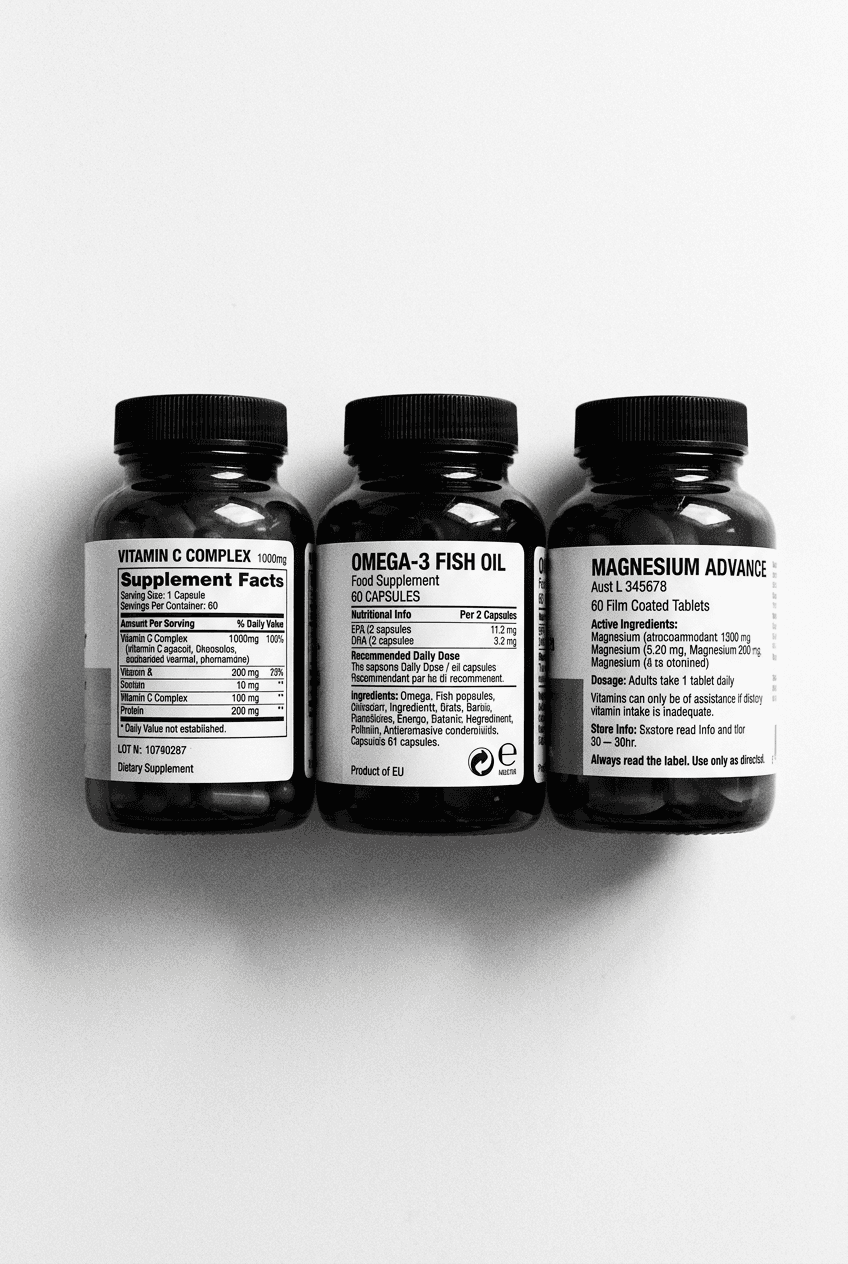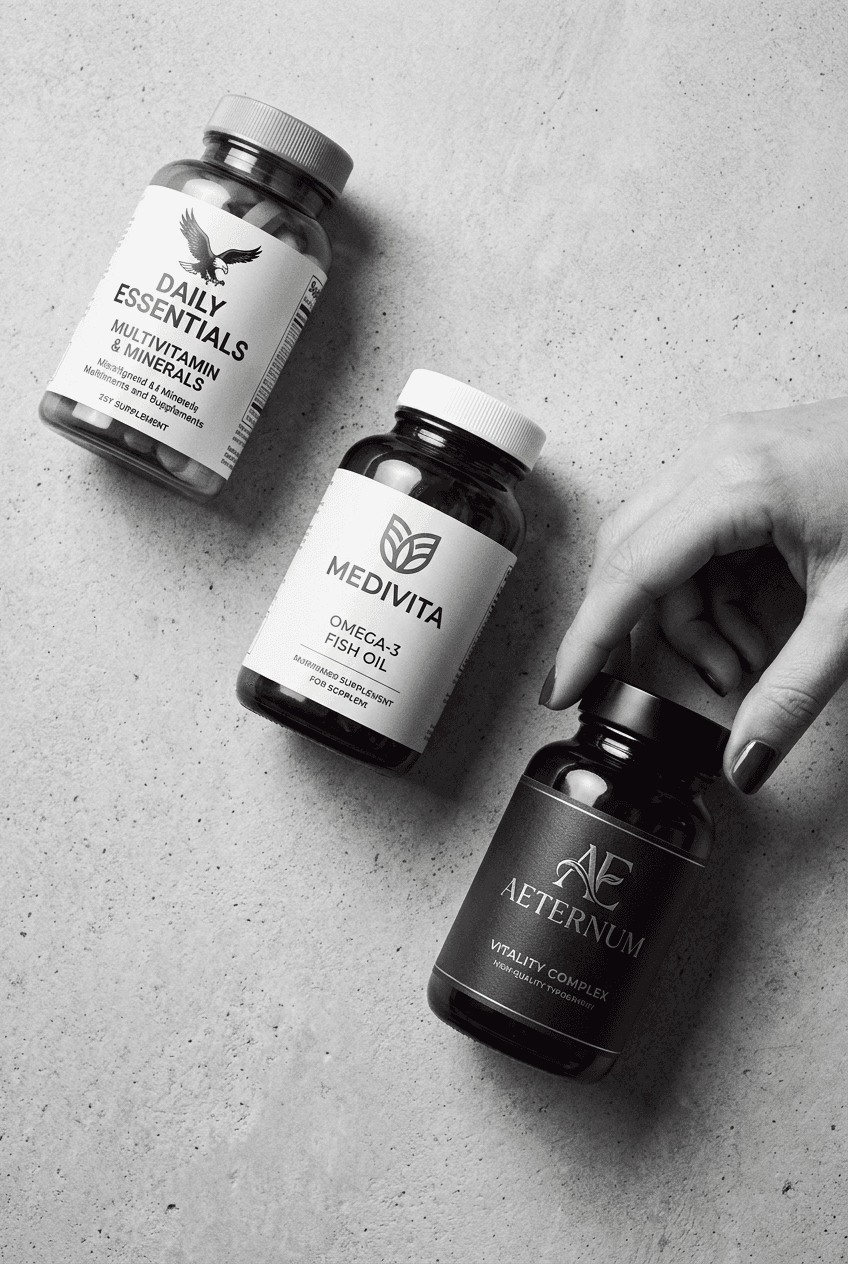

Your supplement logo has less than three seconds to signal credibility, and most cheap logos signal distrust instead.
Why Supplement Logo Design Matters More Than Most Brands Realize
Your supplement logo isn't just decoration. It's the first signal of whether your product is safe, effective, and worth the price the consumer is about to pay. People buy supplements based on trust more than any other category, because they can't taste the difference and the benefits are often delayed or invisible. Your logo carries the entire trust burden in that first three-second glance. A weak logo says "this brand cut corners," and the consumer immediately wonders what else you cut corners on. According to a 2024 Statista study, 67% of supplement consumers make purchasing decisions based on brand credibility signals, with visual identity ranking third after ingredient transparency and third-party certification. That means your design choices have real commercial weight.
The Three Tiers of Supplement Logo Design
I see supplement logos fall into three clear categories: cheap, competent, and premium. Understanding the specific visual differences between them is how you stop accidentally building a cheap logo when you have a competent or premium product.
Cheap logos share unmistakable traits. They use clip-art icons sourced from generic design libraries. They combine five or more fonts, often including decorative scripts that have no business on a supplement label. The colors are either screaming neons or dull muddy tones with no intentionality behind them. There's no negative space, no breathing room, no clarity when the logo scales down. When I see kerning this loose and letter spacing this random, I know a template was used. The emblem itself, if there is one, has too many detail lines that collapse into mud at small sizes. Most critically, cheap logos try to do too much: they're trying to convey "energy" or "natural" or "science" all at once, and instead convey "confused." Competent logos are clean and modern. They use one primary font, possibly one secondary. There's white space. The mark is simple enough to work at any size. The color palette is restrained, usually two or three colors that have a clear relationship to the brand positioning. You can look at a competent logo and understand the brand idea. The problem is that competent isn't enough in supplements. Competent is what 400 other vitamin brands are doing right now. Competent doesn't own the shelf. Competent doesn't make the consumer think "this is premium." Premium logos are immediately recognizable even as a small icon. They use a single, custom typeface or heavy customization of a single font family. There's an icon or mark, but it's so restrained and geometric that it works as a symbol at any scale, down to a 0.5-inch box on an Amazon listing. The color palette often uses a single strategic color plus black and white, or a subtle complementary pair. There's breathing room between elements. The kerning and letter spacing are perfect. Most importantly, premium logos feel intentional about what they exclude. They say one thing powerfully instead of three things mediocrely.
The Visual Decisions That Separate Cheap From Credible
Let me break down the specific design choices that separate a logo that damages your credibility from one that builds it.
Typography: Your Single Biggest Decision
The font you choose for your supplement logo communicates more than anything else. I see brands use Helvetica, Montserrat, or Proxima Nova and believe they're building premium. They're not. They're using fonts that 10,000 other supplement brands are using right now. When your font is generic, your brand is generic.
Premium supplement logos use either a custom drawn typeface, heavy customization of a commercial font, or a distinctive commercial font that has clear personality. I'm talking about typefaces like Dinot, Futura (when used with intelligence), or Sofia Pro. But here's the key: the font must stay consistent across the logo and the packaging. If your logo uses a sans-serif but your label uses a serif, that disconnect signals indecision and therefore cheapness. Font consistency builds confidence.
Avoid decorative fonts on supplement logos entirely. They're the visual equivalent of an exclamation point after every sentence. They scream amateur, and they especially scream "health claim unproven" because that's the visual language of gym supplements and MLM brands. I've seen premium collagen brands accidentally price their logo at $9.99 by choosing a script font that signals chain-store energy.
Icon Complexity: Subtract Before Adding
The icon or mark in your supplement logo should be simple enough to render clearly at 0.25 inches. This is non-negotiable if your product will ever be sold on Amazon, sold in a vitamin aisle where it competes with 200 other bottles, or printed on a label smaller than 8 inches wide.
I often see supplement brands create logos with intricate line work, gradient overlays, and detailed botanical illustrations. These collapse into illegible mud at small sizes. They look sharp on a presentation deck, but they fail in real-world application. Premium brands understand this constraint and design within it. The Thorne logo is a simple circle with two thin lines. The Momentous logo is a clean wordmark with a single geometric accent. Neither has excessive detail. Both are immediately recognizable at any size.
A good test: can your logo read clearly when printed one inch wide on a white background? If you squint and can't tell what it is, it's too complex.
Color Strategy: Abundance Is Your Enemy
Most cheap supplement logos use four, five, or sometimes six colors. They're trying to convey energy, nature, science, and trustworthiness all through color. Instead, they create visual noise.
Premium supplement logos typically use one primary color plus black and white, or a carefully considered complementary pair. The primary color is almost always chosen to align with the positioning: greens and earth tones for natural or plant-based, deep blues for clinical or pharmaceutical trust, warm golds for luxury or premium positioning. That color is then applied strategically, not scattered across the entire logo.
Supplement consumers also associate certain colors with efficacy. Deep blue and navy signal pharmaceutical trust and clinical credibility. According to a 2023 IBISWorld report, 43% of premium supplement consumers associate blue packaging with higher efficacy. That's not opinion, that's data. Black signals luxury and sophistication. Greens signal natural or botanical positioning. Warm oranges and reds signal energy and performance. Your color choice is positioning.
Avoid rainbow logos entirely. Avoid logos that use the same color for every element. Avoid colors that are chosen based on what the founder likes rather than what the positioning requires.
The Cheap Logo Checklist: Mistakes to Avoid
Here's what I see in supplement logos that never leave the small-business shelf:
Clip-art icons: This is the single most common mistake. Founders browse Fiverr, find a designer who offers "unlimited revisions," and end up with a generic bottle or leaf that 500 other brands are using. A generic icon doesn't own equity in the market.
Too many fonts: If you're using more than one font in your supplement logo, you'd better have a brilliant reason. Usually you don't. Usually it's inconsistency masquerading as variety. One font, possibly with variations in weight and size, is almost always the right answer.
No white space: Cheap logos feel crowded. Every pixel is filled with something. Premium logos breathe. There's negative space around the mark, between letters, and around the entire composition.
Gradient overlays: A gradient on your supplement logo usually signals that the designer was trying to hide weak fundamentals with a visual trick. Solid colors or simple separations read cleaner and scale better.
Decorative elements that don't scale: Thin lines thinner than 0.5 points, intricate shading, photorealistic elements. All of these disappear when your logo appears on an Amazon thumbnail or a small label.
Logo that looks different in color vs black and white: If your supplement logo only works in color, it's not a logo. It's decoration. A true logo works in full color, black and white, grayscale, and as a single-color reverse. If it doesn't, you need to redesign.
Custom kerning that's unprofessional: Letterspacing so tight it feels cramped, or so loose it feels disconnected. I see supplement logos where the first letter looks like it belongs to a different word than the last letter.
Comparison Table: Cheap vs Premium Supplement Logo Traits
Trait | Cheap Logo | Premium Logo |
|---|---|---|
Icon Source | Generic clip-art library | Custom drawn or heavily modified |
Number of Fonts | 3-5 fonts, mixed styles | 1 primary font, possibly 1 secondary |
White Space | Crowded, every pixel filled | Deliberate negative space around mark |
Color Palette | 4-6 colors, scattered | 1-2 strategic colors plus black/white |
Scalability | Collapses at small sizes | Reads clearly at 0.25 inches |
Font Consistency | Different across logo and packaging | Consistent across all applications |
Line Weight | Inconsistent, overly thin | Considered, intentional |
Works B&W | No, only works in full color | Yes, works in all formats |
Primary Signal | "This is cheap" | "This brand thought about details" |
Typical Shelf Life | 12-18 months before rebranding | 5+ years of competitive strength |
How Premium Supplement Brands Design Their Logos
I've worked with supplement brands doing $5M+ annually, and I've analyzed every major player in the space. The pattern is consistent: premium supplement logos are designed with ruthless constraint, not abundance.
First, they define positioning before design. Natural vs synthetic, clinical vs lifestyle, luxury vs performance. That positioning determines the color. Then they choose a single typeface that carries the personality of that positioning. Then they either create a custom mark or adapt an existing mark so heavily that it's distinct. Then they strip away everything that doesn't support the positioning.
The Orgain logo is a excellent example: single sans-serif, custom rounded letterforms that feel organic without being cute, single green color that's unmistakably natural positioning, and a mark so simple it's almost minimal. The logo works at any size, in any format, and it clearly owns the "clean organic protein" position.
The Athletic Greens logo is another reference: single sans-serif, single forest green, clean geometric wordmark, minimal icon that's almost abstract. It reads as premium and science-backed without trying too hard.
Your supplement logo doesn't need to be complicated to work. It needs to be considered.
The Cost of Getting It Wrong
If you invest $2,000 in your supplement logo with a cheap designer and then realize it's not working, the real cost isn't the $2,000. The real cost is the opportunity cost of six to twelve months of sales with a logo that's positioning your brand below where it should be. If your logo signals distrust, your conversion rate suffers. If your logo looks cheap, your perceived price ceiling drops. If your logo doesn't scale, you can't list on certain platforms or use certain label sizes.
I recommend investing between $3,000 and $8,000 in a supplement logo, depending on your budget. Find a designer who specializes in supplements or pharmaceuticals, not a generalist. Ask to see their portfolio. Look specifically at how their previous logos perform at small sizes. Ask them about their process for testing scalability. A designer who doesn't test at small sizes will design a logo that fails on Amazon.
If you're reading this and you already have a supplement logo that you suspect is holding you back, consider a refresh. Many premium brands successfully rebrand after their first iteration. See our post on cosmetics rebranding for how to manage that process smoothly.
Internal Link Opportunities
When you're ready to build the full visual identity beyond just the logo, read about supplement brand identity strategy. If your supplement is also a functional wellness product, wellness brand identity will show you how to bridge pharmaceutical trust signals with consumer wellness aesthetics. For detailed guidance on the complete packaging ecosystem, review our work on supplement packaging design brief to understand how your logo integrates with label design, color systems, and typography across the full product line.
FAQ: Supplement Logo Design
Q: How much should I spend on a supplement logo?
A: I recommend $3,000 to $8,000 for a professional supplement logo. This typically includes initial concepts (3-5 directions), two rounds of revisions, final files in multiple formats, and testing across small sizes. Anything cheaper than $3,000 usually means the designer hasn't allocated time for proper strategy and iteration. Anything over $8,000 should include additional deliverables like a style guide or brand system.
Q: Can I use the same designer who creates my label design?
A: Yes, and I actually recommend it. A designer who understands your supplement positioning can create a cohesive system where your logo, label, typography, and color palette all feel intentional and connected. When the logo designer and label designer are different people, you risk inconsistency. However, make sure the designer has experience with both disciplines. Some logo designers don't understand label constraints like minimum type sizes or print bleed. Some label designers can't extract a proper logo from their label composition.
Q: Should my supplement logo include my supplement type?
A: Only if it's truly your positioning. If you're "The Collagen Supplement" and that's your whole brand idea, sure. But if you're a multi-category supplement company, or if you plan to expand into adjacent categories, including the supplement type in your logo limits you. Most premium supplement logos are generic enough to work whether you're selling protein, collagen, vitamins, or minerals. Think about where you'll be in three years, not just where you are today.
Q: Why do so many supplement logos look the same?
A: Because most supplement brands use the same three to five designers on Fiverr or Upwork, and those designers use the same template systems and icon libraries. Template-based design creates visual homogeneity. Additionally, supplement consumers have been trained by existing successful brands (which use blue, clean sans-serifs, and minimal design) to associate those visual codes with quality. So new brands copy those codes, and the visual category becomes even more homogeneous. Breaking out of that sameness requires being willing to look different, which most founders aren't comfortable with.
Q: My product isn't premium priced, so should my logo look cheap?
A: Absolutely not. This is a false economy. If your supplement is $14.99, your logo should look like it's for a $24.99 product. The logo is your only opportunity to convince the consumer that your product is worth the price. A weak logo makes a $14.99 supplement feel like it should cost $7.99. A strong logo makes a $14.99 supplement feel like it's actually a bargain.
Q: Should my supplement logo include a health claim or benefit statement?
A: No. Your logo shouldn't make any claims, implied or direct. Save the claim substantiation and benefit communication for your label, where you have space and regulatory guidance to do it properly. Your logo should be pure positioning, pure visual identity. Claims belong on the package, not on the mark itself.
Q: How do I test if my supplement logo is working?
A: Test it at actual use sizes: 1 inch wide, 0.5 inches wide, and 0.25 inches wide. Print them at those sizes. Put them on a label mockup at the size they'll actually appear in the aisle. Look at how it appears on Amazon at thumbnail size. Ask 10 people who aren't in your business if they can tell what the logo communicates about your brand positioning just by looking at the mark. If they can't, you need to iterate. The logo passes when consumers can instantly identify it and associate it with your positioning without reading the wordmark.
Q: Is a monogram or initials-based logo acceptable for supplements?
A: Yes, if executed at the premium level. Brands like "N" (nature-focused supplement line) and "AG" (Athletic Greens, though it uses the full wordmark more often) have proven that initial-based logos work. The key is that the monogram must be distinctive and custom, not a generic set of initials. It must also be supported by a strong wordmark that's lockup-friendly with the monogram. You can't rely on the monogram alone if consumers don't immediately recognize it. Use the wordmark primary and the monogram as a secondary mark.
I am Tambi Haşpak, a brand strategist and creative director with an unfair advantage: I am a pharmacist. I run a creative studio for cosmetics, supplements and beyond. 17+ years. Exclusively.