
In protein powder, the formulation gets you to the starting line. The brand is what wins.
Why Most Protein Powder Businesses Fail Before the Brand Does
The majority of new protein powder businesses fail for the same reason: they approach the market as a product business when the market demands a brand business. They choose a manufacturer, select a formula from the catalog, pick a flavor or two, design a label quickly, and launch. Six months later they are competing on price against dozens of identical products and wondering why sales are flat.
According to a 2024 report by Grand View Research, the global protein supplement market was valued at over $28 billion and is projected to grow at a 7.7% compound annual rate through 2030. But this growth is not evenly distributed. It is concentrated in brands — not products. The brands that are growing are those with a clear identity, a specific audience, and a brand story that their customers repeat. The generic products are shrinking, commoditized, and surviving only on price.
Starting a protein powder business in this environment requires a brand-first approach. That means defining who you are for, what you stand for, and how you will look before you finalize your formulation, choose your packaging format, or write a single word of copy. The product can be refined. The brand strategy cannot be retrofitted onto a business that already exists without significant cost and disruption.
Step One: Choose a Position That Is Actually Ownable
The first mistake founders make when starting a protein powder business is choosing a position that is already occupied by brands with significantly more resources. "High-quality protein for athletes" is not a position. It is a description of every product in the category. "The cleanest protein for women who train but do not want to look like they train" is a position. "Post-surgical recovery protein formulated with dietitians" is a position. "Protein powder that actually tastes good without sweeteners" is a position.
A position is ownable when it is specific enough that a customer who encounters your brand immediately knows whether it is for them or not. The fear that specificity will limit the market is almost always misplaced. In a category with hundreds of options, the brands that are specific enough to be immediately relevant to a defined audience grow faster than brands that try to speak to everyone.
To find an ownable position, map the existing category across two axes: the type of customer served (age, gender, lifestyle, training type, dietary preference) and the brand promise being made (performance, health, taste, cleanliness, convenience, community). Most of the center is occupied. The gaps are where the opportunity is.
Common positions that remain genuinely underpopulated in the protein powder market include: protein for older adults focused on muscle preservation rather than growth; protein for people managing specific health conditions; protein formulated for specific dietary restrictions beyond the standard vegan/whey split; and protein marketed around the food experience rather than the fitness outcome.
Step Two: Understand Your Manufacturing Options Before You Lock In Your Brand
The way you manufacture your protein powder will affect what claims you can make, what ingredients you can use, and what your unit economics will support. Understanding manufacturing options early prevents you from building a brand promise that your product cannot deliver.
White-label manufacturing is the fastest and lowest-cost entry point. A white-label manufacturer produces a formula they already own, and you apply your branding to their product. The advantages are speed, low minimum order quantities, and minimal product development investment. The disadvantage is that your formula is identical to other brands using the same manufacturer, which limits the product differentiation that could support a premium price point. White-label works best for brands where the differentiation is primarily in the audience positioning, distribution channel, or brand experience rather than in the formulation itself. Private-label manufacturing gives you more control over the formulation. You work with a contract manufacturer to develop or modify a formula to your specifications — ingredient selection, protein blend ratios, flavor profiles, texture, and additional ingredients such as digestive enzymes, adaptogens, or performance compounds. The minimum order quantities are higher, the lead times are longer, and the development costs are greater, but the resulting product can be genuinely differentiated on ingredients and efficacy, which supports stronger brand claims and higher price points. Own manufacturing is the highest investment entry point and is rarely appropriate for a new protein powder business unless the founder has significant manufacturing experience and capital. The operational complexity of food-grade supplement manufacturing — GMP compliance, raw material sourcing, quality control, batch testing, and regulatory documentation — is substantial. The rare cases where own manufacturing makes sense at launch are when the formulation is genuinely proprietary and protectable, or when the brand story is fundamentally tied to the manufacturing process itself.
Regardless of which manufacturing model you choose, your manufacturer should hold relevant certifications: NSF Certified for Sport, Informed Sport, or Banned Substances Control Group (BSCG) for sports nutrition markets; GMP certification from an accredited body; and third-party batch testing with certificates of analysis available for every production run. These are not optional premium features. They are the floor-level requirements for a protein powder brand that makes any quality claim.
Step Three: Build a Brand Identity That Looks Like It Belongs to Your Specific Customer
The visual identity of most protein powder brands communicates one of two things: aggression (neon colors, impact typography, athletes mid-exertion) or wellness (pastel colors, clean script fonts, lifestyle photography of smoothies). Both of these visual languages are so common in the category that they effectively signal nothing about a specific brand's identity. The customer sees the design and immediately categorizes it as "another sports supplement" or "another wellness brand" without registering what makes this particular product worth their attention.
Building a protein powder brand identity that actually works for your specific customer requires treating design as communication rather than decoration. Every visual decision — color, typography, layout, photography direction, copy voice, packaging format — should answer the question: does this look like it was made for the specific person I am trying to reach?
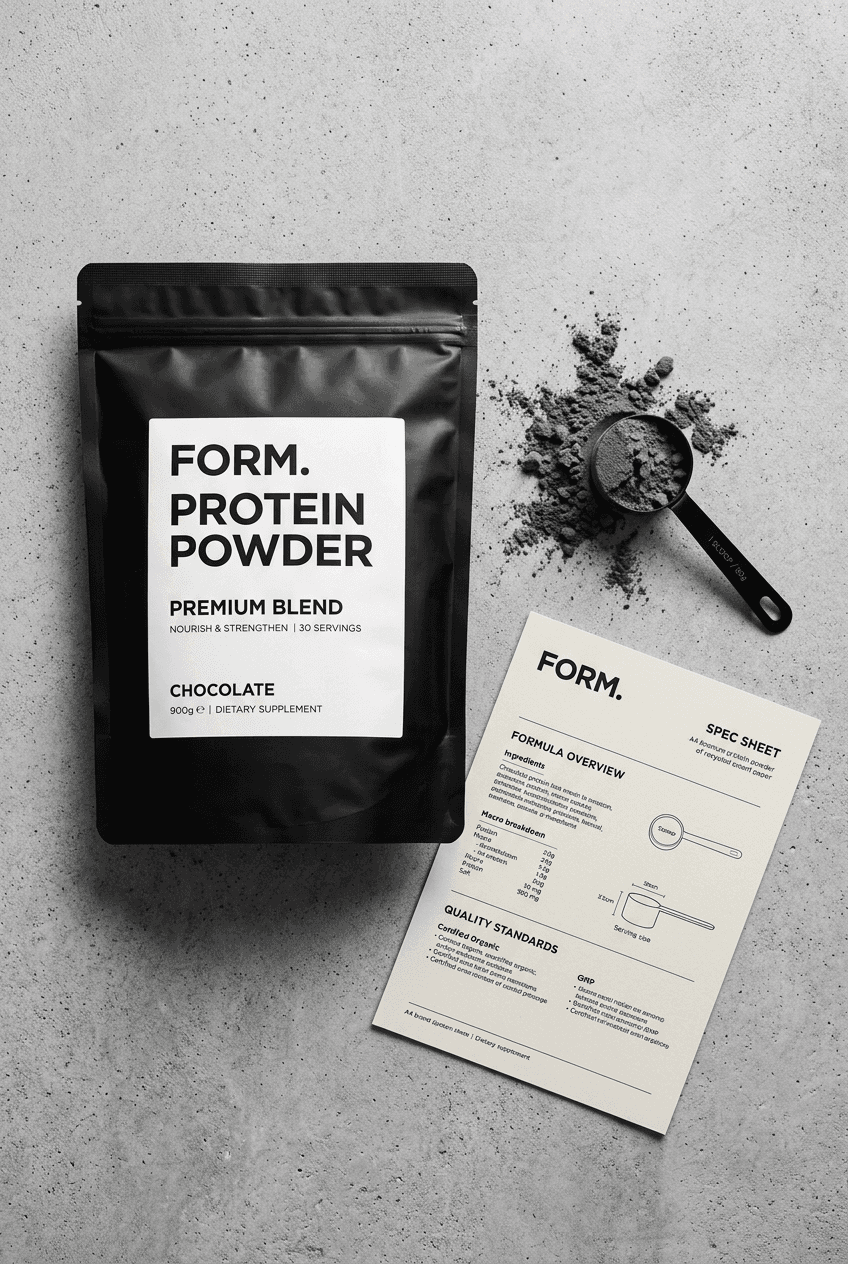
Naming deserves serious attention before any visual work begins. The name of a protein powder brand is the first and most persistent piece of communication the brand makes. Names in this category tend to cluster around three archetypes: performance/strength names (often aggressive, often generic), function names (often clinical, often forgettable), and emotional/lifestyle names (often vague, occasionally powerful when executed well). The strongest protein powder brand names are distinctive enough to own as a trademark, short enough to be said easily in conversation, and connected to the brand's positioning in a way that becomes more meaningful as the customer learns more about the brand. Packaging is the primary brand touchpoint for a protein powder business selling through physical or e-commerce retail. The packaging must work in two contexts simultaneously: on a crowded shelf or product listing where it needs to arrest attention and communicate the category and key claims at a glance, and in the customer's home where it will be handled repeatedly and where the quality of the packaging construction and print execution signals the quality of what is inside. Brands that invest in packaging design only to execute it in budget print formats immediately undermine the positioning the design was meant to create.
The format choice itself is part of the brand story. A stand-up pouch with a matte finish communicates something different from a rigid canister with a metal lid. A kraft paper bag with minimal print communicates something different from a fully printed PETG bag with structural rigidity. The format should be chosen in alignment with the brand positioning, not primarily on cost grounds.
Step Four: Set Up the Regulatory and Compliance Foundation Early
Protein powder is a food supplement product, which means it operates under regulatory frameworks that vary by market. In the United States, protein supplements are regulated as dietary supplements under the Dietary Supplement Health and Education Act (DSHEA), which means they do not require pre-market approval from the FDA but must comply with labeling requirements, GMP regulations, and truthful-and-not-misleading advertising standards enforced by the FTC. In the European Union, the regulatory environment is more prescriptive, with the Food Supplements Directive and member-state implementing regulations governing what claims can be made and how products must be labeled.
The most common compliance mistakes made by new protein powder businesses are: making structure/function claims without the required disclaimers; using ingredient names that do not match approved nomenclature in the relevant market; understating or miscalculating nutritional values on the label; and making implied health claims through imagery or language that the explicit label copy does not make.
Getting the regulatory foundation right at launch is significantly cheaper than correcting it after products are in market. A regulatory consultant specializing in food supplements typically charges between $2,000 and $8,000 to review and advise on a product label and marketing materials — a cost that should be treated as mandatory rather than optional. The alternative is a reformulation, relabeling, or recall that costs multiples of that figure.
Step Five: Build the Distribution Strategy Before You Have the Product
One of the most common traps in starting a protein powder business is building the brand and the product without a clear, realistic distribution strategy, then discovering at launch that the channels they assumed would be available are not.
The main distribution models for a protein powder business in 2026 are direct-to-consumer (DTC) e-commerce, Amazon marketplace, independent specialty retail (health food stores, independent gyms, specialty supplement retailers), national supplement retail (GNC, Vitamin Shoppe, and equivalent chains), and broadline grocery. Each of these channels has different minimum requirements, different margin structures, different promotional expectations, and different implications for brand positioning.
DTC e-commerce gives the highest margin and the most brand control but requires significant ongoing investment in customer acquisition, typically through paid social advertising, content marketing, and influencer partnerships. The customer acquisition cost for supplement brands in DTC channels has increased substantially over the past three years as competition for attention has increased. A realistic DTC launch budget for a protein powder brand includes not just product development and inventory but a minimum six-month customer acquisition budget of $5,000 to $20,000 per month, depending on the scale of launch ambition. Amazon provides reach but at significant cost to brand equity and margin. Amazon's algorithm favors established review volume and competitive pricing, which means new entrants typically need to price aggressively and invest in advertising spend within the platform to build initial velocity. Amazon also limits the brand experience a customer has — the packaging and the product are the only brand touchpoints, since Amazon controls the pre-purchase experience. For a brand where the story and positioning are central to the purchase decision, Amazon works better as a secondary channel than as the primary launch channel. Specialty retail is the channel most aligned with brand-building for premium positioning, but it requires a sales function that most founding teams underestimate. Buyers at health food stores and specialty supplement retailers evaluate new brands on several criteria: packaging quality, brand story clarity, the founder's ability to explain why their product is different, proof of consumer demand (even if small), and margin. Getting onto the shelf is a sales process that takes time, relationship-building, and a compelling sell-in presentation. It also typically requires support through in-store demonstrations, point-of-sale materials, and potentially temporary price promotions.
What the Brand Must Do That the Product Cannot
The most important thing to understand about starting a protein powder business is that the product is the minimum. Every protein powder that reaches market has passed a bar of quality, taste, and function that the customer now takes for granted. What the product cannot do is give the customer a reason to choose it over the dozens of other adequate products at a similar price point. That is what the brand does.
A well-built protein powder brand communicates not just what is in the product but what the product says about the person who uses it. This is not a cynical observation about consumer psychology. It is an accurate description of how purchasing decisions are made in a category where functional differences between products are often small and difficult for a non-expert consumer to evaluate. The customer chooses the protein powder that reflects who they are or who they want to be. The brand's job is to make that identification unmistakably clear.
Brand Element | Minimum Standard | What Great Looks Like |
|---|---|---|
Positioning | Specific audience defined | Audience can identify themselves in 5 seconds |
Naming | Trademarkable, memorable | Name that becomes a category reference |
Visual Identity | Cohesive, professional | Immediately distinctive in category context |
Packaging | Accurate, compliant | Design-led, tactilely premium, format-differentiated |
Copy voice | Clear, claim-appropriate | Owns a specific tone no competitor has |
Website | Functional, mobile-optimized | Brand story told as well as product sold |
The Realistic Launch Budget
Starting a protein powder business requires capital for three distinct areas: product development and initial inventory, brand development, and launch marketing. Founders routinely underestimate the brand development and marketing budget while over-investing in inventory, which results in having more product than their marketing can move.
A realistic brand-first launch budget for a protein powder business with serious intent typically includes: contract manufacturer deposit and first run (which varies widely by MOQ but typically ranges from $8,000 to $30,000); brand identity development including naming, visual identity, and packaging design ($5,000 to $20,000 for serious professional work); regulatory review and compliance documentation ($2,000 to $8,000); website design and development ($3,000 to $10,000); and initial customer acquisition budget for the first three to six months ($15,000 to $60,000).
The brands that succeed in this market are not necessarily the ones with the largest budgets. They are the ones that allocate their budget with discipline — investing in brand development before product development, in customer acquisition before scale production, and in positioning before any visual work begins. The supplement graveyard is full of beautiful products with underfunded distribution and beautiful brands with underdeveloped positioning.
Starting a protein powder business is genuinely viable in the current market. But the path to viability runs through brand strategy, not through formulation. The founders who understand that are the ones worth watching.