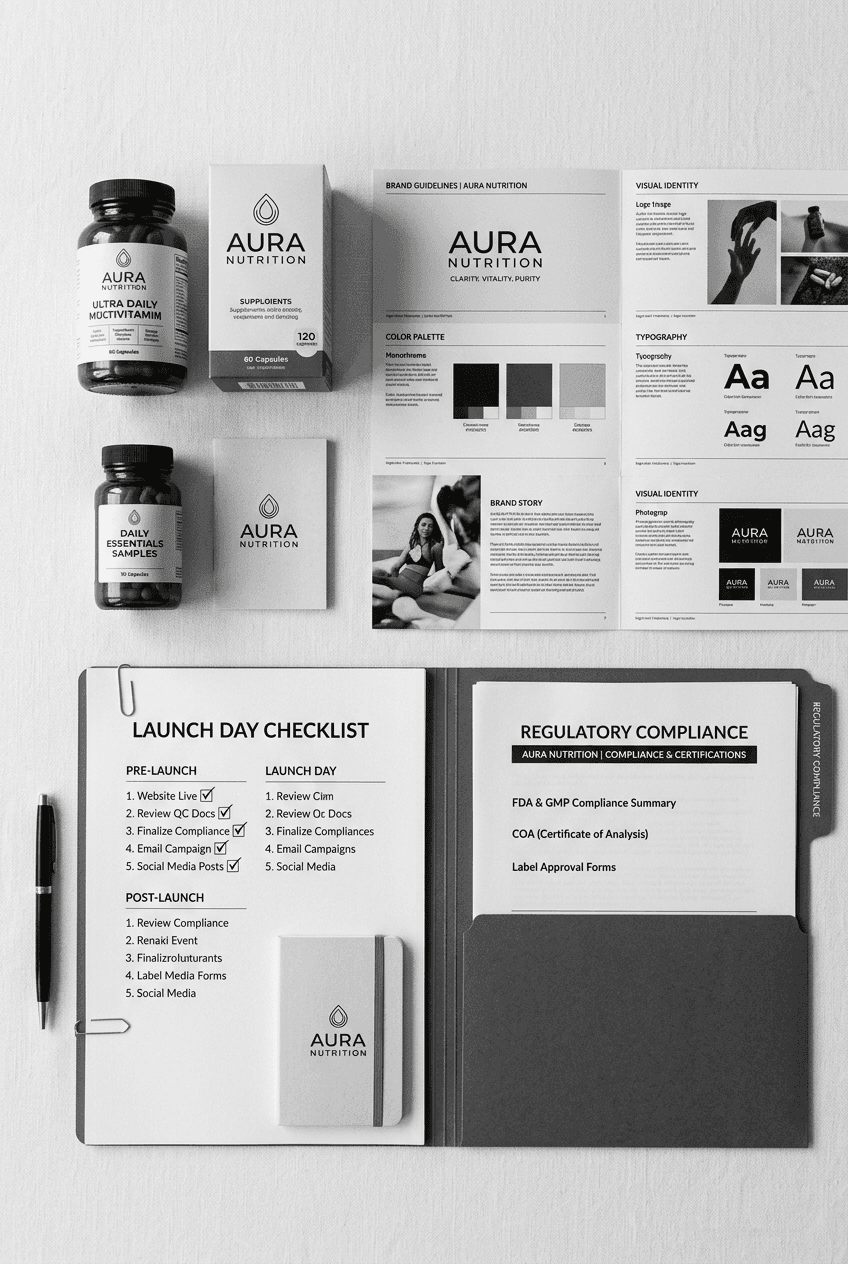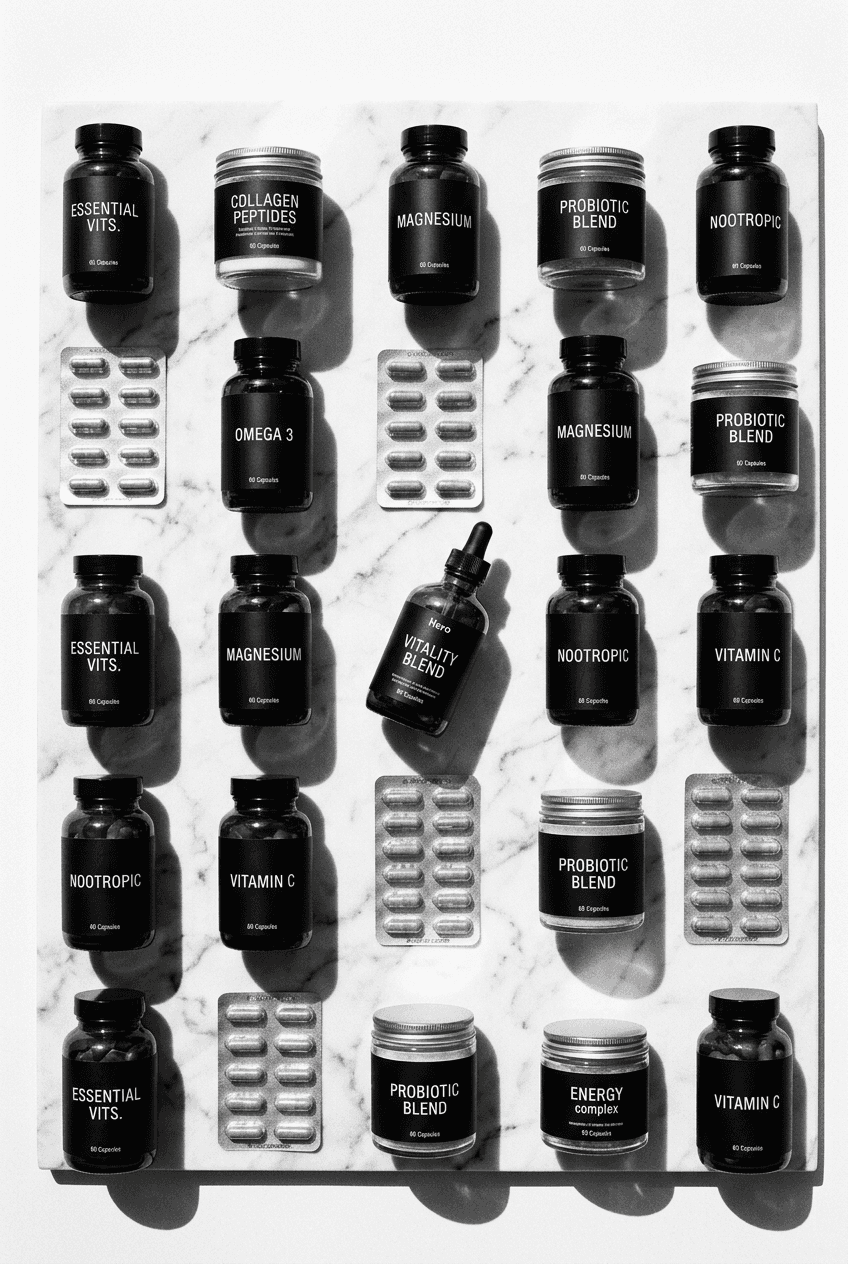

Amazon is a search result. DTC is a brand experience. The packaging that wins on both must respect both contexts simultaneously.
What Amazon Demands from Supplement Packaging
The Amazon supplement marketplace is a search-dominated environment where the buyer's first encounter with your brand is a 250x250 pixel thumbnail in a list of 48 competing products. This context creates specific packaging requirements that are different from every other sales channel.
Main image requirements. Amazon's main image policy for supplements requires: pure white background (RGB 255,255,255), product occupying at least 85% of the image frame, no text, graphics, or design elements outside the product itself. This means the label is the only communication surface you have in the main image. Everything you want the buyer to understand from the thumbnail must be on the label. Thumbnail legibility test. At 250px (the size at which your product appears in most Amazon search results), the following must be legible without squinting: your brand name, the product name (not a marketing name, the actual ingredient or benefit identity), and ideally the key specification (dosage, capsule count, days of supply). Labels that have these elements at appropriate scale and contrast pass the thumbnail test. Labels that bury this information in complex label architecture fail it. Color contrast for search differentiation. In a grid of 48 supplement products, your packaging must visually differentiate itself from the 47 others. The primary tool for this on Amazon, where photography style is constrained by the white background requirement, is label color. Strong color contrast between the label background and the surrounding white page performs better in Amazon search contexts than light or muted label color palettes. This is a specific Amazon consideration that conflicts with the premium supplement aesthetic, which often favors light, refined, muted palettes. Amazon supplement certification requirements. Amazon's supplement quality program (Supplemental Quality Initiative) has progressively increased its documentation requirements. Third-party testing certificates (NSF, USP, or equivalent), COAs, and GMP certificates are increasingly required for supplement listings to remain active. Packaging that carries third-party certification logos on the label (with the certifying body's permission) performs better in Amazon search because it satisfies a filter that many buyers use.
What DTC Supplement Packaging Demands
Direct-to-consumer supplement packaging operates in a fundamentally different context. The buyer discovers the product through brand-controlled channels (social media, email, content), arrives at the brand website with some level of brand familiarity already established, and makes a purchase decision with more information available than in any other channel.
Unboxing as a brand experience. In DTC supplement purchasing, the unboxing moment is a brand touchpoint that Amazon does not offer. The outer box or mailer, the tissue paper or wrap, the insert card or welcome note, and the product container itself all contribute to a brand experience that reinforces the brand's positioning and increases the likelihood of repeat purchase and social sharing. A 2023 Dotcom Distribution study found that 40% of DTC shoppers said premium packaging influenced their decision to share their purchase on social media. Secondary packaging with brand storytelling. DTC supplement brands can use secondary packaging (outer boxes, pouches, shipper boxes) to carry brand narrative that would not fit on the primary container label. The inside of a box lid, the insert card, the product description on the back of a pouch -- these surfaces allow a level of brand communication that creates the relationship depth that DTC brands need to sustain repeat purchase without the retail environment doing any of the trust-building work. Photography surface variety. DTC product photography does not have to comply with Amazon's white background requirement. This allows the full range of lifestyle and editorial photography that creates the brand's aesthetic on the website, in social media, and in digital advertising. DTC supplement brands should plan for both: the strict white-background photography required for Amazon and the full brand photography required for DTC brand expression. Subscription packaging design. If your DTC model includes a subscription option (which most successful DTC supplement brands offer), the packaging should be designed to feel satisfying on the third, fifth, and tenth delivery, not just the first. Subscription churn in supplements correlates with reduced perceived value over time, and packaging that creates an ongoing ritual or sensory pleasure is a retention tool, not just an aesthetics decision.
Designing Supplement Packaging That Works on Both Channels
The design challenge for a dual-channel supplement brand is to create a primary container label that performs in the Amazon thumbnail context AND communicates the brand's premium positioning in the DTC context. These demands are not entirely compatible, but they can be reconciled.
The hierarchy resolution. Amazon demands clear, large-type product identity. DTC demands sophisticated brand identity. The resolution is a front label hierarchy that places the product identity (ingredient name + key spec) prominently enough to pass the thumbnail test, while the brand mark and overall label aesthetic communicate the brand tier. The trick is in the proportion and positioning: brand mark at the top with appropriate scale, product name and spec in large, clear type below, benefit claim and credentials below that. All of this must hold together at 250px. Color palette dual-testing. Test every label color decision at both small scale (thumbnail) and at package scale. Colors that look sophisticated and premium at full scale often lose their quality signal at thumbnail scale. Aim for a palette that has enough contrast to differentiate in a white-background search grid while remaining premium in the full-size brand context. Label finish compatibility with FBA. If you are using Fulfillment by Amazon, the physical condition of your packaging when it arrives at the buyer is determined by FBA's handling. Glossy labels can show handling marks more visibly than matte-finish labels. Soft-touch coatings that feel premium when handled gently can show fingerprinting under FBA warehouse conditions. Test your label finish against realistic fulfillment handling before committing to a production run. Information density calibration. DTC buyers, who come to the purchase with more brand context, can tolerate a more visually complex label with more information. Amazon buyers need the most critical information at a glance. The calibration for dual-channel packaging is to put the critical information (product identity, dosage, key benefit, certification) in the A-position (front label, large type), and put the deeper information (full ingredient story, formulation philosophy, brand narrative) in the B-position (back label, insert, secondary packaging). This serves both buyer types without compromising either.
Supplement Packaging Materials: Amazon vs. DTC Considerations
The physical packaging format for supplements has channel implications that go beyond label design.
Bottles vs. pouches vs. stick packs. Rigid plastic or glass bottles are the dominant supplement packaging format for Amazon, where the bottle format photographs well on white background and scans clearly for the Supplement Facts panel thumbnail image. Flexible pouches and stick packs are growing in the DTC segment, where the unboxing experience and the sustainability story of reduced packaging weight are commercially valued. Brands selling on both channels may need different packaging formats for each, or may need to choose the format that creates the least disadvantage in each. Size and weight for Amazon fulfillment. Amazon FBA fees are largely calculated on the dimensional weight and physical weight of the unit. Supplement packaging that is unnecessarily large (oversized for the product it contains) incurs higher fulfillment fees that directly impact margins. For Amazon, the most economical packaging is as compact and lightweight as is consistent with the brand's quality positioning. Glass vs. plastic for premium positioning. Glass supplement packaging is common in the premium DTC segment because it communicates premium quality and sustainability more powerfully than plastic. But glass is heavier, more fragile, and more expensive to ship, making it less economical for Amazon FBA and more vulnerable to damage in transit. Many premium supplement brands use glass for their DTC channel and high-quality HDPE (high-density polyethylene) for their Amazon channel, with identical labeling.
The Amazon Supplement Listing Beyond the Packaging
Packaging design is the foundation of an Amazon supplement listing, but the listing performance depends on additional elements that work in conjunction with the packaging.
A+ Content. Amazon Brand Registry access enables A+ Content, which allows brands to add enhanced image and text modules below the product description. A+ Content is where the brand story, ingredient story, and benefit communication that cannot fit on the main image can be presented visually. The most effective A+ Content for supplements mirrors the brand's DTC website look and feel, creating brand consistency for buyers who research both channels. Secondary images. The 6-8 secondary image slots in an Amazon listing are your primary conversion communication surface. The first secondary image should show the Supplement Facts panel. Subsequent secondary images should address the top buyer purchase questions: what is in it, how much do I take, what will I experience, who makes this, why should I trust it. Infographic-style secondary images (showing key ingredients with clinical data callouts, certifications, or formulation differentiators) consistently outperform lifestyle photography in supplement category conversion rate optimization.
According to a 2024 Jungle Scout study, supplement listings with 7+ secondary images had 23% higher conversion rates than listings with 3 or fewer secondary images, controlling for price and review count.
FAQ: Supplement Packaging for Amazon and DTC
What are Amazon's main image requirements for supplements?
Amazon requires the main product image to have a pure white background, with the product occupying at least 85% of the image frame. No text, watermarks, borders, or graphics outside the product itself are permitted in the main image. For supplements, this means the label must carry all brand and product communication.
How do I design supplement packaging that works as an Amazon thumbnail?
At 250px (standard Amazon search result thumbnail size), your brand name, product name, and key specification (dosage or servings) must all be legible. Test every label design at this scale before finalizing. Strong color contrast between label and white page background improves thumbnail performance. Avoid complex label designs with many small elements.
Should supplement packaging be different for Amazon vs. DTC?
For many brands at scale, yes -- different packaging formats or finish specifications for each channel make commercial sense. For brands just starting out, designing a single packaging system that performs adequately on both channels and then optimizing for each channel over time is the more practical approach.
What supplement certifications help most on Amazon?
NSF International, USP, and Informed Sport certifications are the most recognized by Amazon buyers and are increasingly required by Amazon's quality programs. Displaying these certification logos on the label (with the certifying body's permission) improves both buyer trust and compliance with Amazon's supplement documentation requirements.
Does packaging affect Amazon supplement listing rankings?
Not directly. Amazon's ranking algorithm weighs conversion rate, review count and quality, sales velocity, and keyword relevance. But packaging quality affects conversion rate, and conversion rate is one of the strongest Amazon ranking signals. A label that performs better in the thumbnail test will drive higher click-through rates, which drives higher conversion rates, which improves ranking. The indirect effect of packaging quality on Amazon ranking is significant.
I'm Tambi Haşpak, a brand strategist and creative director with an unfair advantage: I'm a pharmacist. I run a creative studio for cosmetics, supplements and beyond. 17 years. Exclusively. If your supplement packaging is not performing on Amazon, DTC, or both, let's look at it together. Book a call or email me.