
Most supplement launch failures are not market failures. They are pre-launch preparation failures that show up after the product ships.
Formulation Readiness
Finalized formula with specification sheet. Before any label design, packaging, or marketing work begins, the complete formula specification must be finalized with your contract manufacturer (CM). The spec sheet includes every ingredient, its INCI or IUPAC name, concentration, function, and source. This is the document that drives the Supplement Facts panel and the other ingredients list. Designing labels before the formula is finalized creates expensive revision cycles. Certificate of Analysis (COA) for each raw ingredient. Every ingredient used in your formula should have a COA from your supplier confirming identity, purity, and potency. These documents are required for your own quality records, for retailer compliance review, and for FDA inspection readiness. Supplement brands that cannot produce COAs for their ingredients have a compliance exposure that major retailers will identify during their vendor review process. Finished product COA from independent laboratory. An independent third-party COA on your finished product, confirming that it contains what the label says it contains in the declared amounts, is not legally required but is commercially essential. Retailers with ingredient testing programs (Whole Foods, Target, Thrive Market) will request this. Amazon's supplement quality program increasingly requires it. Consumer complaints about label claim discrepancies are a significant source of brand damage in the supplement category. Stability testing data. Your formula must be demonstrated to be stable for at least the duration of the claimed shelf life under appropriate storage conditions. Stability testing is a commitment that takes time: a 24-month shelf life claim requires either 24 months of real-time stability data or accelerated stability testing (typically 6 months at elevated temperature and humidity, with a statistical model projecting real-time stability). Beginning stability testing early in the development process is essential for launching with a defensible shelf life claim. Safety substantiation file. DSHEA requires that the brand have reasonable evidence that the product is safe as intended to be used. This is typically documented through a safety substantiation file that includes ingredient safety data, relevant toxicological information, and any history of use data for novel ingredients. This file is for your records and for FDA inspection readiness, not for public submission.
Regulatory and Compliance Readiness
FDA product listing. Under MoCRA (for cosmetics) and DSHEA, supplement brands must notify FDA of their products. For dietary supplements, the specific requirements depend on the type of product and whether it contains any new dietary ingredients (NDIs). NDIs require a 75-day pre-market notification to FDA. Standard supplements with established ingredients require no pre-market notification but must comply with all labeling and manufacturing regulations. GMP-compliant manufacturing. Dietary supplement manufacturing must comply with 21 CFR Part 111, the Good Manufacturing Practice regulations for dietary supplements. If you are using a contract manufacturer, confirm that they are GMP-compliant for dietary supplements (not just for food or cosmetics, which have different GMP standards). Request their most recent third-party GMP audit certificate. Structure/function claim notifications. If your label or marketing includes structure/function claims (and they should), each claim must be notified to FDA within 30 days of first marketing the product with that claim. The notification is submitted to FDA's CFSAN (Center for Food Safety and Applied Nutrition). Keep copies of all notifications filed. FTC substantiation files. The FTC requires that all marketing claims about supplement benefits be substantiated by competent and reliable scientific evidence. Create a substantiation file for each claim you intend to make, documenting the scientific evidence that supports it. "Competent and reliable scientific evidence" means controlled human clinical studies in most cases, though the specific standard depends on the type and magnitude of the claim. State-specific requirements. California's Proposition 65 applies to any brand selling into California. If your product contains any Proposition 65-listed ingredients above threshold levels, you must provide the required warning either on the label or at point of sale. Other states have additional requirements. A regulatory review that includes the states where you intend to sell is worth the investment before launch.
According to a 2024 Natural Products Insider industry report, brands that engaged a regulatory consultant before launch reduced their compliance-related relaunch costs by an average of $42,000 compared to brands that addressed compliance issues reactively after launch.
Label and Packaging Readiness
Compliant Supplement Facts panel. The Supplement Facts panel format is specified by FDA regulation. Before printing any labels, have the panel reviewed by a regulatory consultant or someone with specific supplement label compliance experience. Common errors (wrong type size, incorrect format for percent daily values, missing serving declaration elements) are invisible to a graphic designer but immediately visible to a compliance reviewer. All required label elements present and correct. In addition to the Supplement Facts panel: statement of identity ("Dietary Supplement"), net quantity of contents, name and address of the responsible company, directions for use, required warnings, and structure/function claim disclaimers where applicable. Label printed and proofed against artwork. The final printed label must be proofed against the approved artwork file with specific attention to type size legibility, color accuracy, and barcode functionality. The barcode must scan correctly at retail and in Amazon's receiving system. Test your barcode with multiple scanners before committing to a print run. Secondary packaging approved and tested. If your product has outer packaging (a box, sleeve, or pouch), this packaging carries its own label requirements. Net quantity on the outer package, product identity, and all required compliance statements must appear on the outer package as well. Photography and listing images completed. For Amazon and DTC launches specifically, product photography must be completed and approved before any listing goes live. Amazon main image requirements (white background, product filling 85%+ of the frame) differ from the DTC photography style most brands prefer. Plan for two distinct photography outputs: compliant e-commerce photography and brand-expressive lifestyle photography.
Brand and Marketing Readiness
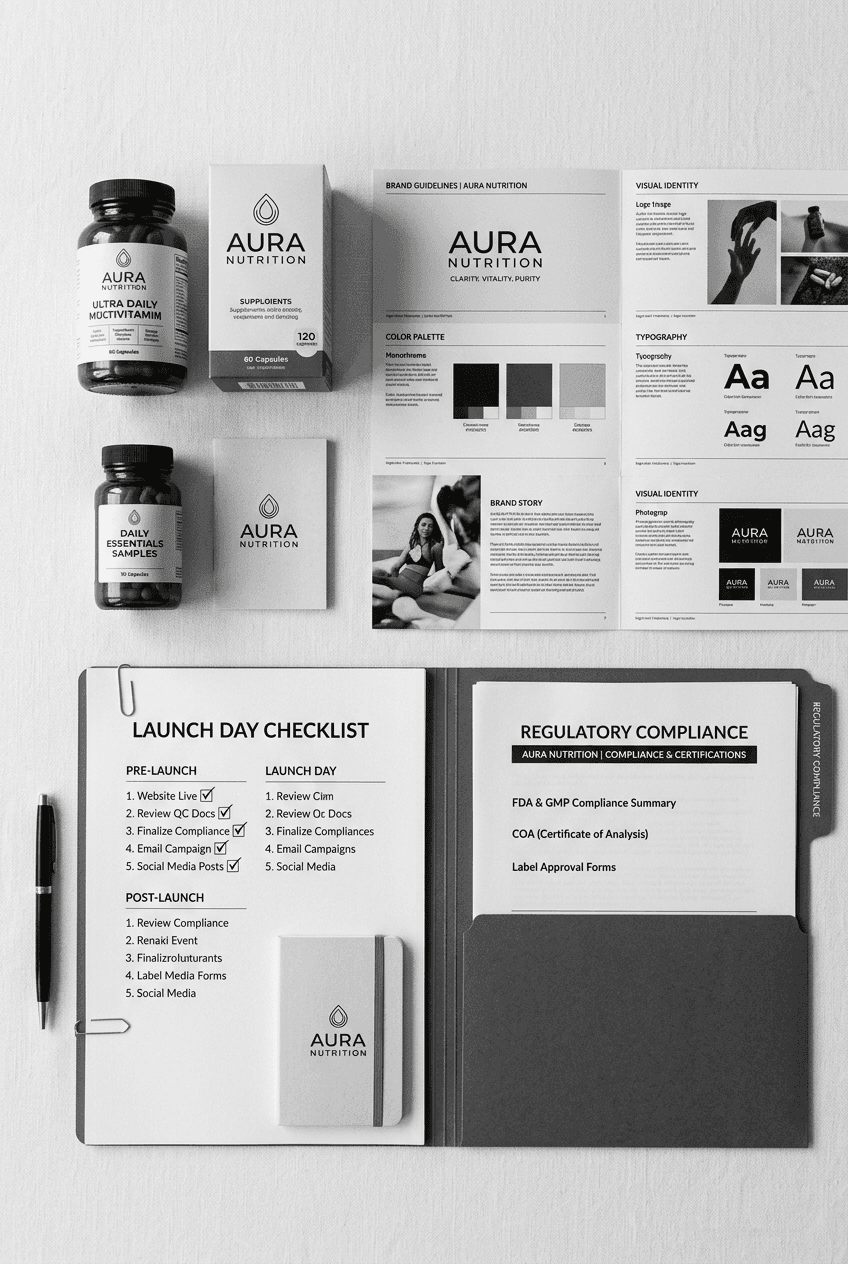
Brand identity complete and applied consistently. The brand identity (logo, color palette, typography, photography style, tone of voice guidelines) should be finalized and documented in a brand guidelines document before any marketing assets are produced. Brand inconsistency at launch is very difficult to correct later and creates a poor first impression with both consumers and retail buyers. Website live with compliant product pages. The brand website is typically a retailer's first stop when evaluating a new supplier. The website must be live, the product pages must include all required claim disclaimers, the privacy policy and terms must be in place, and the brand story must be clearly and credibly presented. A website that is not yet live or is clearly incomplete signals unreadiness that retail buyers interpret as a risk. FTC-compliant marketing copy reviewed. All marketing copy, including website product descriptions, social media captions, and any paid advertising, must be reviewed for FTC compliance before going live. Claims that are compliant on the label may not be compliant in marketing copy depending on how they are presented and what supporting claims accompany them. Social media channels established. Even for brands that are not primarily social media focused, having established social media profiles with consistent branding before launch establishes legitimacy for buyers and reviewers who will search for the brand. Absent or clearly thin social media presence is a trust negative for supplement buyers. PR and launch communications prepared. For brands seeking retail distribution, a concise sell-in deck (brand story, product range, target buyer, positioning, pricing architecture, trade terms) should be prepared before approaching any buyer. A launch press kit for editorial media outreach should be prepared if earned media is part of the launch strategy.
Operational and Supply Chain Readiness
Inventory plan confirmed with realistic lead times. Supplement manufacturing lead times from contract manufacturers range from 8-16 weeks for standard products. Specialty formulations, custom packaging, or novel ingredients can extend this to 20-30 weeks. Build your launch timeline backward from your target launch date with actual lead time data, not optimistic estimates. Warehouse and fulfillment confirmed. Whether you are using a 3PL (third-party logistics), a fulfillment by Amazon (FBA) model, or your own warehouse, the fulfillment infrastructure must be confirmed and tested before launch inventory ships. FBA receiving requirements, in particular, have specific labeling and packing requirements that products must meet to be received without a return or additional fee. Return policy and customer service process documented. Supplement return rates and the customer service load associated with them are significant operating considerations. Before launch, document your return policy (which must meet any Amazon return policy requirements if you are selling there), your customer service process for product quality complaints, and your adverse event reporting process (required by law for any serious adverse event associated with your supplement). Reorder forecasting model in place. The most common supply chain failure for new supplement brands is running out of the ingredient or packaging component with the longest lead time. Build a simple reorder model that tracks current inventory, average daily velocity, and lead time for each component, and set reorder triggers based on lead time plus a safety buffer.
Amazon-Specific Pre-Launch Checklist
Brand Registry application submitted and approved. Amazon Brand Registry is not optional for supplement brands. It provides access to A+ Content, Brand Analytics, and the ability to protect against counterfeit listings and hijackers. The application requires a registered trademark. Trademark applications typically take 10-18 months in the US. Apply early. ASIN structure planned. If you are launching multiple products, the ASIN structure (parent-child variations for same products in different sizes, flavors, or formulations) must be planned before any listings are created. Retroactively restructuring ASINs after launch is disruptive and can affect ranking history. Amazon supplement documentation ready. Amazon increasingly requires documentation for supplement listings: COAs, GMP compliance certificates, and in some categories, Prop 65 compliance documentation. Have these ready before the listing is submitted to avoid delays.
FAQ: Supplement Brand Launch
How long does it take to launch a supplement brand?
A realistic timeline from formulation decision to market-ready launch is 12-18 months for a new brand doing it properly. This includes formulation development and stability testing (4-6 months), regulatory review and compliance work (1-2 months overlapping with formulation), packaging and label design and production (2-3 months), photography and marketing asset creation (1-2 months), and inventory production and fulfillment setup (2-3 months). Brands that try to compress this to 6 months typically skip stability testing, regulatory review, or both, and pay for it later.
Do I need a contract manufacturer for a supplement brand?
Yes. Dietary supplement manufacturing in the US requires GMP compliance under 21 CFR Part 111. Establishing your own GMP-compliant manufacturing facility requires significant investment in facilities, equipment, personnel, and quality systems. Contract manufacturing at a GMP-certified facility is the standard model for new supplement brands.
What is the minimum order quantity for supplement manufacturing?
Most contract manufacturers have minimum order quantities (MOQs) that range from 1,000-5,000 units per SKU for standard products. Custom formulations or custom packaging typically have higher MOQs. Specialty manufacturers working with smaller indie brands may accept 500-unit minimums, though at higher per-unit costs.
Do supplements need FDA approval before launch?
Dietary supplements do not require pre-market FDA approval (with the exception of new dietary ingredients, which require a 75-day pre-market notification). Brands are responsible for ensuring their products are safe and their labels are compliant before market. FDA enforces compliance post-market through inspections, consumer complaints, and adverse event reports.
What third-party certifications should a supplement brand have?
NSF International and USP (United States Pharmacopeia) are the two most recognized third-party supplement certifications in the US market. Informed Sport certification is essential for any supplement targeting athletes. These certifications verify manufacturing quality and/or product contents against the label claim. For retail distribution in health food stores and natural retailers, at least one third-party quality certification is increasingly a prerequisite.
I'm Tambi Haşpak, a brand strategist and creative director with an unfair advantage: I'm a pharmacist. I run a creative studio for cosmetics, supplements and beyond. 17 years. Exclusively. If you are planning a supplement launch and want an experienced set of eyes on your readiness, book a call or email me.