
Positioning is the decision your brand makes about who it is for and who it is not for. Every design decision flows from that.
Why Cosmetics Brand Strategy Must Come Before Design
Design is the expression of a strategy. It is the visible output of positioning decisions that should have already been made. A cosmetics brand identity designed without a positioning strategy is a solution to an undefined problem, and it will require revision the moment the positioning is actually defined.
The consequences of this sequencing error are concrete. According to a 2023 industry survey by Indie Beauty Expo, 64% of indie beauty brands reported undergoing at least one significant brand identity revision within the first two years of launch, at an average cost of $18,000-35,000 per revision. The most common reason cited was "the original branding did not match where the brand evolved." The correct answer is that it did not match where the brand should have started.
Brand strategy for a cosmetics company involves answering five questions before a designer opens a brief. Each question has implications for every design decision that follows. Skipping any one of them creates a gap that will show up in the brand's commercial performance.
Question 1: What Positioning Tier Are You Actually Building?
The cosmetics market operates across distinct tiers: mass market (drugstore and value retail), accessible prestige (Sephora, Ulta), prestige (luxury department stores, specialty beauty), and luxury (selective distribution, premium pricing). Each tier has distinct visual language, packaging cost expectations, pricing architecture, retail channel requirements, and buyer psychology.
A brand that tries to sit between tiers creates ambiguity that buyers resolve by assigning the brand to the lower tier. The buyer who encounters an accessible prestige price point with mass-market packaging does not perceive a discovery. They perceive a mismatch, and they move on.
Defining your tier is not about aspiration. It is about commercial reality: what packaging cost per unit can you sustain at your target price point with your expected volume? What retail environments will your positioning support access to? What marketing spend is required to build awareness in your tier? The tier decision is a financial model constraint, not just a brand preference.
For context: accessible prestige brands typically spend 8-15% of retail price on packaging. Prestige brands spend 15-25%. Luxury brands spend 20-35%. A brand that aspires to prestige pricing while spending 5% on packaging is attempting to create a signal its budget does not support.
Question 2: Who Is Your Specific Target Customer?
Not a demographic. Not "women aged 25-45 who care about skincare." A specific person with specific beliefs, specific aesthetic values, a specific relationship with the cosmetics category, and specific reasons for buying or not buying products like yours.
The target customer definition for a cosmetics brand strategy should answer: What is her (or his, or their) relationship with cosmetics? Does she see it as a ritual, a regimen, a luxury, or a necessity? What brands does she currently use, and what does that tell you about her aesthetic values and quality expectations? What does she believe about ingredients? About sustainability? About luxury? About scientific claims? Where does she discover new brands? What would cause her to try a new brand in this category? What would cause her to trust it enough to repurchase?
The more specific and honest the target customer definition, the more useful it is as a brand strategy tool. Vague target definitions produce vague positioning and vague design briefs. A vivid, specific target customer definition makes every subsequent design decision testable: "would this person understand and desire this label?" is a question you can actually answer when you know specifically who that person is.
A 2024 McKinsey report on beauty consumer segmentation found that cosmetics brands with clearly defined target customer profiles had 40% higher new product success rates than brands that described their target audience in broad demographic terms.
Question 3: What Is Your Specific Competitive Territory?
The competitive landscape for a cosmetics brand is not the whole market. It is the specific set of brands that compete directly with your brand for the same buyer's purchase decision, in the same channel, at the same price point, with the same benefit territory.
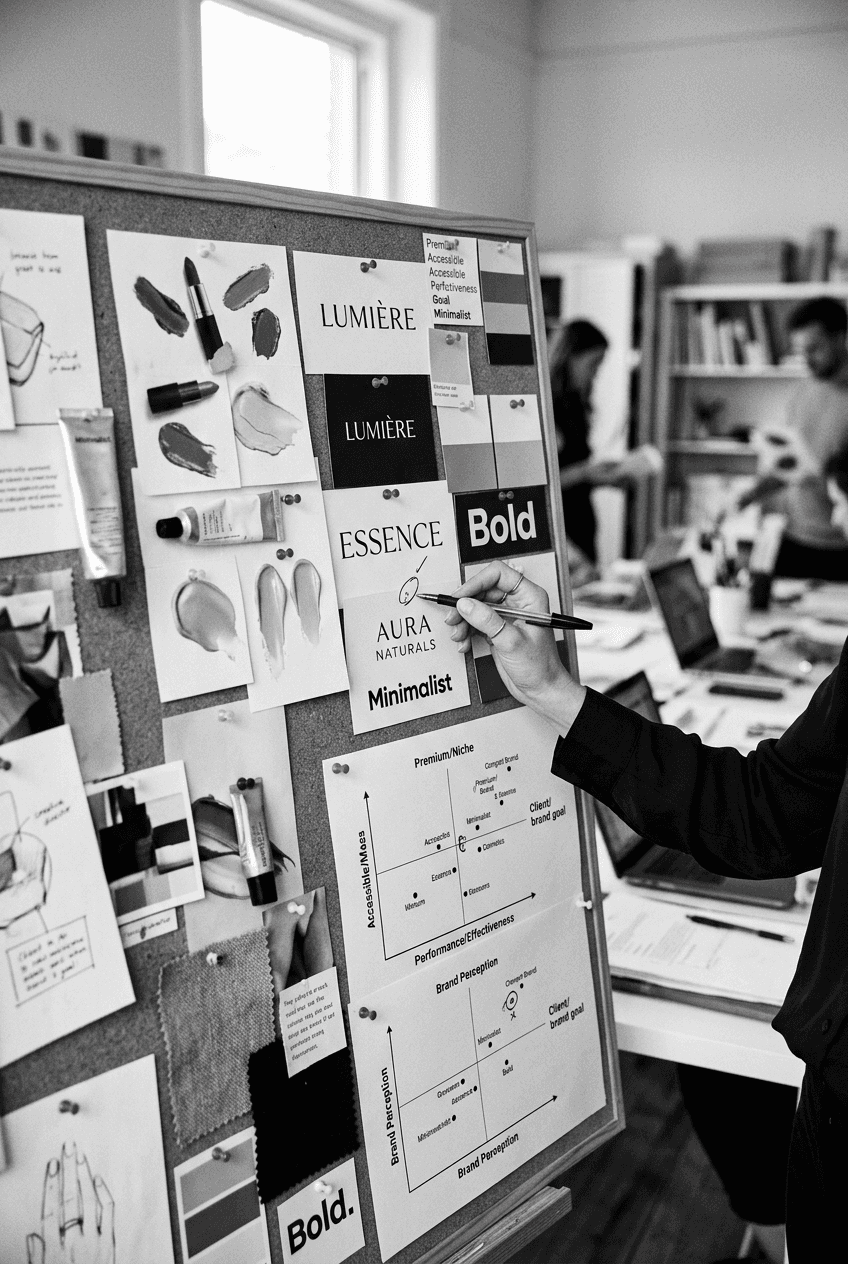
Mapping this competitive territory accurately requires: identifying the 5-10 brands your target buyer is actually choosing between when she considers a purchase in your category, analyzing their positioning (what each brand claims as its core reason to believe), their visual identity character (color, typography, photography style, packaging aesthetic), and their brand story approach. From this analysis, the white space in the competitive territory becomes visible: the positioning angles, visual territories, and brand story approaches that the competitive set has not claimed.
The goal of this analysis is to identify a positioning territory that is both relevant to the target buyer and differentiated from the competitive set. Positioning that is relevant but undifferentiated creates a "me-too" brand with no purchase reason. Positioning that is differentiated but irrelevant to the buyer creates a distinctive brand nobody buys.
Question 4: What Is Your Brand's Reason to Believe?
Your reason to believe (RTB) is the specific claim your brand makes about why it delivers its core benefit better than alternatives. In cosmetics, RTBs cluster around a few categories: ingredient authority (a specific formulation philosophy or hero ingredient with provenance), expertise authority (the background and credentials of the founder or formulation team), methodology authority (a specific approach to product development), and origin authority (a specific connection to a place, tradition, or scientific body).
The RTB must be: specific (not "we use only the best ingredients"), defensible (grounded in something real and verifiable), and relevant (connected to the benefit the target buyer is seeking). A pharmacist-founded skincare brand's RTB might be the formulation discipline that comes from pharmaceutical-grade precision in the approach to active ingredient concentrations. That is specific, defensible, and relevant to a buyer seeking efficacy over aesthetics.
The RTB is the brand's most important strategic asset in the long term. It is the answer to the buyer's question: "Why should I choose this brand over the others?" Without a clear RTB, a cosmetics brand competes purely on aesthetics, and aesthetics without substance is the most fragile possible competitive position.
Question 5: What Is Your Brand Architecture?
Brand architecture in cosmetics covers two related decisions: how many products and product lines does the brand have, and how do they relate to each other?
For new brands, the architecture question is primarily about restraint. How many products to launch with (the answer is almost always fewer than the founder wants), and how to organize the range so that each product has a clear role that does not cannibalize or confuse the others.
For growing brands, the architecture question becomes more complex: does each new product launch reinforce the core brand positioning, or does it extend the brand into adjacent territory that dilutes the original positioning? The discipline of brand architecture in cosmetics is the practice of saying no to product opportunities that do not serve the brand's strategic positioning, even when those opportunities look commercially attractive in isolation.
Brand architecture decisions also determine whether sub-brands or product lines within the main brand make sense, and if so, how they relate to the parent brand identity. Getting these decisions wrong at the architecture stage creates future confusion for buyers and future complexity for the brand team. Getting them right creates a brand system that can scale without losing coherence.
How Brand Strategy Translates to a Design Brief
A completed cosmetics brand strategy translates directly into a creative brief for the design team. The five strategy questions produce five brief inputs:
The positioning tier determines the packaging investment level, the visual quality standard, and the appropriate retail channel to design for. The target customer profile determines the aesthetic reference set (what does this person find beautiful and credible?), the communication tone (how does she like to be spoken to?), and the conversion triggers to prioritize on the label. The competitive territory defines the design constraints (what visual territory to avoid because it is claimed) and the differentiation opportunities. The reason to believe determines the brand story architecture and which elements of the story get prominence on the label vs. in content. The brand architecture determines the system requirements for the design: how many SKUs at launch, how product names should be structured, how sub-ranges will be differentiated.
A design brief built from these five inputs gives a designer everything needed to produce work that solves the right problem. A design brief that omits any of these inputs produces work that solves part of the right problem and part of the wrong one.
FAQ: Cosmetics Brand Strategy
What is cosmetics brand strategy?
Cosmetics brand strategy is the process of defining a brand's positioning (what tier it occupies, who its target buyer is, what competitive territory it claims, what its reason to believe is) before the visual identity or packaging design is developed. It is the foundational work that ensures design decisions are commercially grounded.
How long does brand strategy take for a cosmetics brand?
A thorough cosmetics brand strategy for a new brand typically takes 4-8 weeks with a specialist brand strategist, including competitive research, target customer definition, positioning territory mapping, and brand architecture decisions. Attempting to compress this timeline by skipping elements typically results in a design revision cycle that costs more time and money than the strategy process would have.
What is the difference between brand strategy and brand identity?
Brand strategy is the thinking and positioning work. Brand identity is the visible expression of that thinking: the logo, color palette, typography, packaging design, photography style, and tone of voice. Strategy precedes identity. Identity is designed to express the strategy.
Do I need a brand strategist, or can I do my own brand strategy?
The strategy questions can be answered by a founder with the right research and analytical framework. The risks of doing it without a specialist are: confirmation bias (defaulting to the positioning you already believe in rather than the one the market evidence supports), insufficient competitive knowledge (not knowing the landscape well enough to see the real white space), and scope blindness (not knowing which strategy questions you are failing to answer). An experienced cosmetics brand strategist brings category knowledge and analytical frameworks that accelerate the process and reduce these risks.
What is brand positioning in cosmetics?
Brand positioning is the specific territory a brand claims in the mind of its target buyer: what it is, who it is for, why it is better than alternatives, and what it stands for beyond its products. Positioning is not a tagline. It is the strategic foundation that determines which buyers will choose your brand and why.
How often should a cosmetics brand review its strategy?
Annual strategy reviews are a minimum for any growing cosmetics brand. When a brand enters a new market, changes its target audience, launches in a new channel, or prepares for a significant product range expansion, a strategy review is essential before the commercial decision is finalized.
I'm Tambi Haşpak, a brand strategist and creative director with an unfair advantage: I'm a pharmacist. I run a creative studio for cosmetics, supplements and beyond. 17 years. Exclusively. If you are building a cosmetics brand and want to get the strategy right before the design work starts, book a call or email me.