
Luxury buyers do not pay more for better ingredients. They pay more for certainty that this brand understands them and has solved their problem completely.
What "Luxury" Actually Means to a Skincare Buyer
The word "luxury" is one of the most misused terms in skincare branding. Brands apply it to products at $30 price points. They apply it to packaging that uses black and gold because that reads as premium. They apply it to marketing copy that says "indulge yourself" and "experience the difference." None of this is luxury. These are signals that luxury looks like to people who have not studied how luxury buyers actually think.
Luxury in skincare, as in every luxury category, is a function of three things: rarity (real or perceived), authority (evidence of superior expertise), and desirability (the aspiration to own and use this specific product). Brands that have all three create genuine luxury positioning. Brands that have one or two create something closer to "accessible prestige."
The commercial significance of this distinction is large. According to a Bain & Company luxury report, luxury skincare buyers have significantly lower price sensitivity than prestige buyers and significantly higher repeat purchase rates. They also have a very low tolerance for brand inconsistency -- a single element that breaks the luxury signal pattern can permanently damage a brand's premium positioning in that buyer's perception.
The Brand Elements That Create Luxury Skincare Positioning
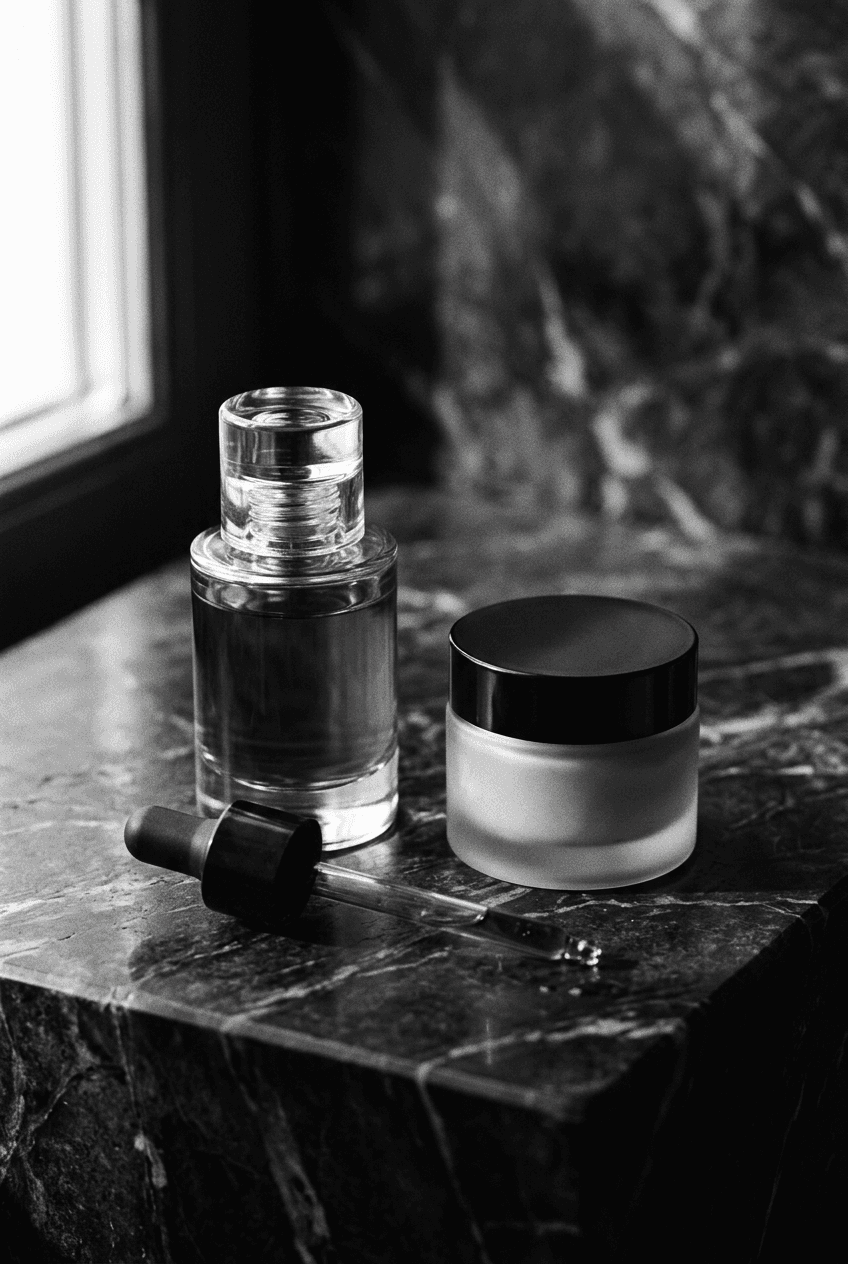
Brand origin and founder authority. Every luxury skincare brand that commands genuine premium prices has a credible founding story that creates authority. This is not a biography on an About page. It is a foundation narrative that explains why this specific brand exists and why the person or people behind it are qualified to build it. La Mer has the marine biologist founder story. Dr. Barbara Sturm has the orthopedic surgeon specialization. Augustinus Bader has the stem cell researcher foundation. The authority narrative is the first luxury signal. Without it, everything else reads as premium aspiration, not luxury conviction. Ingredient specificity and sourcing narrative. Mass market skincare talks about ingredient categories (hyaluronic acid, retinol, vitamin C). Luxury skincare talks about specific ingredient sources with specific attributes. Tatcha uses Hadasei-3, a proprietary complex from specific Japanese botanical ingredients. La Mer uses Bio-Ferment from kelp harvested from specific Pacific locations. The specificity itself signals that level of attention was paid at every stage of formulation. For new brands, the sourcing narrative must be genuine -- invented ingredient specificity is transparent to sophisticated luxury buyers. Visual identity restraint. Luxury visual identity in skincare is characterized by restraint and precision, not decoration. Fewer elements, more white space, typography that rewards examination rather than shouting for attention. The luxury signal in visual design is confidence: we do not need to tell you we are premium because our execution shows it. Brands that pile on gold foil, elaborate patterns, and claims-heavy copy are communicating uncertainty, not luxury. Packaging material quality as a tactile statement. The physical experience of handling a luxury skincare product communicates brand values before the product is opened. Heavy glass containers, precisely engineered closures that feel satisfying to operate, secondary packaging (outer boxes) with dimensional printing or embossed details, custom bags or pouches as standard purchase packaging -- these tactile signals create a sensory experience that confirms the luxury positioning at the moment of receipt and at every moment of use. A 2023 Mintel report found that 78% of luxury skincare buyers said "the physical quality of the packaging" was a key element of their perception of brand luxury level. Curation as a brand signal. Luxury brands typically offer fewer products, not more. A brand with 3-5 precisely formulated hero products communicates expertise and curation. A brand with 35 SKUs at launch communicates the opposite. For luxury positioning, the edit is the statement. "We focus on the things we do better than anyone" is a luxury brand message. "We have something for every concern" is a mass market message.
The Luxury Skincare Brand Architecture
Luxury skincare brand architecture decisions determine whether the brand can scale the luxury positioning or whether luxury claims will become an embarrassment as the product range grows.
Hero product strategy. The most durable luxury skincare brands are built around one or two hero products with iconic positioning, with the rest of the range structured to support and extend the hero. La Mer's Crème de la Mer is the most famous example: a single product with a specific and credible origin story that anchors the entire brand. Clé de Peau Beauté's La Crème. Augustinus Bader's The Cream and The Rich Cream. Hero products create brand recognition, word-of-mouth advocacy, and a clear entry point for new buyers. Range extension logic. When luxury skincare brands extend their ranges, the extension logic must be apparent and credible. Extensions that follow the brand's established expertise (if the brand's authority is in cellular repair, the range should expand within cellular repair) maintain the luxury positioning. Extensions that reach for adjacent trends or popular ingredient categories signal commercial opportunism, which is antithetical to luxury brand behavior. Retail environment selection. Where a luxury skincare brand is available is as important as what the brand is. Luxury skincare brands are typically distributed through luxury department stores (Harrods, Neiman Marcus, Saks Fifth Avenue), specialty beauty retailers with luxury curation (Space NK, Violet Grey, Cos Bar), or direct-to-consumer channels where the brand controls the full experience. Distribution in discount channels, broadly accessible retailers, or subscription box services is incompatible with luxury positioning. Once a luxury brand distributes widely enough that its products appear in off-price channels, the luxury positioning is very difficult to recover. Pricing as brand architecture, not margin calculation. Luxury skincare pricing is not primarily a margin decision. It is a brand architecture decision. The price point creates a barrier that functions as a luxury signal. Products priced above a certain threshold signal to buyers that the brand operates in a different category than mass-market alternatives. Pricing at that level must be supported by every other brand element, or it reads as pretension rather than luxury.
Luxury Skincare Branding: The Content Strategy
Content strategy for luxury skincare brands requires a fundamentally different approach than the content strategies that work for accessible prestige or mass-market brands.
Education at depth, not width. Luxury skincare content should go deeper on fewer topics rather than covering a broad range of surface-level content. Long-form explanations of the specific science behind a hero ingredient, detailed explanations of the formulation philosophy, behind-the-scenes content on the sourcing or manufacturing process -- these create the expert authority impression that luxury positioning requires. Visual consistency at the highest level. Luxury brand content suffers more than any other brand tier from visual inconsistency. A single piece of content that does not match the brand's established visual language can damage the perception of luxury credibility that took months or years of consistent communication to build. Content production standards for luxury skincare brands should be higher than the brand's marketing budget intuitively suggests, and a visual identity guide with strict application rules is a non-negotiable brand management tool. Distribution channel for content. Luxury skincare brands reach their buyers through editorial placement in luxury media (Vogue, Harper's Bazaar, Net-a-Porter's editorial content), through influencers in the true luxury tier (not beauty influencers with mass audiences, but figures with small, highly credentialed audiences whose endorsement is perceived as a genuine expert recommendation), and through brand-owned channels that maintain complete control over the experience.
According to a 2024 Vogue Business report on luxury beauty consumer behavior, 71% of luxury skincare buyers cited editorial media (print and digital) as a significant influence on brand discovery, compared to 31% who cited social media influencer content. The implication is clear: luxury skincare brand building requires editorial media investment, not just social media spend.
The Most Expensive Luxury Skincare Branding Mistakes
Launching with too many products. Every luxury skincare brand I have seen lose its premium positioning in the first two years has made the same mistake: launching with a full range of 10-15 products simultaneously. This communicates quantity-over-quality thinking and makes it impossible for the brand to have a clear story in its early months. Launch with 2-3 products with an irreproachable brand story, and let the range grow from a position of established authority. Using "luxury" language without luxury execution. The words "luxury," "prestige," "premium," "indulgent," and "elevated" in brand copy, when the packaging is standard stock containers with a label, immediately signal to sophisticated buyers that the brand is performing luxury rather than being luxury. The gap between the language and the execution is more damaging than if the brand had simply positioned at accessible prestige from the start. Inconsistent retail presence. Being available at Saks Fifth Avenue and on Amazon simultaneously, in the same formulation and packaging, sends conflicting signals that the buyer resolves by disbelieving the luxury positioning. Luxury requires controlled distribution. The commercial temptation to broaden distribution for volume must be resisted until the brand's luxury positioning is strong enough to withstand it, which typically means years of selective distribution first. Competing on ingredient claims. Luxury skincare brands that compete primarily on having "the most of" a trending active ingredient (the most niacinamide, the highest retinol concentration, the highest hyaluronic acid molecular weight) are competing on functional product attributes, not brand luxury. This may win in the short term but positions the brand as a product brand rather than a luxury brand, making it vulnerable to any competitor that offers more of the same ingredient at a lower price.
FAQ: Luxury Skincare Branding
What makes a skincare brand luxury?
Genuine luxury skincare positioning requires three things: a credible authority story (why this brand and these founders), a premium brand experience at every touchpoint (packaging, content, retail environment, customer service), and controlled distribution that maintains scarcity and desirability. Any one of these without the others creates accessible prestige at best.
How much should luxury skincare packaging cost?
Luxury skincare packaging typically represents 15-30% of the retail price of the product, compared to 5-10% for mass-market skincare. For a product retailing at $150, packaging cost of $20-45 per unit is within the range expected for genuine luxury positioning. Below this range, the packaging quality typically breaks the luxury signal.
What price point is "luxury" in skincare?
In the current US market, the luxury skincare tier begins broadly around $100-120 for a face cream and $80-100 for a serum, with ultra-luxury products retailing at $200-1,000+. The lines are not fixed, and brand positioning matters as much as price point: a brand with strong luxury positioning can sustain luxury pricing at $80 that a brand without the positioning cannot.
Do luxury skincare brands need a pharmacist or doctor behind them?
Not necessarily, but a credible scientific or expert authority is a significant luxury brand asset. This can be a founding pharmacist, a dermatologist, a biochemist, a plant scientist with deep expertise in the brand's hero ingredients, or a cosmetic chemist with a specific formulation philosophy. The key is that the authority must be genuine and specific, not generic.
Can a new skincare brand launch as luxury?
Yes, but it requires the full stack: the authority story, the packaging investment, the formulation quality, and the distribution discipline to resist early revenue temptations. Many brands try to shortcut by investing in one or two of these elements while compromising on others. Luxury buyers are experts at detecting the compromises.
I'm Tambi Haşpak, a brand strategist and creative director with an unfair advantage: I'm a pharmacist. I run a creative studio for cosmetics, supplements and beyond. 17 years. Exclusively. If you are building a luxury skincare brand and want to get the brand architecture right from the start, book a call or email me.