
A supplement label is not a design project. It is a regulatory document that also has to sell your product. The sequence matters.
What FDA Requires on a Supplement Label: The Non-Negotiable Elements
Dietary supplement labels in the US are governed by 21 CFR Part 101, the dietary supplement specific provisions, and the Dietary Supplement Health and Education Act (DSHEA) of 1994. The required elements for every supplement label are:
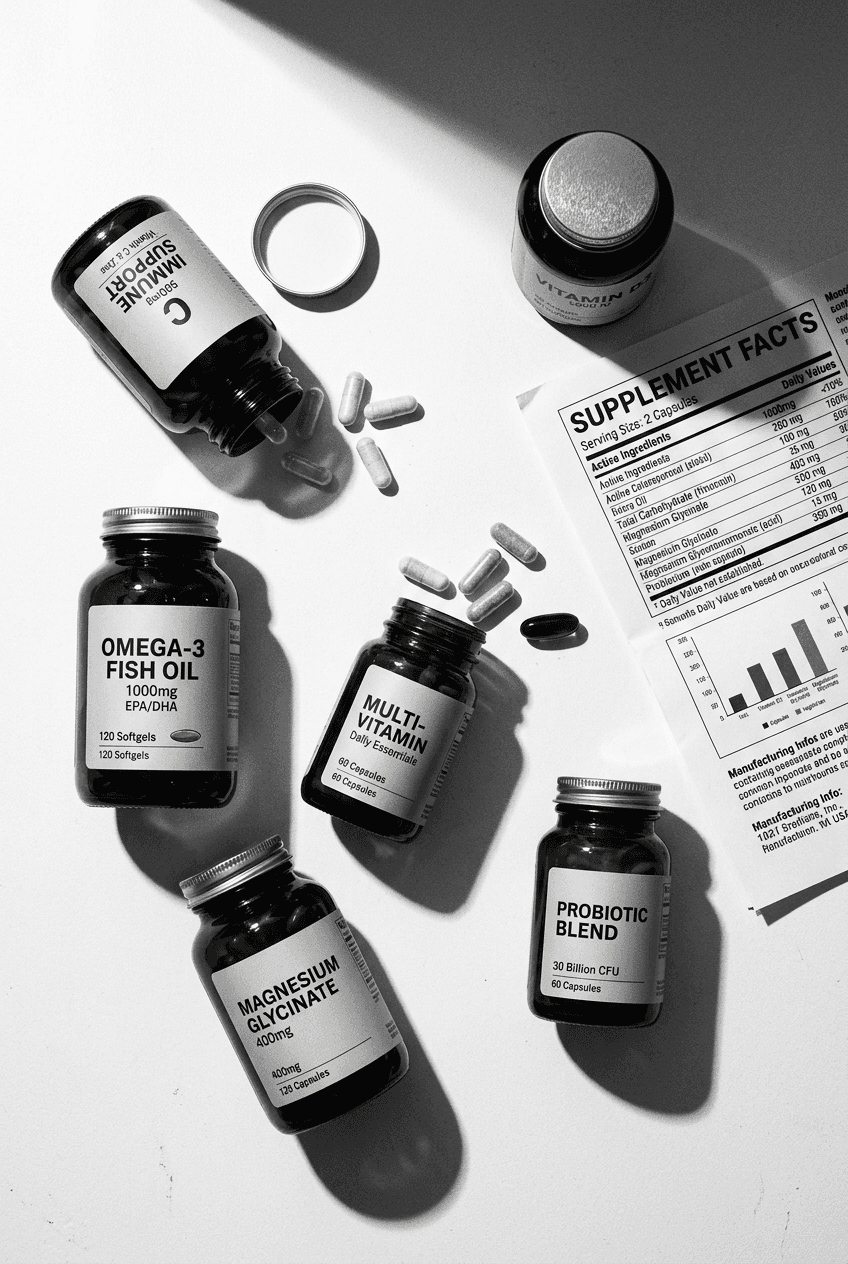
Statement of identity. The label must identify the product as a dietary supplement. "Dietary Supplement" must appear on the principal display panel (PDP). Net quantity of contents. Stated in appropriate units (capsules, tablets, ml, grams, etc.) on the PDP. Supplement Facts panel. This is the most design-intensive compliance requirement. The Supplement Facts panel format is specified by FDA regulation, including the panel heading, serving size declaration, servings per container, list of dietary ingredients with amounts per serving, and percent daily value where established. The format is prescribed: specific typefaces (Helvetica or similar sans-serif), specific minimum sizes, specific line weights for the ruling lines, specific placement hierarchy. Brands cannot deviate from the regulated format without risking regulatory action. Other ingredient statement. Ingredients not listed in the Supplement Facts panel (excipients, fillers, coatings, flavorings) must be listed separately below the Supplement Facts panel in descending order. Name and place of business. The manufacturer, packer, or distributor's name and domestic address. Directions for use. How to use the product, how many to take, how often. Warnings (where required). Any required cautionary statements must appear prominently. For certain ingredients and categories, FDA specifies exact warning language.
According to a 2023 FDA compliance survey, Supplement Facts panel formatting errors were cited in 34% of all supplement labeling warning letters reviewed. The panel format regulations are detailed, and small deviations -- wrong type size, incorrect ruling line weight, missing daily value notation -- create compliance exposure.
Structure/Function Claims: The Most Commercially Valuable and Legally Sensitive Label Element
Structure/function claims are the statements on supplement labels that link the product to a physiological function or describe a nutritional deficiency benefit. They are the most commercially powerful part of a supplement label, and they are subject to specific FDA and FTC requirements that many brands do not fully understand.
Under DSHEA, structure/function claims must: be truthful and not misleading, be substantiated by competent and reliable scientific evidence, be notified to FDA within 30 days of first marketing, and carry the required disclaimer: "This statement has not been evaluated by the Food and Drug Administration. This product is not intended to diagnose, treat, cure, or prevent any disease."
What this means in practice for label design:
The disclaimer must appear on the label in at least 1/16 inch type, in a box with a hairline border, adjacent to every structure/function claim. The disclaimer cannot be separated from the claim by other content. It must be present every time a structure/function claim appears. This is a design constraint: brands that want to make a claim on both the front panel and the back panel need two separate disclaimer placements.
Claims that go too far become disease claims, which reclassify the product as a drug. The line between a compliant structure/function claim ("supports healthy immune response") and a disease claim ("treats respiratory infections") can be subtle. FTC guidelines on supplement advertising, which apply to claims on the label as well as in marketing, require substantiation at the "competent and reliable scientific evidence" standard. For claims without robust clinical backing, the regulatory exposure is significant.
Designing the Supplement Facts Panel Within Brand Identity
The Supplement Facts panel format is regulated, but within the regulation there is more design latitude than most brands use.
The regulation specifies Helvetica (or a comparable font) for the panel. Within the Helvetica family, brands can use bold, regular, and italic variations to create a slightly differentiated typographic feel while remaining compliant. The panel background color can be varied as long as contrast requirements are met. The ruling lines can be hairline or up to 1.5 points as appropriate. Brands that understand these constraints can create a Supplement Facts panel that feels more premium and brand-aligned than the generic version that many supplement label designers default to.
What cannot be changed: the heading "Supplement Facts" in its specified size and weight, the serving size line immediately below, the servings per container line, the column structure for amounts and % DV, and the other ingredients list format below the panel.
For premium supplement brands, the goal is typically to make the Supplement Facts panel feel like part of the label design, not a legal insert. This is achievable through careful color selection, refined ruling line weights, and precise typographic execution within the regulated constraints.
The Front Label Hierarchy That Converts Supplement Buyers
The supplement purchase decision involves more cognitive engagement than most cosmetics purchases. Supplement buyers are often researching a specific benefit or ingredient, and they are evaluating trust signals as part of the decision. The front label hierarchy that performs in this context:
Brand mark at the top. Trust is the primary purchase driver in supplements, and brand recognition is the primary trust proxy for repeat buyers and the aspirational standard for first-time buyers. The brand mark must be prominent and clearly positioned. Product category identifier. "Magnesium Glycinate," "Vitamin D3 + K2," "Omega-3 Fish Oil" -- the specific identity of this product, in type large enough to read at shelf or in a product listing thumbnail. Not a marketing name that obscures what the product actually is. Supplement buyers are sophisticated. They know what they are looking for. Strength or dosage statement. "500mg," "2000 IU," "1000mg EPA/DHA" -- for ingredient-literate supplement buyers (the majority in the premium segment), this number is part of the purchase decision. It signals whether the product is formulated to therapeutic ranges or at token doses. This element belongs on the front panel. Key differentiating claim. One structure/function claim that communicates the primary benefit, with the required disclaimer adjacently placed. Not five claims. One clear, substantiated claim. Form and serving information. Capsule count, days of supply, format (capsules, softgels, powder) -- enough for the buyer to understand what they are getting without reading the Supplement Facts panel. Certifications. Third-party testing certifications (NSF International, USP, Informed Sport) are particularly powerful trust signals in supplements. A 2024 ConsumerLab survey found that 67% of regular supplement buyers consider third-party testing certification "very important" to their purchase decision. These certifications belong prominently on the front panel.
Supplement Label Design for Amazon vs. Retail vs. DTC
The channel context for supplement label design creates genuinely different requirements.
Amazon supplement listings. The primary container label is photographed and used as the product listing hero image. At the thumbnail scale of an Amazon search result (roughly 200px wide), the brand name, product name, and key dosage figure must all be legible. Most supplement labels are not designed with this constraint explicitly in mind, and many fail at thumbnail scale. Testing every label at 200px width before finalizing should be non-negotiable.
Amazon also has specific main image requirements: white background, product occupying at least 85% of the image frame, no text overlays on the main image. The label itself must communicate everything, because no claim copy can be placed on the main image outside the label boundary.
Retail supplement shelves. The competitive context on a health food or pharmacy shelf is dense. Supplement sections are among the most visually complex retail environments, with hundreds of products competing for attention. Labels that use strong color contrast, bold typography, and clear category identifiers perform significantly better at shelf than those designed with a minimal, editorial aesthetic. DTC supplement brands. Direct-to-consumer supplement brands have more latitude to design for a specific aesthetic because the label is viewed in context of brand communication (website, social, packaging inserts) that can do more of the education work. DTC supplement labels can afford to be more refined, more editorial, and more premium in aesthetic because the buyer arrives with more brand context.
Common Supplement Label Design Mistakes That Retailers Flag
Supplement Facts panel formatting errors. Non-compliant panel formatting is the most common retailer rejection trigger. Major supplement retailers (including Whole Foods, Sprouts, and Natural Grocers) have ingredient and label compliance review processes that flag Supplement Facts formatting deviations. The compliance review adds weeks to the onboarding process if a label reprint is required. Missing or misplaced disclaimers. The structure/function claim disclaimer must accompany every claim, on every panel where a claim appears. Brands that include the disclaimer once on the back panel but make claims on the front panel without a disclaimer have a compliant label in one place and a non-compliant label in another. Over-claiming without substantiation. "Clinically proven," "doctor-formulated," "pharmaceutical grade" are claims with specific standards attached. "Clinically proven" requires actual clinical trial evidence. "Doctor-formulated" means a specific formulation contribution by an identified physician. These claims receive FTC scrutiny and have been the subject of numerous enforcement actions and consent decrees. Serving size discrepancy with Supplement Facts. If the label says "take 2 capsules daily" in the directions but the Supplement Facts panel is based on a 1-capsule serving, the label presents conflicting information that creates both compliance and consumer confusion issues.
A 2023 Natural Products Insider industry report found that 58% of supplement brands launching retail distribution had to revise at least one label element before retailer acceptance, with Supplement Facts formatting and claims compliance being the top two categories of revision.
FAQ: Vitamin and Supplement Label Design
What is a Supplement Facts panel?
The Supplement Facts panel is the FDA-regulated nutrition label format for dietary supplements, analogous to the Nutrition Facts panel on food products. It must list serving size, servings per container, and all dietary ingredients with their amounts per serving and percent daily value where established. The format, typography, and layout of the panel are specified by FDA regulation.
Can I design my own Supplement Facts panel layout?
The core format of the Supplement Facts panel is regulated and cannot be changed without compliance risk. The heading, serving size hierarchy, column structure, and ruling line requirements are all specified. Within those constraints, small design adaptations are possible (compliant typeface variants, ruling line weight within specifications), but the structure itself is fixed.
What is a structure/function claim?
A structure/function claim is a statement linking a dietary ingredient to a role in the body's structure or function (for example, "calcium supports bone health" or "vitamin C supports immune function"). These claims are permissible under DSHEA but must be notified to FDA, substantiated by scientific evidence, and accompanied by the specific disclaimer: "This statement has not been evaluated by the Food and Drug Administration. This product is not intended to diagnose, treat, cure, or prevent any disease."
What is the difference between a structure/function claim and a disease claim?
A disease claim implies the product can diagnose, cure, treat, or prevent a specific disease. This reclassifies the product as a drug, triggering full drug approval requirements. "Supports heart health" is a structure/function claim. "Reduces risk of heart disease" is a disease claim. "Supports healthy blood pressure already within normal range" is permissible. "Lowers blood pressure" is a disease claim.
Do I need a third-party certification on my supplement label?
Third-party certification is not legally required but is increasingly commercially necessary. Major retailers including Whole Foods require NSF certification or equivalent for certain supplement categories. Amazon has expanded its requirements for third-party testing documentation. And consumer research consistently shows that third-party testing certification is one of the strongest purchase drivers for supplement buyers.
How do I list proprietary blends on a supplement label?
Proprietary blends must be listed in the Supplement Facts panel with the total quantity of the blend declared. Individual ingredient amounts within the blend do not need to be disclosed (this is the protection the "proprietary" designation provides), but they must be listed in descending order of predominance within the blend. The blend must be named.
I'm Tambi Haşpak, a brand strategist and creative director with an unfair advantage: I'm a pharmacist. I run a creative studio for cosmetics, supplements and beyond. 17 years. Exclusively. If your supplement label has compliance exposure, conversion problems, or both, let's talk before it costs you. Book a call or email me.