
Your cosmetic label must pass a legal audit and close a sale. Most brands only design for one of those two jobs.
What FDA Requires on a Cosmetic Label (And What It Actually Means for Design)
A compliant cosmetic label for the US market must include the identity of the product, the net quantity of contents, the name and address of the responsible company, and a full ingredient declaration in INCI (International Nomenclature of Cosmetic Ingredients) order by predominance. The Modernization of Cosmetics Regulation Act of 2022 (MoCRA) added new requirements that came into effect in December 2023, including facility registration and product listing for products sold in the US, as well as expanded safety substantiation requirements.
For label design specifically, the compliance implications are:
The principal display panel (PDP) must declare the identity of the cosmetic and the net quantity, in a type size and placement that makes both legible without magnification. The FDA specifies a minimum type size for the net quantity declaration based on the principal display panel area -- for panels under 5 square inches, the minimum is 1/16 inch. For labels between 5 and 25 square inches, it is 1/8 inch.
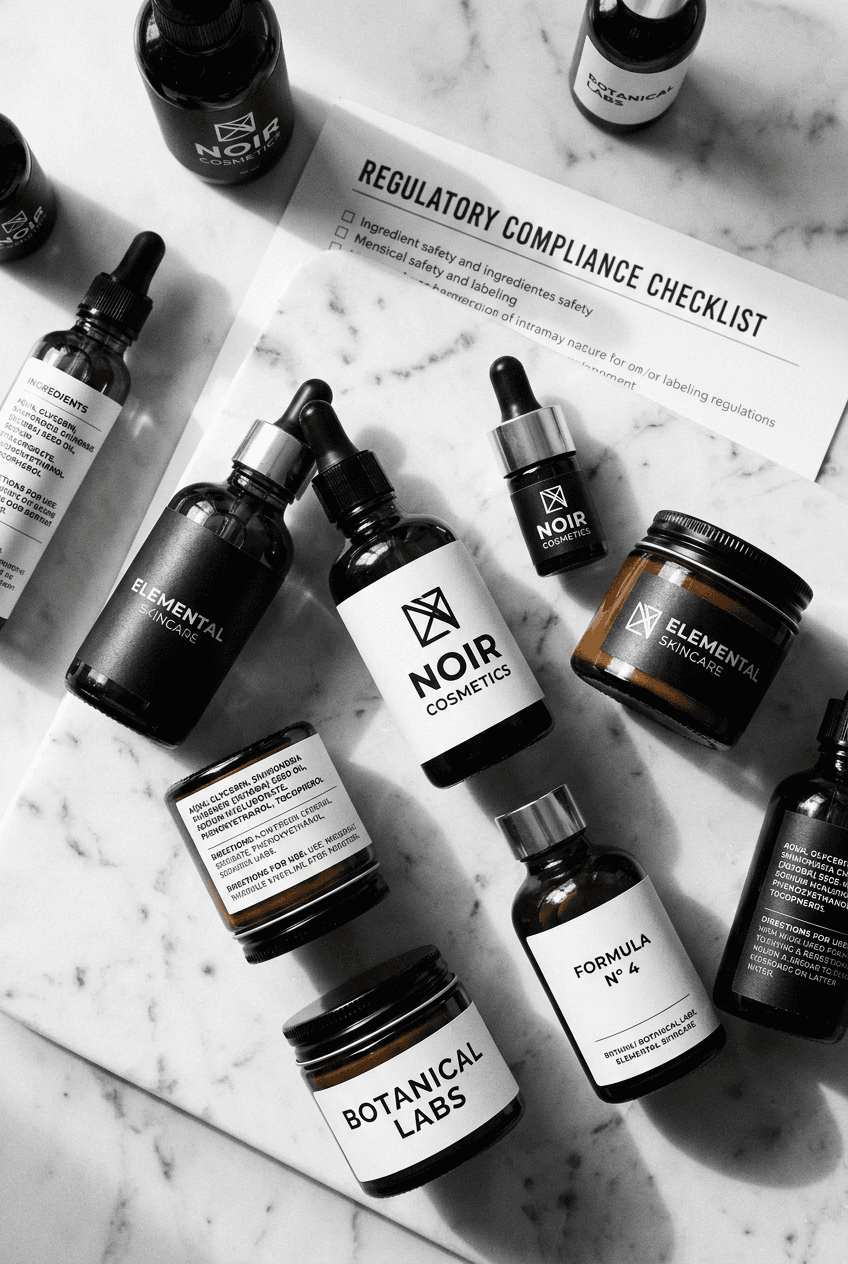
The ingredient declaration must appear on an information panel (usually the back or side label), in INCI nomenclature, in descending order of predominance. For ingredients below 1% concentration, order may be arbitrary after all ingredients above 1% are listed. Type size minimum is 1/16 inch. Color additives must be listed separately using their FDA-approved names (not INCI names).
Required allergen declarations under MoCRA (for fragrances and certain preservatives) add to the information panel requirements. For brands exporting to the EU, additional requirements apply including responsible person identification and the full 26 EU fragrance allergens if any are present above threshold concentrations.
All of this compliance content must fit on the label. The design challenge is making it fit without destroying the brand experience.
Where Cosmetic Label Compliance and Brand Design Conflict (And How to Resolve It)
The tension between compliance and brand design is real. Here is where it manifests most often and how I resolve it with clients.
The ingredient list area. An ingredient list for a 15-ingredient formula at minimum legal type size takes significant panel space. On a small product (30ml serum bottle), this can consume the entire back label. Brands frequently respond by shrinking the type below legal minimums, abbreviating INCI names incorrectly, or burying the list under other marketing content. All of these are compliance violations. The correct resolution is to design the label knowing the ingredient count before the visual direction is set, so that panel space allocation reflects the actual content requirement. The net quantity placement. Net quantity must appear in the bottom 30% of the PDP, parallel to the base of the package. This is a hard requirement. Brands that design the PDP with a full-panel image and add the net quantity as an afterthought often create placement issues. The solution is to design the PDP with the net quantity placement as a fixed constraint from the start, not an afterthought. Required font sizes vs. desired minimal aesthetics. Minimalist label design often involves very small type as an aesthetic choice. When that small type is carrying required compliance information, it creates a legal exposure. The practical resolution is to use minimum required sizes for all compliance text and reserve the aesthetic minimalism for brand name and decorative elements. A label with compliant information panel type but refined PDP design reads as premium and compliant.
According to a 2023 report by the Personal Care Products Council, 42% of cosmetic brand founders reported receiving at least one retailer compliance request related to labeling within their first two years of retail distribution. Getting compliance right at the label design stage eliminates this risk entirely.
Strategic Design Hierarchy for a Cosmetic Label PDP
The principal display panel is the label's commercial core. Every buyer who evaluates your product on a shelf or in an online thumbnail will see the PDP and make a snap judgment. The hierarchy that consistently performs:
Brand mark, dominant and placed for recognition. This is the first element, and it carries the identity load. In a category where repeat purchase is the business model, brand mark recognition is the primary commercial asset on the label. It should be the most visually prominent element, either through size, color contrast, or position. Product name, clear and specific. Not a tagline. Not an aspiration. The product name that tells the buyer what this specific product is within the brand range. "Hydrating Serum" not "Radiance Reviving Youth-Optimizing Elixir." Buyers make faster decisions on labels with clear, specific product names. Key benefit or hero ingredient, secondary prominence. One statement. The one claim that would make this particular buyer most likely to pick this product up. Not five claims. Not a claims matrix. One focused benefit that speaks directly to the use case or ingredient truth of this formula. Net quantity, compliant placement. Bottom 30% of PDP, correct type size. Part of the design, not an afterthought. Supporting credentials, tertiary. Cruelty-free, dermatologist tested, SPF rating, vegan certification -- these belong on the label but below the primary hierarchy. They are validation, not the headline.
What does not belong on the PDP: the full ingredient list, directions for use, full brand story, safety warnings (unless SPF or OTC drug claims are present). These elements belong on the information panel and should be designed to be clear and legible without dominating the brand face.
Cosmetic Label Design for Different Product Formats
The format of the primary container creates different label design constraints, and solutions that work on a standard 30ml bottle will not work without adaptation on a jar, a tube, or a compact.
Bottle labels (cylindrical). The wrap-around or panel label on a bottle offers distinct front and back real estate. Front carries the PDP. Back and one side panel carry the information panel content. Tall, narrow bottles (serum formats) have a large front panel relative to their surface area, giving more PDP design space. Short, wide bottles present a proportionally smaller front panel. Jar labels. The top of a jar is often used as a secondary branding surface, particularly in luxury skincare where the lid is part of the tactile experience. The wrap-around side label carries the PDP and information panel content. For small jars (under 50ml), the type size minimums become challenging -- this is where a label redesign often requires moving to a folded leaflet or booklet label to accommodate all required content. Tube labels. Tubes offer a long, narrow label canvas. The PDP is typically the front-facing panel, and the information content runs along the back or the two long sides. The tip and base of the tube are often used for ingredient list continuation or for certifications. Flexible and sachet packaging. Single-use and sample sachets present the most constrained label design challenge. FDA requires the full ingredient list even on samples. The practical solution for very small sachets is the booklet label or, for very small formats, a "see website" or QR code reference combined with the minimum required physical content.
The Most Expensive Cosmetic Labeling Mistakes
The label mistakes that cost brands most in terms of regulatory exposure, retailer rejection, and market delays:
Making drug claims on a cosmetic. The FDA distinction between a cosmetic and a drug is based on the intended use claim made on the label and in associated marketing. Claims like "reduces fine lines" or "moisturizes" are cosmetic claims. Claims like "stimulates collagen production," "treats hyperpigmentation," or "reduces acne" are drug claims that trigger OTC drug regulations, which are significantly more stringent. Brands that put drug claims on cosmetic labels face warning letters, mandatory recalls, and potential enforcement actions. A 2024 FDA enforcement report identified cosmetic/drug boundary labeling violations as one of the top three categories of warning letter actions issued to beauty and personal care brands. Incorrect INCI nomenclature. Using common ingredient names instead of INCI names, or using INCI names incorrectly, is a compliance violation that routinely causes retail rejection. Whole Foods, Target, and other retailers with ingredient screening programs use INCI compliance as a gate. A formulation with a perfectly compliant ingredient list presented in incorrect nomenclature fails these screens. Omitting fragrance allergen disclosures. Brands selling in both the US and EU must navigate two different allergen disclosure frameworks. Designing a single global label that complies with both is possible but requires deliberate planning from the outset. Under-declaring net quantity. Underfilling by more than the permitted tolerance AND labeling the declared net quantity accurately is a compliance issue. Mislabeling net quantity intentionally is a more serious one. Net quantity must reflect what is actually in the container within FDA-permitted tolerances.
How to Brief a Label Designer for Cosmetic Compliance
A label designer who understands cosmetic regulatory requirements is not the same as a general graphic designer. When briefing any label designer for cosmetic work:
Provide the complete INCI ingredient list with quantities noted, so the designer can correctly plan the information panel space allocation. Provide the exact net quantity declaration including the unit format you intend to use (fl. oz + mL for US market). Specify the primary container dimensions and material (because this determines whether pressure-sensitive labels, heat-shrink sleeves, or direct printing is the appropriate method).
Clarify all claims that will appear anywhere on the label, and confirm with a regulatory consultant that those claims are appropriate for the cosmetic classification. Confirm the markets the product will be sold in from launch, because EU, Canada, and Australia each have additional labeling requirements beyond FDA minimums.
Give the designer the competitive set context: which brands in the same category have labeling you admire (for inspiration) and which you want to differentiate from. Label design without competitive context produces generic solutions.
According to the Consumer Brands Association, the average time from product formulation completion to retail launch for a new cosmetics brand is 14-18 months, with regulatory and labeling delays accounting for 4-6 weeks of that timeline. Addressing compliance at the brief stage eliminates most of that delay.
FAQ: Cosmetic Label Design
What must be on a cosmetic label for the US market?
A US cosmetic label must include: the product identity (what it is), net quantity of contents, name and place of business of the responsible company, and a full ingredient declaration in INCI order on the information panel. MoCRA (2022) added facility registration and product listing requirements, but these do not change the physical label content requirements directly.
What is the difference between a cosmetic claim and a drug claim on a label?
A cosmetic claim describes how a product affects appearance or skin condition through external action (moisturizes, cleanses, conditions, colors). A drug claim describes physiological action (stimulates collagen synthesis, treats acne, reduces inflammation). Labels with drug claims trigger OTC drug regulations. The line is not always obvious, and a regulatory review of label copy before production is strongly recommended.
Does INCI order matter on a cosmetic ingredient list?
Yes. Ingredients must be listed in descending order of predominance by weight for all ingredients above 1% concentration. Below 1%, order may be arbitrary, but the switch to arbitrary order cannot be noted on the label in a way that implies a specific threshold without supporting data. Using incorrect INCI names or incorrect order is a compliance violation.
Can I use a QR code to replace required label information?
Not for FDA-required information in the US market. A QR code may supplement the label with additional information, but it cannot replace the physical declarations of product identity, net quantity, responsible company, and ingredient list. All mandatory information must appear in physical text on the label itself.
How small can ingredient list type be on a cosmetic label?
FDA requires a minimum type size of 1/16 inch for the ingredient declaration on labels with a principal display panel area of 5 square inches or less. For larger labels, the minimum is 1/8 inch. These are physical minimums -- designing at minimum size for readability reasons is advisable even when not strictly required.
What happens if I use drug claims on a cosmetic label?
The FDA may issue a warning letter requiring reformulation of label claims. In more serious cases, the agency may request or order a recall. Retailers may reject the product from distribution. The costs of a label reprint plus repackaging plus potential product hold can easily run $20,000-100,000 for a brand with modest production volumes. Compliance review before label production is far less expensive.
Do cosmetic labels need to be approved by FDA before launch?
No. The US cosmetic regulatory system is self-certification. Brands are responsible for ensuring their own compliance. FDA does not pre-approve cosmetic labels. However, MoCRA now requires product listing with FDA after launch, and FDA can take enforcement action against non-compliant labels at any point.
I'm Tambi Haspak, a brand strategist and creative director with an unfair advantage: I'm a pharmacist. I run a creative studio for cosmetics, supplements and beyond. 17 years. Exclusively. If your cosmetic label is not compliant, not converting, or both, I can help you fix it before it costs you a retailer relationship or an FDA letter. Book a call or email me.