
Gummies are the most appealing format in supplements and the most dangerous one to brand badly, because the packaging must signal credibility in a format that consumers associate with candy.
Why Gummy Supplement Branding Is a Different Problem
Supplement gummies present a specific branding challenge that does not apply to capsules, tablets, or powders. The delivery format is inherently associated with confectionery. The visual language that the category naturally gravitates toward (bright colors, playful typography, cartoon shapes, fruity imagery) signals food and candy, not health and efficacy.
This is not a minor tension. It is the central brand positioning problem of the gummy supplement format. A brand that leans too far into the candy aesthetic loses credibility with the consumer who is evaluating clinical efficacy. A brand that ignores the format's inherent appeal and positions it like a capsule supplement misses the primary consumer motivation for choosing gummies in the first place, which is palatability and the reduction of supplement aversion.
The global gummy supplement market was valued at $8.3 billion in 2023 and is projected to grow at 12.5% annually through 2030, according to Grand View Research. That growth rate has produced a market that is saturated with me-too brands that have resolved the candy-vs-credibility tension by defaulting to whichever end of the spectrum their designer preferred.
I am a pharmacist and creative director. I have worked on supplement brand identities in formats ranging from practitioner-grade capsule lines to mass-market gummy vitamins. The gummy brands that succeed at building durable consumer trust are the ones that resolve the candy-vs-credibility tension through brand strategy, not through aesthetic compromise.
Gummy Supplement Branding vs. Capsule Supplement Branding
The format choice shapes every subsequent brand decision.
Dimension | Gummy Supplement Brand | Capsule / Tablet Supplement Brand |
|---|---|---|
Primary consumer motivation | Palatability, habit-building, reduced supplement aversion | Efficacy-first, compliance-focused, clinical trust |
Price sensitivity | Higher: consumer compares to candy-adjacent products | Lower: consumer accepts premium for clinical credibility |
Compliance challenge | Consumer must believe format delivers clinical dosage | Consumer evaluates dosage on label; format is neutral |
Visual register | Must balance palatability cues with credibility signals | Can lean fully into clinical, technical, or premium aesthetics |
Packaging format options | Stand-up pouch, jar, flow pack, individual sachet | Bottle, blister pack, sachet |
Regulatory complexity | Serving size, added sugars disclosure, candy-adjacent claims risk | Standard supplement label requirements |
Retail channel | Mass market, pharmacy, DTC, specialty food | All channels; clinical formats more prevalent in practitioner |
Shelf life sensitivity | Gummies are moisture-sensitive; packaging must protect | Capsules and tablets more shelf-stable in standard packaging |
These differences are not superficial. A gummy supplement brand designed with the same visual identity as a capsule supplement brand will look wrong on shelf. A gummy supplement brand designed with confectionery aesthetics will fail in pharmacy and clinical channels.
The Candy-vs-Credibility Problem in Gummy Branding
There are three ways to resolve the candy-vs-credibility tension in gummy supplement branding:
Strategy 1: Premium clinical positioning
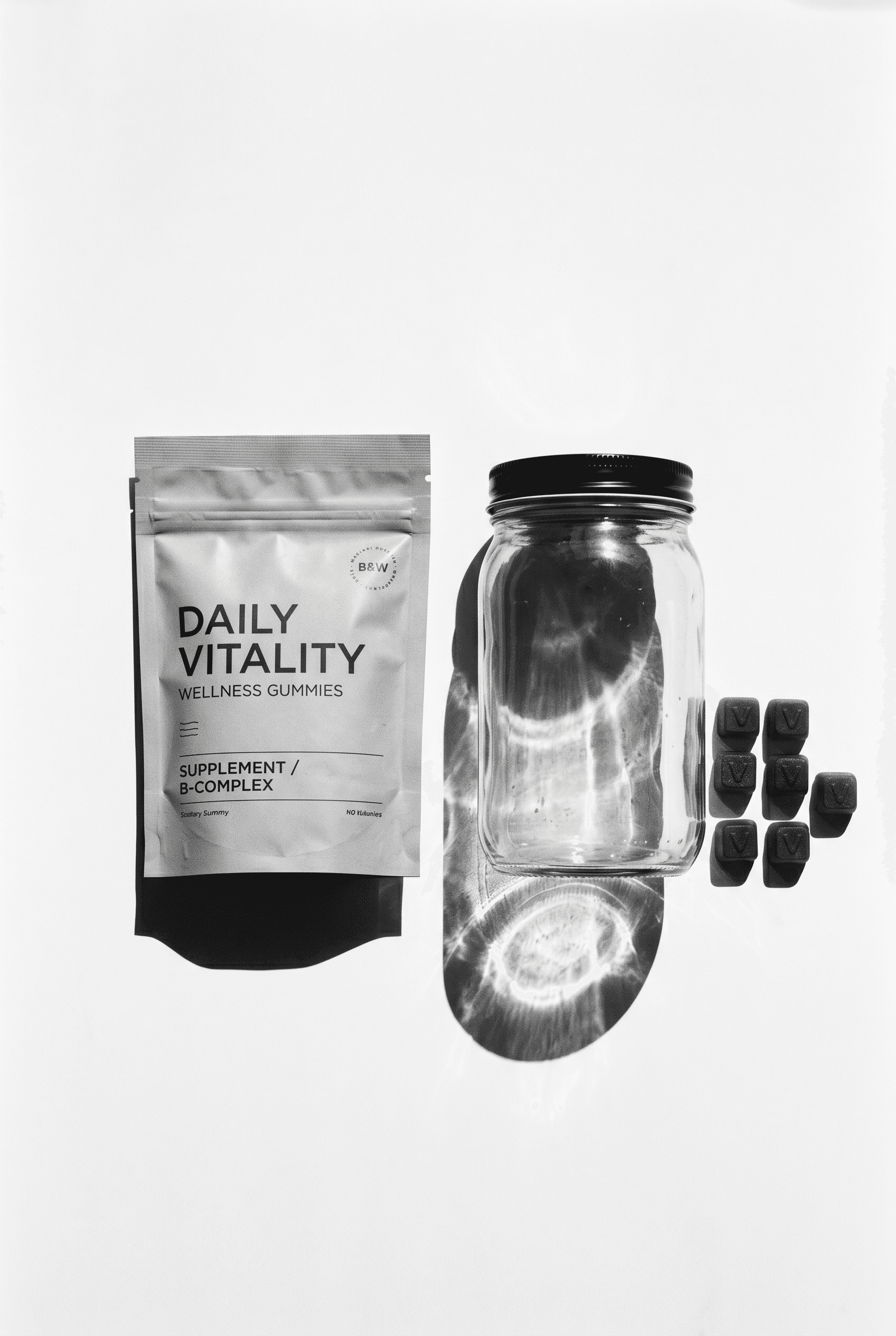
Position the gummy as a premium efficacy product that happens to be in gummy form. The visual identity is minimal and clinical. Typography is precise and information-dense. Color palette is restrained (white, off-white, neutral tones). The gummy format is presented as a delivery innovation rather than a confectionery choice. The primary communication is the active ingredient at a credible dose.
This works for: Health-literate consumers, pharmacy channel, premium DTC, practitioner recommendation.
Strategy 2: Joyful wellness positioning
Position the gummy as the supplement that makes health habits feel good. The visual identity is warm, inviting, and optimistic, but not childish. Typography is modern and accessible. Color palette uses natural fruit tones rather than candy primaries. The gummy's palatability is a feature, not a liability. The primary communication is the health benefit and the daily ritual.
This works for: Mass market DTC, mainstream retail, new-to-supplement consumers, subscription models.
Strategy 3: Functional food crossover positioning
Position the gummy at the intersection of food and supplement: a product that belongs in the kitchen, not the medicine cabinet. The visual identity borrows from premium food branding: natural photography, ingredient-forward communication, clean label aesthetics. The Supplement Facts panel is present and compliant but does not dominate the packaging.
This works for: Natural food retailers, food-adjacent distribution, consumers who reject "supplement" as a category identity.
For a guide to the brand positioning frameworks that underpin these strategic choices, see my guide to food supplement branding.
Gummy Supplement Packaging: Format and Compliance Requirements
Gummy supplements have specific packaging requirements that differ from capsule and tablet formats.
Packaging format selection
The most common gummy supplement packaging formats are stand-up pouches (mylar or kraft-laminate), wide-mouth glass or PET jars, and flow-pack individual serving sachets. The choice has compliance, shelf life, and cost implications.
Stand-up pouches are cost-effective and photograph well for DTC and e-commerce. They are less durable than rigid packaging for physical retail environments. Mylar pouches provide an oxygen and moisture barrier that protects gummy quality. Kraft-laminate pouches signal a clean-label, natural positioning.
Glass jars signal premium positioning and are preferred for clinical and pharmacy-channel brands. They add weight and fragility cost but significantly elevate perceived value. PET jars are a cost compromise that works well for mass-market positioning.
Serving size and added sugar compliance
Gummy supplements must include a Supplement Facts panel with serving size stated in count (number of gummies). Unlike capsule supplements, gummies contain added sugars (from the gelling and sweetening agents), which must be disclosed in the Supplement Facts panel under the 2016 FDA Nutrition Label rules, even when the product is classified as a dietary supplement rather than a food.
This is a frequent compliance error. Gummy supplement brands that classify as dietary supplements but contain added sugars must disclose those sugars. Failure to do so is a labeling violation.
Child safety
Gummy supplements present a child safety risk because the format is indistinguishable from candy to young children. The FDA does not require child-resistant packaging for dietary supplements as a category, but gummy supplements with high-dose iron, fat-soluble vitamins (A, D, E, K), or other potentially toxic-in-excess nutrients should be in child-resistant packaging, and this should be disclosed on the label.
For a complete guide to supplement packaging compliance across all formats and markets, see my guide to supplement packaging compliance.
What Gummy Supplement Brands Get Wrong About Dosing Communication
Dosing communication is the most significant credibility challenge in gummy supplement branding. The problem is inherent to the format: gummies are perceived as candy, which means consumers have lower expectations for their active content than they do for capsules or tablets. At the same time, the clinical efficacy of a gummy supplement depends entirely on the active ingredient being present at a relevant dose.
Many gummy supplement brands choose servings of one or two gummies because it matches confectionery conventions and because higher serving sizes are commercially inconvenient. But if the active content per serving does not reach clinical relevance, the brand is selling a candy with a supplement label.
The pharmacist perspective on this is direct: a two-gummy serving of vitamin D at 1,000 IU is clinically meaningful. A two-gummy serving of a "stress support blend" containing 10mg of ashwagandha is not, given that published efficacy studies for ashwagandha use doses of 300 to 600mg per day.
Brands that disclose the active content of each ingredient at a specific mg per serving, and that use doses consistent with published evidence, communicate clinical credibility that persuades the health-literate consumer. Brands that use proprietary blends or undisclosed doses in gummy format cannot compete on efficacy.
For a detailed guide to how supplement claims on packaging interact with dosing communication, see my guide to supplement claims on packaging. For guidance on packaging designed for the Amazon channel where gummies compete on product listing images, see my guide to supplement packaging for Amazon and DTC.
Building a Gummy Supplement Brand Identity
The visual identity of a gummy supplement brand must navigate the candy-vs-credibility tension at every touchpoint. The brand elements that require specific attention:
Color palette
Avoid primary candy colors (Crayola red, bright yellow, cobalt blue) unless the brand is targeting a children's or low-price mass market segment. Premium gummy supplement brands use color palettes derived from natural fruit tones, mineral colors, or neutral wellness palettes that are warm and approachable without being candy-adjacent.
Typography
Playful rounded typefaces reinforce the candy association. Overly clinical sans-serifs feel incongruent with the gummy format's inherent warmth. The strongest gummy supplement typography uses modern humanist typefaces that are readable, contemporary, and positioned between clinical severity and confectionery casualness.
Photography and imagery
The most effective gummy supplement packaging photography uses actual gummies (not cartoon representations) in natural lighting with food-quality production. Showing the actual gummy color and form builds consumer trust. Cartoon gummies signal mass-market commodity positioning.
Active ingredient communication
The active ingredient name and dose should be among the most prominent elements on the primary display panel of a gummy supplement. This is a departure from confectionery packaging conventions, where ingredient communication is hidden. It is the primary signal that this product is a supplement, not a candy.
For a complete guide to the supplement brand identity system that encompasses all format-specific decisions, see my guide to supplement brand identity.
FAQ: Supplement Gummies Branding
What makes gummy supplement branding different from other supplement formats?
Gummies present a unique tension between palatability (the primary consumer motivation for choosing the format) and clinical credibility (required for supplement efficacy perception). The packaging must signal health authority while being visually approachable. This tension requires a deliberate brand positioning strategy, not just aesthetic choices.
Do gummy supplements need child-resistant packaging?
The FDA does not mandate child-resistant packaging for dietary supplements as a category, but gummies containing potentially toxic-in-excess nutrients (iron, vitamin D, fat-soluble vitamins at high doses) should be in child-resistant packaging as a matter of consumer safety and liability management. State regulations may impose additional requirements.
How do I communicate dosing credibility on gummy supplement packaging?
Disclose the specific amount of each active ingredient in milligrams per serving in the Supplement Facts panel. Ensure the dose is consistent with published clinical evidence for the health benefit being claimed. Avoid proprietary blends that do not disclose individual ingredient amounts. Use the primary display panel to highlight the key active and its dose.
What packaging format is best for gummy supplements?
Stand-up pouches are the most cost-effective for DTC and e-commerce. Glass jars command the highest perceived value for premium retail and pharmacy. Wide-mouth PET jars are a cost compromise for mass-market retail. The choice should be driven by the channel strategy and the brand's positioning, not solely by unit cost.
How do added sugars affect gummy supplement labeling?
Gummy supplements that contain added sugars must disclose them in the Supplement Facts panel, even when the product is classified as a dietary supplement rather than a food. This is a common compliance error. The serving size must also account for the added sugar content in the context of the full Supplement Facts declaration.
Can I position a gummy supplement as clinical-grade?
Yes. Clinical positioning for a gummy supplement requires active ingredients at doses consistent with clinical evidence, disclosure of those doses on the label, third-party testing verification, and a visual identity that signals scientific credibility without relying on candy aesthetics. Several premium gummy supplement brands have successfully built clinical positioning in categories including omega-3, vitamin D, magnesium, and cognitive support.
I'm Tambi Haşpak, a brand strategist and creative director with an unfair advantage: I'm a pharmacist. I run a creative studio for life sciences, cosmetics, and supplements. 17 years. Exclusively. The gummy supplement brands I build are positioned for the health-literate consumer who reads the Supplement Facts panel before opening the bag. Book a call or send me an email.