
A nutraceutical brand name that describes the ingredient or the benefit will not survive trademark clearance and will disappear in a market where every competitor uses the same vocabulary.
What Makes Nutraceutical Brand Naming Different
Nutraceutical is not a regulatory category. The FDA recognizes foods, dietary supplements, and drugs. "Nutraceutical" is a commercial and marketing term covering products positioned at the intersection of nutrition and pharmaceutical efficacy: functional foods, dietary supplements with clinical positioning, condition-specific nutrition, and high-science wellness products.
This category ambiguity creates a specific naming challenge. A nutraceutical brand name must communicate enough credibility to justify a premium price point and attract a health-literate consumer, while staying within the FTC guidelines that prohibit unsubstantiated health claims and the FDA label regulations that restrict disease claims on supplements and foods.
The naming vocabulary that nutraceutical founders instinctively reach for is almost entirely composed of words that are either too descriptive to trademark or too claim-laden to put on a label: "vitalize," "nourish," "restore," "repair," "heal," "cure," "thrive." These words feel right because they express the product's intended consumer benefit. They fail because they are descriptive of the product category, not distinctive of the brand.
The global nutraceutical market was valued at $468 billion in 2023, according to Fortune Business Insights. That scale means naming the brand into a crowded vocabulary is not just a trademark problem. It is a brand differentiation problem. This guide explains how to name a nutraceutical brand that is trademarkable, distinct, and built for the long term.
The Four Naming Traps in Nutraceutical Branding
Trap 1: Naming after the functional benefit
"CognitiveMax," "ImmuneBoost," "GutRestore," "JointRelief." These names describe the product's intended function, which makes them descriptive in trademark law and undifferentiated in the market. Every competitor in the cognitive support, immune health, gut health, or joint care category is using the same benefit vocabulary.
Trap 2: Naming after the hero ingredient
"OmegaPlus," "CollagenCore," "CurcuminGold," "AshwagandhaRX." Ingredient-anchored names have a short shelf life because ingredient trends change and because the name prevents the brand from extending into adjacent categories. They are also frequently rejected at trademark because ingredient names are descriptive of the product's composition.
Trap 3: Importing naming conventions from pharmaceutical branding
Nutraceutical founders with a pharmaceutical or clinical background often name products with INN-adjacent structures (short, two-syllable, Latinate or Greek-rooted words). These names convey credibility but are frequently already taken in the pharmaceutical trademark register (Class 5) or are phonetically similar to approved drug names, which can create conflict.
Trap 4: Using superlatives
"BestLife," "PureEssence," "TrueNature," "PrimeHealth." The FTC's guidance on deceptive advertising covers superlative claims, and the USPTO treats words like "pure," "best," "prime," and "true" as laudatory terms that add no distinctive value to a mark.
For a detailed guide to how naming applies specifically to supplement brands and the trademark clearance process, see my guide to food supplement branding.
Naming Strategies That Work in Nutraceuticals
Naming Strategy | Trademark Strength | Market Differentiation | Example Direction |
|---|---|---|---|
Invented word (fanciful) | Strongest | High (requires brand building) | Invented Latin or Greek root + modern suffix |
Real word, unrelated meaning (arbitrary) | Strong | High | Elemental, botanical, or abstract word unrelated to health |
Metaphor or concept name | Moderate-strong | High | Process, natural phenomenon, material property |
Founder-linked (with credential) | Moderate | Depends on founder profile | Surname + Studio / Lab / Science |
Number or compound naming | Moderate | Depends on execution | Formula numbering, product series naming |
Descriptive with acquired distinctiveness | Low baseline | Low | Requires years of commercial use to build distinctiveness |
The strongest nutraceutical brand names use the top three strategies. They create a distinctive brand vocabulary that is not shared with any competitor, that passes trademark clearance without conflict, and that can extend across a product range without contradiction.
The Nutraceutical Naming Process
1. Define the positioning platform first
A nutraceutical brand name must carry the brand's strategic positioning. If the positioning is not defined, the name cannot reflect it. The most common symptom of a positioning-free naming process is a name that describes the product category rather than the brand's specific point of view.
The positioning platform should define: what the brand believes about health, what category it is creating or claiming, who the specific customer is, and what the brand does differently from every other nutraceutical in the space. The name should be the condensed expression of this platform.
For a guide to building the brand strategy that must precede naming, see my guide to nutraceutical branding.
2. Audit the competitive naming landscape
Map the naming conventions of the top 50 to 100 nutraceutical brands in your target category. Identify the vocabulary clusters (benefit language, ingredient language, nature language, science language). Then deliberately name outside those clusters to create distinctiveness.
3. Generate a broad candidate list
Generate 40 to 80 candidate names across the strongest naming strategy categories: fanciful, arbitrary, and metaphorical. Avoid filtering the list too early. The names that survive preliminary filtering should be evaluated together, not in isolation.
4. Apply the five-filter evaluation
For each candidate name:
Can it be trademarked? (Preliminary TESS search)
Is the .com domain available or acquirable?
Can it be pronounced correctly by someone who has never seen it?
Does it extend across multiple product categories without contradiction?
Does it carry the positioning platform, even implicitly?
Names that fail any of these filters are removed. Names that pass all five proceed to attorney clearance.
5. Attorney clearance
A trademark attorney conducts a full clearance search for each finalist name. The clearance opinion evaluates phonetic equivalents, marks in related International Classes (primarily Class 5 and Class 29/30 for food-adjacent nutraceuticals), and design marks that incorporate the proposed name. Budget $500 to $1,500 per name for a full clearance opinion.
6. Final selection and application
Select the name with the strongest trademark clearance and the best alignment with the positioning platform. File the trademark application before any brand development investment (design, packaging, website).
For a complete guide to nutraceutical packaging and label design that follows naming, see my guide to nutraceutical packaging design.
What Nutraceutical Sub-Brands and Product Line Naming Require
Most nutraceutical brands eventually need a product line naming architecture. The brand name governs the company; product names govern individual SKUs. This architecture has specific requirements.
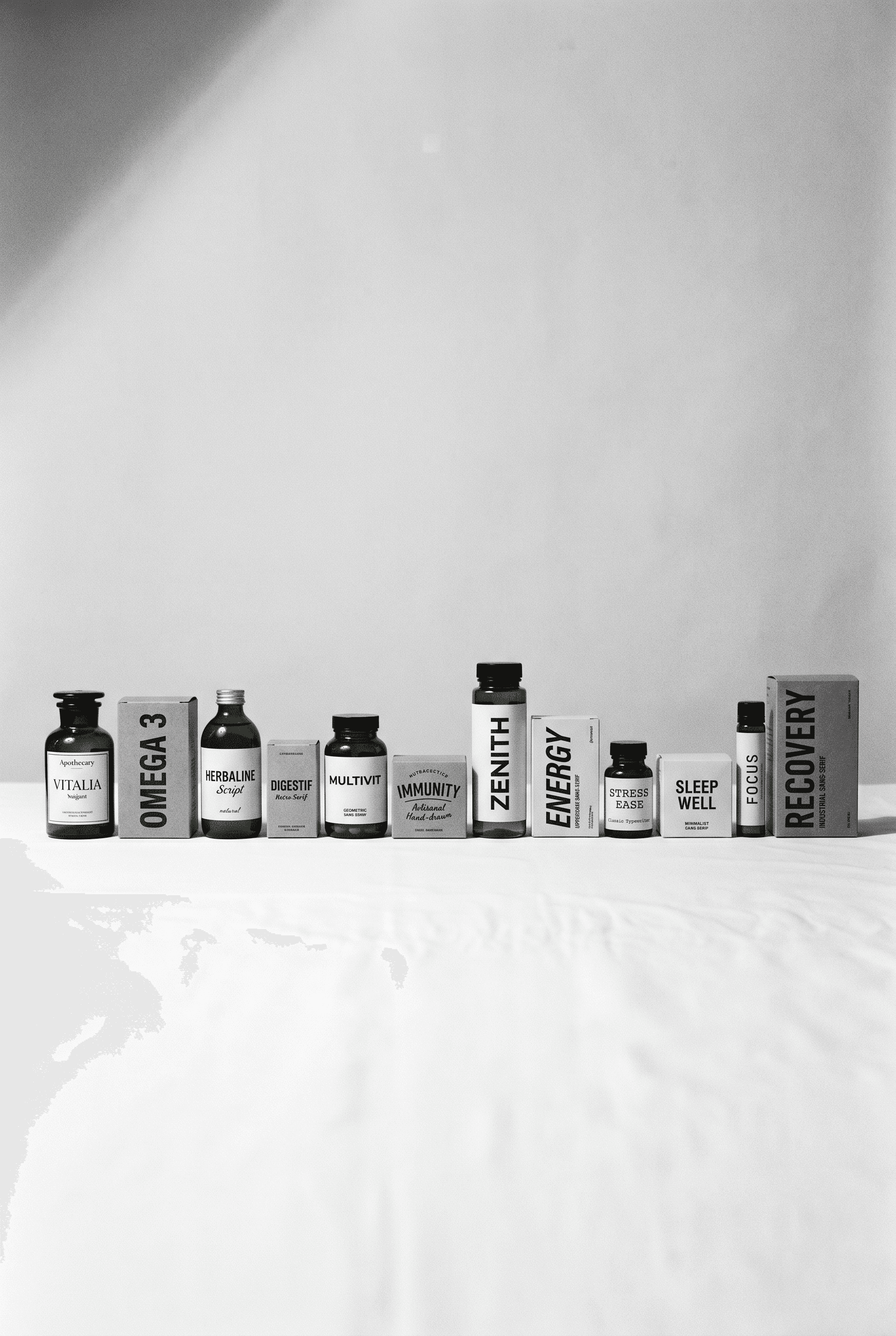
Master brand architecture: The brand name appears on all products, with product names serving as descriptive identifiers. Works for simple ranges where all products share the same quality and positioning. Easy to build and maintain. Endorsed brand architecture: The brand name appears on all products, but each product line has a distinct sub-brand name with its own positioning. Works for nutraceutical companies that serve different customer segments (sports performance, senior health, children's nutrition) that need different positioning signals. Hybrid architecture: Some products carry the brand name alone; others carry a sub-brand. Works for companies that have a hero product line and adjacent extensions that need distinct identities.
The architecture decision should be made at the naming stage, not retrofitted after the brand has already launched multiple SKUs with inconsistent naming conventions.
For a detailed guide to the brand identity system a nutraceutical brand name must fit within, see my guide to supplement brand identity. For a guide to building the complete visual system that follows naming, see my guide to supplement logo design.
FAQ: Nutraceutical Brand Naming
What makes a good nutraceutical brand name?
A good nutraceutical brand name is distinctive enough to be trademarked, different enough from the category vocabulary to be differentiated on shelf, extensible across a product range, easy to pronounce and spell in the primary market, and aligned with the brand's positioning platform. It should not describe the product's primary ingredient or benefit, because descriptive names are weak at trademark and undifferentiated in a saturated market.
Can I name my nutraceutical brand after a clinical term?
You can incorporate clinical or scientific language into a nutraceutical brand name, but clinical terms have two risks: they may already be registered as drug brand names in Class 5, and they may imply drug-like efficacy that creates regulatory risk for a supplement or food product. Names that are suggestive of clinical credibility without literal clinical terminology are generally safer.
How long should a nutraceutical brand name be?
One to three syllables is optimal for primary brand names. Longer names are harder to remember, harder to pronounce correctly, and harder to integrate into packaging design. Product names within a brand system can be longer because they serve a descriptive rather than a brand-building function.
Should I use a Latin or Greek root for my nutraceutical brand name?
Latinate and Greek-rooted invented words (fanciful names) are among the strongest trademark choices for nutraceuticals because they are inherently distinctive and carry an implied scientific credibility. The risk is that many have already been registered. A thorough clearance process is essential. An alternative is to use a Greek or Latin root as a suffix or prefix combined with a novel element.
What international trademark classes does a nutraceutical brand need?
Class 5 covers dietary supplements. Class 29 and 30 cover food products including functional foods. Class 32 covers functional beverages. A nutraceutical brand planning to sell across supplement, food, and beverage formats should file in all relevant classes.
How do I choose between a founder-led name and a brand name for a nutraceutical company?
Founder-led names work when the founder has recognizable credentials and intends to be a public face of the brand long-term. They create complications at acquisition or when the founder steps back from the brand. Brand names that are independent of the founder's identity are more transferable and typically command higher multiples in a sale.
I'm Tambi Haşpak, a brand strategist and creative director with an unfair advantage: I'm a pharmacist. I run a creative studio for life sciences, cosmetics, and supplements. 17 years. Exclusively. The nutraceutical brands I name are built to survive trademark clearance and to differentiate in a market where the category vocabulary is exhausted. Book a call or send me an email.