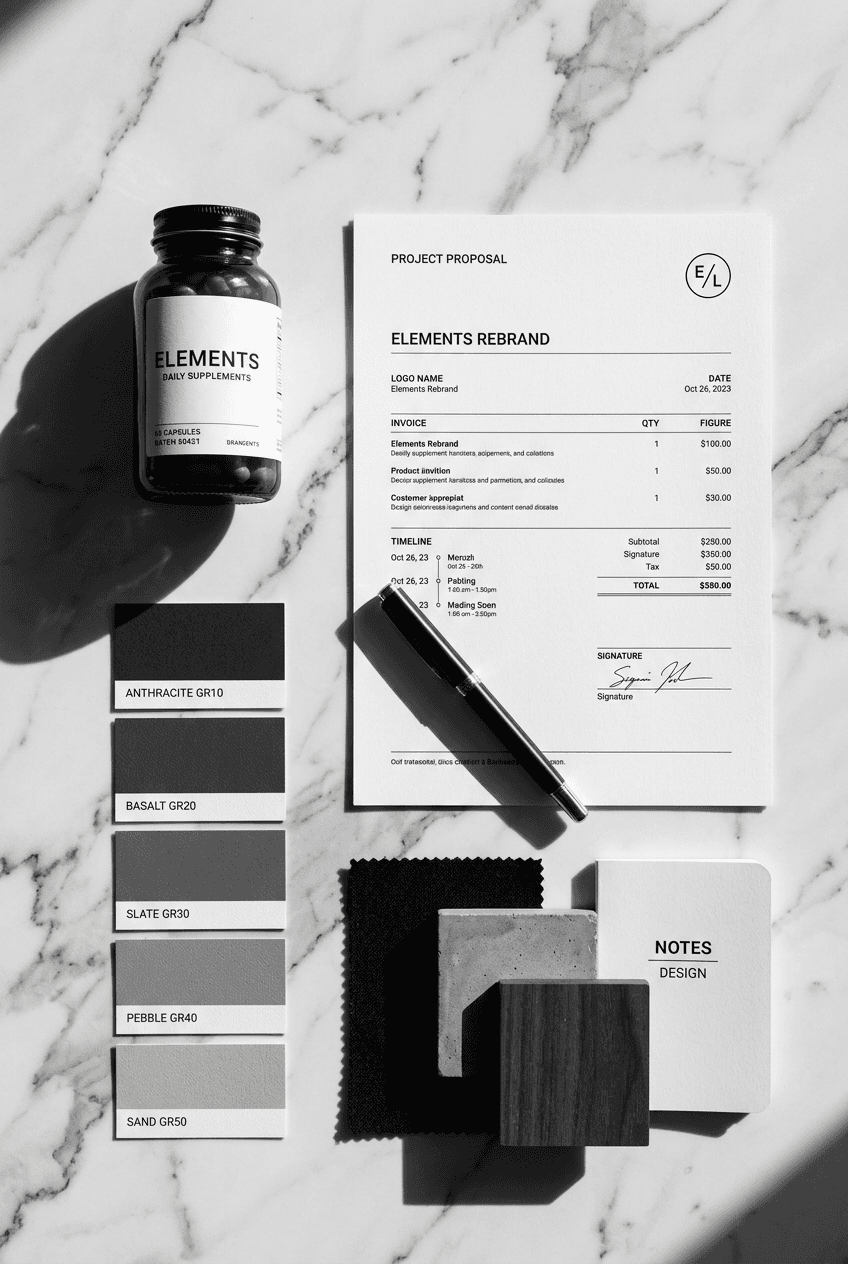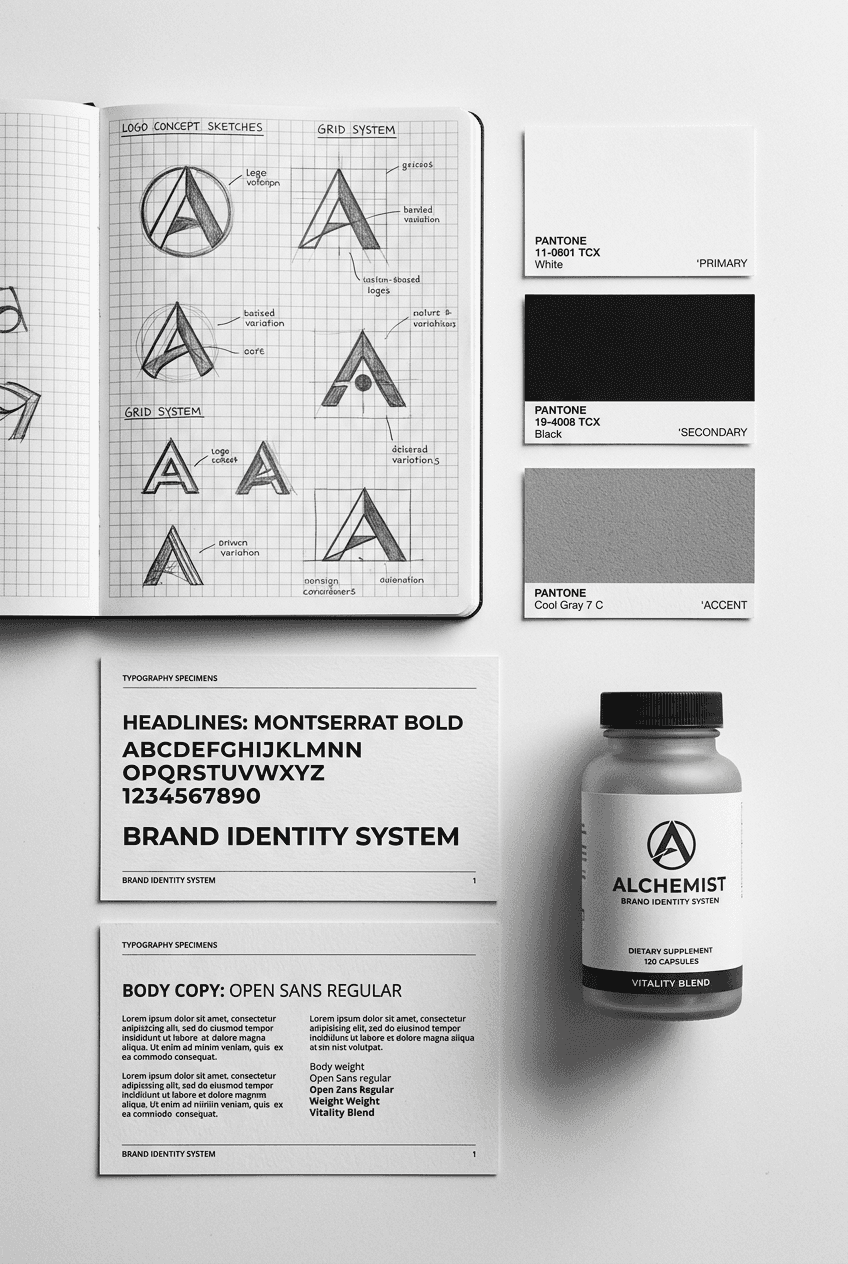

A supplement brand identity is not decoration. It is the reason someone trusts you with their health.
Why Supplement Brand Identity Requires a Different Process
Building a brand identity for a supplement product is not the same as building one for a fashion label, a food brand, or a tech company. The supplement buyer is making a health decision. That changes the weight of every visual choice you make.
The global dietary supplement market was valued at $177 billion in 2023 and is expected to reach $220 billion by 2027, according to Grand View Research. In a market expanding at that rate, new entrants are constant. The visual noise is extraordinary. A supplement brand identity that does not actively signal trust, credibility, and category expertise will not survive the consideration phase. The buyer simply moves on to the next option.
The process I use for building supplement brand identities has six phases. Each phase is necessary. Skipping or compressing any of them produces a brand that looks finished but performs poorly in the market.
Phase 1: Discovery and Positioning Research
The first phase is not design. It is research. Before any visual direction is explored, the brand needs a precise positioning statement that answers three questions: who is the specific target customer, what specific problem are you solving for them, and why should they trust you over every other option in the category?
These questions sound basic. The answers almost never are. Most supplement founders describe their target customer at a demographic level (women 25-45 interested in health) rather than at a psychographic and behavioral level (women 30-42 managing career and family stress, who research ingredients carefully, distrust exaggerated claims, and are willing to pay a premium for brands that treat them as intelligent adults). The second description can anchor a complete visual language. The first cannot.
Competitive research in this phase goes beyond listing competitors. It means mapping the visual territory they occupy. What color palettes are saturated in your sub-segment? What typographic styles are overused? What positioning territories are overcrowded and which ones are underoccupied? This visual competitive map is one of the most valuable outputs of the discovery phase because it shows you where genuine differentiation is possible.
A 2023 analysis by Mintel found that 61% of supplement launches in the US in the previous 12 months used visual identities that were indistinguishable from at least three direct competitors. That is not a coincidence. It is the result of brands making visual decisions based on category conventions rather than competitive differentiation strategy.
Phase 2: Naming and Brand Architecture
If the brand name is not yet finalized, the brand identity process should not begin. A name is not just a label. It constrains and enables specific visual directions, shapes the brand voice, and determines the range of logo solutions available.
For supplement brands, naming involves several specific considerations. Regulatory sensitivity is real: names that imply disease treatment (even colloquially) can attract FDA attention. Category crowding is extreme: the number of supplement brands with names incorporating words like "pure," "vital," "nature," "life," and "optimal" has made these feel generic. International phonetics matter if you plan to sell across markets: a name that sounds trustworthy and memorable in English may be problematic in German, Japanese, or Arabic.
Brand architecture, the system for organizing products under the master brand, is equally important to resolve before visual identity design begins. A single product launching with future range extensions requires different identity architecture than a multi-SKU launch with distinct product lines. Getting this wrong means rebuilding the naming and visual system when the range expands, which is expensive.
Phase 3: Visual Identity Development
With positioning research complete and naming finalized, visual identity development can begin. This phase covers logo design, color palette selection, typography system development, and the establishment of visual language rules.
Logo design for supplement brands has specific requirements. The logo must be legible at label size (often very small: 1-2 cm on a compact container). It must reproduce clearly in one color (for regulatory and production reasons, labels often require single-color print runs). It must work on both light and dark backgrounds. And it must communicate the brand's positioning character in its form: a geometric sans-serif logotype signals modernity and precision; a structured serif signals authority and heritage; a custom monogram or mark signals premium positioning; an icon-plus-wordmark combination gives flexibility across touchpoints. Color palette development in supplement branding is more constrained than in most other categories because color carries specific trust signals in this market. The palette must work within the color science limits of supplement label printing (certain Pantone colors are difficult to reproduce accurately on coated vs. uncoated stock). It must maintain visual distinction at shelf among competitors. And it must communicate the positioning character that was defined in Phase 1.
A comparative study in the Journal of Marketing Research found that supplement brands with clearly differentiated color palettes achieved 29% higher brand recall among category shoppers compared to brands using conventional category colors. The investment in an original palette is not aesthetic preference. It is commercial strategy.
Typography system development for supplement brands requires decisions about hierarchy: the brand font used in the logo and brand communications, the label font used for product names and benefit statements, and the regulatory font used for Supplement Facts panels and disclaimer text. These are often three different fonts because they serve three different functions with different technical requirements.
Phase 4: Packaging Design and Label Architecture
Once the visual identity elements are established, packaging design translates them into commercial reality. This is the phase where the brand identity moves from abstract visual system to the physical object that sits on a shelf or arrives in a customer's letterbox.
Supplement label architecture requires a specific hierarchy discipline. The front panel hierarchy that consistently performs at retail places the primary benefit statement at the top (what it does), the product name below (what it is), the quantity and format information at the bottom (what you get), and the brand mark anchoring the composition. Supporting trust signals (third-party certifications, non-GMO, vegan, clinical formulation markers) appear as iconographic elements rather than competing text blocks.
One area that most supplement founders underestimate dramatically is the Supplement Facts panel. The FDA-required panel layout is specified in regulatory guidance but has significant room for typographic quality variation. A badly laid out Supplement Facts panel, with inconsistent spacing, poor alignment, and illegible font sizes, signals a brand that does not care about quality at the detail level. A beautifully executed Supplement Facts panel, meeting all regulatory requirements while maintaining typographic precision, communicates professionalism and signals that every detail of the product received the same care.
According to Ipsos research on supplement purchase behavior, 44% of supplement buyers read the Supplement Facts panel before making a final purchase decision. The panel is not a regulatory formality. It is a conversion element.
Phase 5: Brand Guidelines and System Documentation
A brand identity without documentation is a brand that will be inconsistently applied as soon as the founding team grows by a single person. Brand guidelines for a supplement brand should cover: logo usage rules and exclusion zones, color palette specifications (Pantone, CMYK, RGB, and HEX values), typography system with weight and size rules, label design templates with locked regulatory elements, photography style guidance, and voice and tone principles for product copy and marketing communications.
The level of documentation specificity matters enormously in supplement branding specifically because the category involves multiple production partners: packaging manufacturers, label printers, contract manufacturers, and e-commerce platforms. Each of these touchpoints is an opportunity for brand inconsistency if the guidelines are not specific enough to prevent it.
A practical test for brand guideline quality: give the document to a designer who has never seen the brand before and ask them to create a new product label using only the guidelines. If the result looks unmistakably like the brand, the guidelines are strong. If it looks like a vaguely related interpretation, the guidelines need more specificity.
Phase 6: Application and Launch Preparation
The final phase bridges brand identity development and commercial launch. It covers the preparation of production-ready files for all physical packaging, digital asset creation for e-commerce and social, and the handover documentation that allows in-house teams and future agency partners to extend the brand without needing to rebuild it.
For supplement brands specifically, this phase includes preparing label files for the packaging manufacturer in the correct format (typically Adobe Illustrator or InDesign with outlined fonts and embedded images), supplying Pantone colors with substrate-specific reproduction guidance, and creating a digital asset library organized for ongoing use.
One commonly missed element in launch preparation is the "brand in use" documentation: examples showing how the brand elements should be applied to social media formats, email templates, trade show materials, and influencer seeding packaging. These examples prevent the brand from fragmenting across touchpoints in the growth phase.
Supplement Brand Identity Checklist
Use this framework to assess whether a supplement brand identity is complete and commercially strong.
Element | Required | Performance Standard |
|---|---|---|
Brand positioning statement | Yes | Specific enough to anchor design decisions |
Logo (full color, reversed, one color) | Yes | Legible at 1cm minimum size |
Color palette | Yes | Differentiated from top 3 competitors |
Typography system | Yes | Three-level hierarchy: brand, product, regulatory |
Front panel label design | Yes | Communicates primary benefit in under 3 seconds |
Supplement Facts panel | Yes | Regulatory compliant, typographically precise |
Secondary packaging design | If applicable | Extends front panel identity |
Brand guidelines | Yes | Specific enough for third-party production use |
Digital asset templates | Yes | Optimized for e-commerce thumbnail at 200px |
Photography style guide | Recommended | Consistent visual language across channels |
FAQ: Supplement Brand Identity
What is supplement brand identity?
Supplement brand identity is the complete visual and strategic system that represents a supplement brand: its name, logo, color palette, typography, packaging design, and brand guidelines. It is the framework that makes a brand recognizable, consistent, and trustworthy across every touchpoint from shelf to social media.
How long does supplement brand identity development take?
A complete supplement brand identity project from discovery to final deliverables typically takes 10-16 weeks with a specialist studio. Rushing the discovery and positioning phase is the most common cause of brands that need complete redesigns within 18 months of launch.
What is the most important element of a supplement brand identity?
Positioning clarity is more important than any visual element. A brand with precise positioning will produce better visual outcomes than a brand with beautiful design built on vague strategy. If you have to choose where to invest most heavily, invest in the strategy and positioning phase.
How do I know if my supplement brand identity is working?
Key indicators include: organic social sharing of your packaging by customers without incentive, press coverage that describes your brand using your intended positioning language, retail buyer interest, and brand recall in consumer research. Commercially, repeat purchase rate is the most reliable proxy for brand strength in supplements.
Can I build a supplement brand identity myself?
Early-stage brands can develop basic brand elements independently using tools like Canva or by hiring individual freelancers. The risk is that DIY brand development produces identities that lack strategic coherence: the logo looks fine but the colors send the wrong signal, the typography undermines the positioning, or the label design fails to convert at shelf. For brands intending to scale or enter retail, professional specialist studio involvement is a sound investment.
What files should I own at the end of a brand identity project?
You should own: master logo files in Adobe Illustrator (vector format), all approved color specifications in Pantone, CMYK, RGB, and HEX, typography licenses or open-source font documentation, all label design files production-ready, and the brand guidelines document in PDF. Never accept a project handover that includes only flattened image files or PDFs without source files.
I'm Tambi Haspak, a brand strategist and creative director with an unfair advantage: I'm a pharmacist. I run a creative studio for cosmetics, supplements and beyond. 17 years. Exclusively. If you want to build a supplement brand identity that does the work it is supposed to do, book a call or email me.