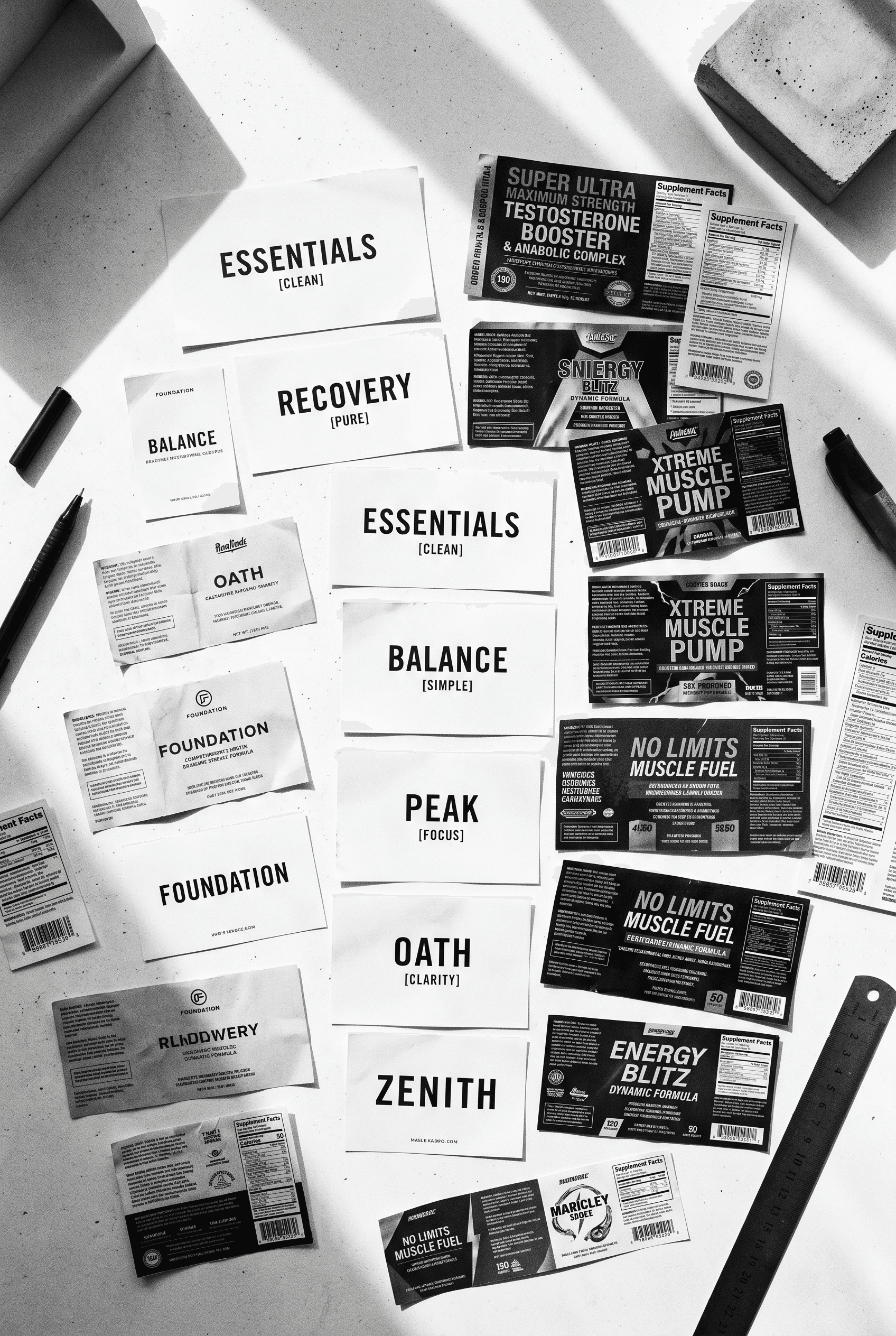

A supplement brand name is not a creative decision. It is a strategic and legal one, and getting it wrong costs more than starting over.
Why Supplement Brand Naming Fails
Supplement brand naming fails because founders treat it as a creative exercise. They brainstorm words associated with health, strength, nature, or science, run a quick domain search, and choose the name that feels right. Then they brief a designer, build packaging, register a company, and begin manufacturing. Six months later, a trademark attorney tells them the name is too descriptive to protect, too similar to an existing mark, or prohibited by FTC guidelines for supplement claims.
The supplement market in the United States alone was valued at $59.5 billion in 2023, according to the Council for Responsible Nutrition. That scale means there are hundreds of thousands of registered supplement brands, and the naming landscape is saturated with words like "vital," "pure," "apex," "forge," "primal," and "nature." Choosing a name in this environment requires a different process than most founders apply.
I am a pharmacist and creative director. I have spent 17 years building supplement brands from strategy to packaging. The naming failures I see consistently are not random. They follow predictable patterns, and they are all avoidable with the right sequence.
The Four Types of Supplement Brand Names (and Which Ones Work)
Before evaluating specific names, it helps to understand the four naming categories and how they perform in the supplement category.
Name Type | Definition | Trademark Strength | Supplement Examples |
|---|---|---|---|
Arbitrary / Fanciful | Invented word or word unrelated to supplements | Strongest | Zoe, Nori, Vela |
Suggestive | Hints at benefit without describing it directly | Strong | Ritual, Seed, Cymbiotika |
Descriptive | Directly describes the product or benefit | Weak to unregistrable | VitaBoost, NatureMax |
Generic | The category name itself | Cannot be trademarked | Vitamins, Supplements |
Fanciful and arbitrary names are the strongest from a trademark standpoint. They are also the hardest to build initial awareness around because they carry no inherent meaning. Suggestive names strike the best balance: they imply a benefit or positioning without describing it literally, which means they can be trademarked and they require less explanation than a completely invented word.
Descriptive names fail for two reasons. First, the USPTO will frequently reject a mark that merely describes the product or its characteristics. Second, descriptive names are impossible to own in a saturated category. If your brand is called "PureVitamin" or "NaturalForce," competitors can use similar language without infringing your trademark, because neither of you owns descriptive terms in the category.
What the FDA and FTC Say About Supplement Names
Supplement brand naming sits at the intersection of trademark law, FDA labeling regulations, and FTC advertising guidelines. A name that sounds appealing to a founder can simultaneously violate all three frameworks.
The FDA does not pre-approve supplement names, but its labeling regulations prohibit a product name from implying disease treatment or cure. A supplement called "DiabetesClear" or "ArthritisRelief" would be making an implied drug claim through the name alone, which the FDA categorizes as an unapproved new drug, regardless of what the label says elsewhere.
The FTC governs advertising for supplements, which it has interpreted to include brand names. Names that imply specific clinical outcomes ("CancerDefense," "HeartRescue") attract regulatory scrutiny because they constitute implied health claims that must be substantiated by adequate scientific evidence.
For a detailed breakdown of what you can and cannot claim on supplement packaging beyond the brand name, see my guide to supplement claims on packaging.
The Naming Criteria That Actually Matter
1. Trademarkability
Before you fall in love with a name, conduct a preliminary clearance search in the USPTO TESS database and an international trademark database if you plan to sell globally. Look not only for exact matches but for phonetic equivalents and names in the same class (International Class 5 for dietary supplements). A trademark attorney should review any name you are seriously considering before you invest in brand development.
Names that are frequently rejected or challenged:
Any name that describes the supplement's primary ingredient ("CollagenPlus," "MagnesiumMax")
Names that describe the intended benefit literally ("SleepBetter," "FocusBoost")
Names that are primarily a geographic location or a person's surname
Names that are phonetically similar to existing marks in Class 5
2. Category differentiation
Search the top 500 supplement brands by revenue. Map the naming conventions that dominate the category. Then choose a direction that does not replicate those conventions. If the category is saturated with words like "prime," "vital," "pure," and "forge," a name in that vocabulary will disappear on shelf even if it is legally distinct.
3. Pronunciation and global usability
A supplement brand name that is difficult to pronounce in English will struggle with word-of-mouth growth. A name that has negative connotations in a secondary market will limit international expansion. Test the name with five people who have never seen it and ask them to pronounce it. If you get five different pronunciations, simplify the name.
4. Domain and handle availability
The .com domain should be available or acquirable at a reasonable cost before the name is finalized. Social media handles across Instagram, TikTok, and Facebook should also be available. A name with a strong .com presence significantly reduces the brand-building cost in the DTC channel.
5. Longevity across product extensions
A supplement brand name that is tied to a single ingredient or benefit becomes a liability when the product range expands. "OmegaPure" works for a fish oil supplement and fails the moment you launch a probiotic. Names that are anchored in a benefit platform ("Ritual") or a brand ethos ("Seed") extend across product categories without contradiction.
The Naming Process: Sequence Matters
The sequence in which naming decisions are made determines the quality of the outcome. Most founders do it in the wrong order.
Wrong order: Formula selection → Name brainstorm → Domain check → Logo design → Trademark filing Right order: Brand strategy → Positioning platform → Naming criteria → Name generation → Trademark clearance → Domain and handle check → Name selection → Visual identity development
Brand strategy must precede naming. A name is the first expression of a brand's positioning. If the positioning is not defined, the name cannot carry any strategic weight. This is why most supplement names end up generic: they were created without a positioning brief, so they default to category language.
For a step-by-step process for building a supplement brand from strategy to market, see my guide to how to launch a supplement brand. For the complete identity system that a name must fit into, see my guide to supplement brand identity.
Common Supplement Naming Mistakes
Naming after the hero ingredient
"Ashwagandha Rx," "CollagenPro," "Turmeric Gold." These names work as product names for a single SKU but fail as brand names for a company. When you extend the range, the ingredient-anchored name becomes inaccurate. When the ingredient trend passes, the name ages badly.
Using the founder's name as the brand
Founder-named brands can work when the founder has genuine credibility and public recognition in the category. Without that, a founder name provides no strategic advantage and significantly complicates any future acquisition or licensing deal.
Importing names from adjacent categories
Supplement founders often look at successful consumer brands for naming inspiration. "Ritual" works as a supplement name because it implies a daily practice. But lifting naming conventions from fashion, fitness, or food without understanding why they work in those categories produces names that feel borrowed rather than ownable.
Not filing early enough
Trademark applications in the USPTO take 8 to 14 months to process. Founders who launch before filing, or who file after manufacturing has begun, risk discovering at launch that an existing mark owner will contest their name. File before you build the brand.
For the complete checklist of everything that should be in place before you go to market, see my guide to the supplement brand launch checklist.
What a Strong Supplement Brand Name Looks Like in Practice
Strong supplement brand names share a set of characteristics that can be evaluated before launch:
They are 1 to 2 syllables or 2 to 3 syllables at most
They are easy to spell after hearing them once
They carry a distinctive sound that does not exist in the current competitive landscape
They suggest a positioning or ethos without describing a specific ingredient or benefit
They are available as a .com domain and across primary social platforms
They pass trademark clearance in Class 5 without challenge from phonetically similar marks
They work at the brand level and can extend to sub-brands or product lines without contradiction
The logo and packaging system must be designed to work with the name's visual and phonetic character. A name with hard consonants carries different typographic implications than a name built from soft vowel sounds. For the design implications of naming decisions, see my guide to supplement logo design.
FAQ: How to Name a Supplement Brand
What makes a supplement brand name trademarked?
A name that is distinctive and not descriptive of the product's characteristics or benefits is the strongest candidate for trademark protection. Fanciful names (invented words) and arbitrary names (real words unrelated to supplements) are the most registrable. Descriptive names are frequently rejected or granted only limited protection.
Can I name my supplement brand after an ingredient?
You can use an ingredient as part of the brand name, but it creates significant limitations. The name will be difficult to trademark because ingredients are descriptive, the brand will not extend well to other product categories, and if the ingredient trend fades, the brand ages with it. A better approach is to name the brand at the positioning level and use the ingredient prominently in product-level naming.
How do I check if a supplement brand name is available?
Start with the USPTO TESS database for US trademark availability. Check the .com domain using any domain registrar. Check Instagram, TikTok, and Facebook for handle availability. Then consult a trademark attorney for a full clearance search, which will identify phonetically similar marks and marks in related classifications that a basic search might miss.
How much does it cost to trademark a supplement brand name?
USPTO filing fees for a trademark application are currently $250 to $350 per class per mark, depending on the filing basis. Legal fees for a trademark attorney to conduct a clearance search and file the application add $750 to $2,000 for a straightforward application. More complex situations involving office actions, oppositions, or international filing cost significantly more.
Should my supplement company name and product brand name be the same?
Not necessarily. Many successful supplement companies use a corporate name for the legal entity and a separate brand name for consumer-facing products. This structure gives flexibility to extend the brand portfolio, license individual brands, or pivot brand positioning without changing the legal entity. It also provides legal distance between the company and the brand if either encounters regulatory or reputational issues.
How long does it take to name a supplement brand properly?
The naming process, done correctly, takes two to four weeks. This includes positioning definition, naming criteria development, name generation, preliminary clearance, domain and handle confirmation, and final selection. Rushing this process by compressing it into a single brainstorm session produces names that fail at the trademark or market differentiation stage later.
I'm Tambi Haşpak, a brand strategist and creative director with an unfair advantage: I'm a pharmacist. I run a creative studio for life sciences, cosmetics, and supplements. 17 years. Exclusively. If you are looking for a naming and brand strategy partner who understands the regulatory and commercial landscape of the supplement category, book a call or send me an email.