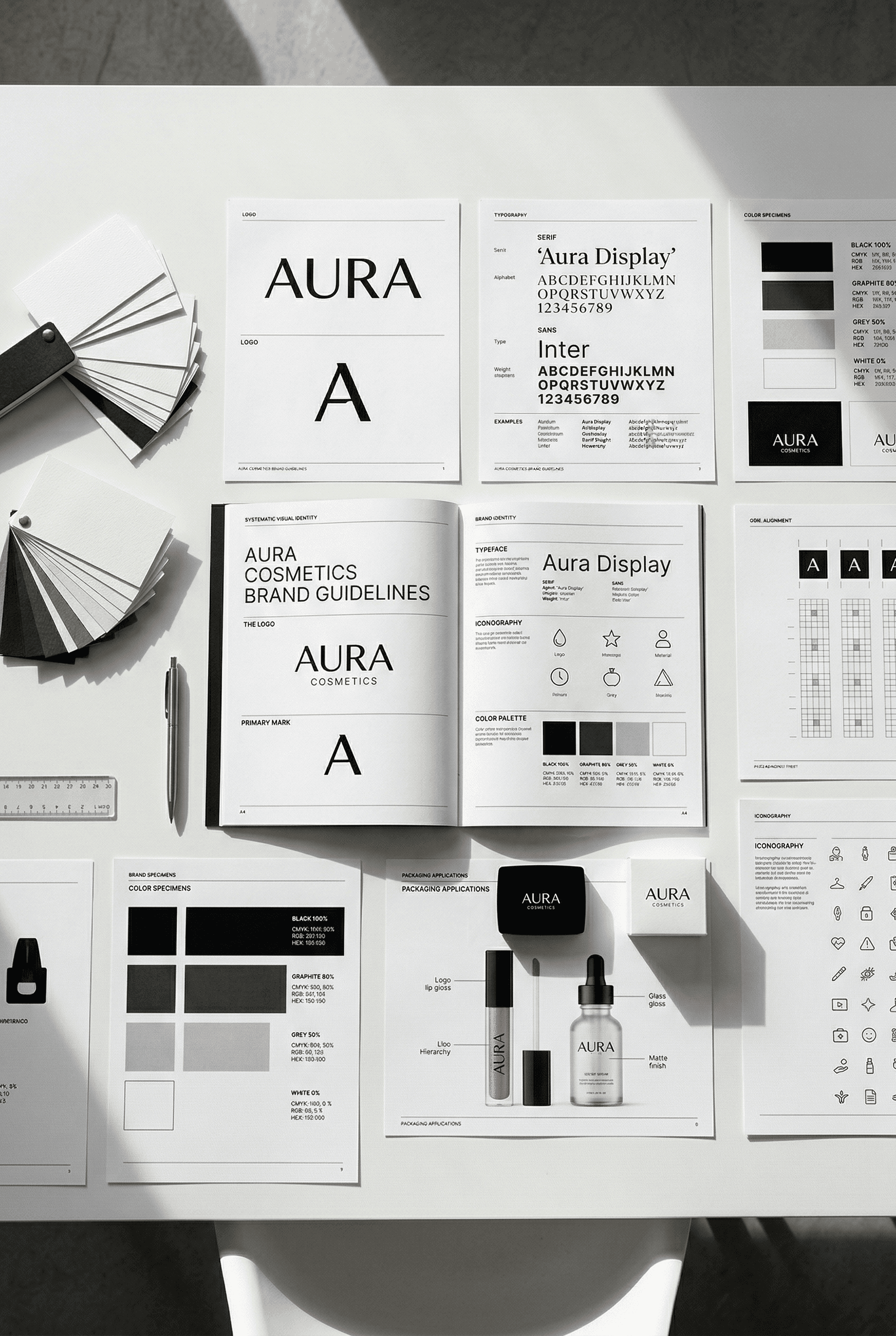

Brand guidelines are not a design deliverable. They are the governance system that determines whether your brand investment compounds over time or dilutes the moment someone else touches it.
Why Cosmetics Brand Guidelines Are Different From General Brand Guidelines
Most brand guidelines cover the same foundational elements: logo, colors, typography, basic usage rules. For most industries, these foundational elements are sufficient to maintain brand consistency across typical use cases. For cosmetics brands, foundational guidelines leave out the elements that matter most.
Cosmetics brands have specific considerations that general brand guidelines templates do not address: regulatory label compliance requirements that affect every single packaging application, claims governance rules that determine what can and cannot be said about the product, print production specifications for cosmetics-specific materials and finishes, and channel-specific visual standards for pharmacy, beauty retail, and e-commerce.
According to a 2024 study by the Cosmetics Industry Compliance Group, 67% of cosmetics brands have experienced at least one significant brand consistency failure in the two years following launch, and of those, 78% attributed the failure to inadequate or incomplete brand guidelines. The cost of these failures includes: label reprinting, packaging correction, inconsistent retail presentation, and diluted brand equity.
The solution is not just to have brand guidelines. It is to have brand guidelines that are specific enough to prevent the cosmetics-specific failures that incomplete guidelines allow.
The Complete Cosmetics Brand Guidelines Checklist
Here is what a complete set of cosmetics brand guidelines must include, organized by the category of governance each section provides.
1. Brand Foundation
The brand foundation section documents the strategic decisions that all design and communication decisions flow from. It should include: the brand purpose (why the brand exists beyond making money), the brand positioning (what specific market position the brand owns), the target consumer (specific, not generic), the brand personality (the human characteristics that describe how the brand behaves), the brand voice (the specific linguistic style of the brand's written communication), and the brand values (the principles that govern how the brand makes decisions).
Most cosmetics brand guidelines skip this section entirely or include a vague one-paragraph brand story. This is the most expensive omission because without strategic foundation, every design and communication decision defaults to aesthetic preference rather than brand logic. The next designer, the marketing manager, and the retailer all make decisions that feel right to them individually but collectively fragment the brand.
2. Logo and Visual Mark System
The logo system section should include: the primary logo in all approved variants (full color, black, white, reversed), clear space requirements (the minimum space around the logo in all applications), size minimums for all media types, the approved logo placement zones for packaging, the incorrect usage examples (showing specifically how not to use the logo), co-branding rules when the logo must appear alongside retailer or partner logos, and lockup specifications for when the logo is paired with sub-brand names or product line names.
For cosmetics specifically, include logo placement specifications for primary packaging (bottle, tube, jar), secondary packaging (box), labels (adhesive labels have different constraints than printed surfaces), and shipping packaging. Each surface type has different dimensional constraints and print process considerations.
3. Color System
The color system section should include: the complete color palette with names and exact specifications for every use context. Specifications should include Pantone Matching System references for printed packaging, CMYK values for offset and digital printing, RGB values for screen, HEX values for web and digital, and RAL equivalents if relevant for your packaging formats. Also include color proportions (which colors are dominant, which are secondary, which are accent-only), color combination rules (which colors may and may not be used together), and approved background color relationships.
The cosmetics-specific additions to color guidelines include: metalized and specialty ink equivalents (gold, silver, copper, and other metallic references for foil stamping, hot foil, or metallic inks), color on packaging substrate notes (colors shift significantly on natural materials, kraft, frosted surfaces, and different plastics), and color compliance notes for markets that have specific color restrictions on beauty product packaging.
4. Typography
The typography system should document: the primary typeface family with all approved weights and styles, the secondary typeface family, clear hierarchy rules (which type styles are used for headlines, subheads, body text, captions, disclaimers), minimum type sizes by medium, line spacing and letter spacing specifications, and approved type treatments (bold, italic, caps, mixed case rules).
Cosmetics-specific typography additions: regulatory text requirements for label compliance (the minimum type sizes mandated by FDA, EU Cosmetics Regulation, or equivalent for your target markets), INCI ingredient list formatting rules, and claims typography rules (which claims require specific type treatment for clarity and compliance).
5. Packaging Standards
The packaging standards section is the most important cosmetics-specific addition that most brand guidelines templates completely omit. It should include: approved packaging formats by product category, label layout templates for each packaging format, mandatory label element placement requirements (front panel, back panel, bottom), INCI list formatting specification, net quantity declaration format, responsible party declaration format, country of origin format (if required by your markets), batch code format and placement, and any market-specific mandatory element requirements.
This section should also include print production specifications: approved printing processes by packaging type, approved substrates and materials, approved finishing techniques (lamination types, varnish options, foil specifications), color profile specifications for printing production, and file format requirements for artwork supply.
6. Claims Governance
The claims governance section is the section most agencies skip and most cosmetics brands urgently need. It should document: the list of approved claims for each product category, the list of prohibited claims (particularly drug claims that cross the cosmetic/drug regulatory line), the evidence requirements for each claim type, the mandatory qualification language for specific claim types, and the review process for new claims before they appear on packaging or in marketing.
This section should also include market-specific claims rules, because what is permissible in the US may not be permissible in the EU or Australia, and vice versa. Specific guidance for claims used in influencer marketing, social media, and e-commerce product descriptions should also be included, as these channels have historically been less well-governed than packaging.
7. Photography and Visual Language
The visual language section documents the photographic and illustrative standards that define how the brand looks across all channels. It should include: photography art direction guidelines (lighting approach, color treatment, casting direction, styling direction), approved photography styles by application (pack shots, editorial, lifestyle, ingredient photography), composition rules, retouching standards, image selection criteria, and prohibited visual approaches.
For cosmetics brands operating across retail and digital channels, include separate specifications for each context. Retail shelf photography priorities differ significantly from social media content photography, and both differ from product page photography. Without context-specific guidance, the brand's visual language will fragment across channels even when the same photographer is used.
8. Retail and Packaging Applications
This section documents how the brand identity is applied to every retail and packaging context. It should show: planogram specifications for major retailer formats, retail display stand design standards, gift set and multipacks packaging standards, travel retail or travel size packaging adaptations, sample packaging standards, and outer case or shipping packaging standards.
Include retailer-specific application notes if your brand has specific requirements from key retail partners. Major beauty retailers have their own packaging and labeling requirements that must be accommodated within your brand standards.
Comparison Table: Minimal vs. Complete Cosmetics Brand Guidelines
Section | Minimal Guidelines | Complete Guidelines |
|---|---|---|
Brand foundation | Brand story paragraph | Purpose, positioning, consumer, personality, voice, values |
Logo | Primary logo files | All variants, clear space, size limits, incorrect usage, co-branding rules |
Color | Hex and RGB values | PMS, CMYK, RGB, HEX, metalized equivalents, substrate notes |
Typography | Font names and weights | Complete hierarchy, regulatory minimums, claims typography |
Packaging | None | Templates, mandatory elements, print specs, substrate specs |
Claims | None | Approved/prohibited claims, evidence requirements, market-specific rules |
Photography | None | Art direction, composition rules, retouching standards |
Applications | A few mockups | All packaging formats, retail contexts, digital contexts |
How to Keep Brand Guidelines Current
Brand guidelines are a living document, not a one-time deliverable. As the brand's product range expands, as new markets are entered, and as new channels emerge, the guidelines must be updated to cover new use cases. Build a formal review process into your brand management: at minimum, review and update guidelines annually or whenever a significant product launch or market expansion occurs.
The version control discipline matters particularly in regulated industries. When guidelines are updated, especially to the claims governance or packaging standards sections, all active vendors and internal teams must be notified and must confirm receipt of the updated document. Outdated packaging artwork produced against old guidelines creates costly reprinting and potential compliance problems.
Store your brand guidelines in a location that is easily accessible to all approved vendors, but controlled enough that outdated versions are not accidentally used. A shared digital library with version control is more effective than emailed PDF attachments, which have no version control and no access revocation capability.
Getting Buy-In for Brand Guidelines Across Teams
Brand guidelines only protect brand investment if people actually use them. Getting buy-in requires making the guidelines accessible, specific, and practically useful rather than theoretical. Guidelines that are too abstract to apply to real situations are guidelines that people ignore.
The most effective approach I have found is to build guidelines around real examples from the brand's actual applications. Show the correct application. Show the incorrect application. Explain why the rule exists. Designers, marketers, and manufacturers who understand the reason behind a rule are significantly more likely to follow it, and significantly more capable of making correct judgment calls in situations the guidelines did not explicitly anticipate.
Internal Links
For cosmetics brands building a complete brand system, the guidelines document should be developed alongside the full brand identity process. My guide to cosmetics brand strategy covers the strategic layer that brand guidelines document and protect. For brands also developing packaging design, cosmetic packaging design covers the design and production considerations that should be reflected in your packaging standards section. Brands with multiple product lines will need their guidelines to address the architecture rules covered in brand architecture for cosmetics.
FAQ: Cosmetics Brand Guidelines
Q: How long should cosmetics brand guidelines be?
A: Long enough to cover all the situations your brand encounters, and no longer. A single-product DTC skincare brand might have effective guidelines in thirty pages. A multi-product, multi-market cosmetics range might need eighty or more pages. Length is not the goal. Completeness and usability are the goals. A fifty-page document that people actually use is worth more than a two-hundred-page document that sits in a shared drive.
Q: Should brand guidelines include social media content specifications?
A: Yes, for any cosmetics brand with active social media channels. Social media has become one of the highest-volume touchpoints for cosmetics brands, and it is the channel most prone to brand inconsistency because it is often managed by multiple people with varying levels of brand knowledge. Social media specifications should cover: image format requirements by platform, caption tone and style, hashtag usage, claims compliance for social media (particularly important for regulated beauty categories), and influencer briefing standards.
Q: Who should have access to brand guidelines?
A: All internal teams involved in brand communication (marketing, sales, product development), all external vendors involved in brand production (packaging suppliers, printers, manufacturers, digital agencies, social media agencies), and any retail partners who produce brand materials on your behalf. Access should be controlled so that outdated versions cannot be used, and updated versions are automatically communicated to all access holders.
Q: Should brand guidelines include tone of voice examples?
A: Absolutely, and this is one of the most practically useful sections for cosmetics brands. Tone of voice examples should show the correct language style alongside incorrect alternatives, for the types of content your brand actually produces: product descriptions, social media captions, email subject lines, customer service responses, and retailer listings. Without examples, "warm but authoritative" or "clean and minimal" are too abstract to actually guide writing decisions.
Q: How often should brand guidelines be reviewed?
A: Formally at minimum once per year, and immediately following any of these triggers: new product line launch, new market entry, major brand evolution or refresh, new retail channel entry, or significant regulatory change in target markets. The claims governance section should be reviewed whenever there are regulatory developments in any of your markets.
Q: What happens if a vendor or retailer does not follow the guidelines?
A: This is where your review and approval process matters as much as the guidelines themselves. Every packaging artwork and marketing material produced by an external vendor should go through a brand approval review before production. Brand guidelines are most effective when they are part of a defined review and approval process, not just a reference document that vendors optionally consult. Include your review and approval requirements in all vendor contracts.
I am Tambi Haşpak, a brand strategist and creative director with an unfair advantage: I am a pharmacist. I run a creative studio for cosmetics, supplements and beyond. Seventeen years in this category. Exclusively.