
Brand architecture is not a problem you solve when your portfolio gets big. It is a decision you make before you launch your second product, or you pay for that delay with years of consumer confusion.
What Is Brand Architecture in Cosmetics?
Brand architecture in cosmetics is the strategic framework that defines how multiple product lines, sub-brands, and SKUs relate to each other and to the parent brand. It answers the questions: which products carry the parent brand name, which products operate as independent sub-brands, and how much visual and naming distance exists between different parts of the portfolio. Done well, brand architecture gives each part of your portfolio the space it needs to win its specific market while contributing equity back to the parent brand. Done poorly, it creates consumer confusion, dilutes your positioning, and makes every new product launch harder than it needs to be.
According to a 2024 study from the Beauty Industry Group, 68% of cosmetics consumers say that a confusing brand portfolio makes them less likely to purchase across product lines, even if they love one specific product. This means poor architecture is not just a marketing problem. It directly reduces your ability to cross-sell, upsell, and build brand loyalty across your full portfolio.
The good news is that cosmetics brand architecture follows a small number of proven structural models. Understanding these models, and knowing which one fits your specific portfolio, is the foundational work that makes every subsequent branding decision easier.
The Three Core Cosmetics Brand Architecture Models
The three main brand architecture models are the monolithic model, the endorsed model, and the house of brands model. Each has specific advantages and is appropriate for specific portfolio types.
The monolithic model means that every product in your portfolio carries the same parent brand name and visual identity. Think of brands like CeraVe, where every product from moisturizers to cleansers to eye creams shares the same name, the same packaging system, and the same visual language. The advantage is strong brand equity concentration: every purchase reinforces the parent brand. The disadvantage is positioning inflexibility. When all your products must align with the same brand positioning, launching into significantly different categories or price points becomes difficult without confusing the parent brand. The endorsed model means that product lines have their own names but clearly display their connection to the parent brand. The parent brand endorses the sub-brand. This model gives product lines more independence while leveraging parent brand equity for credibility. It works well when different product lines serve different consumer needs or price points but share the same core brand values. The house of brands model means that each product line operates as an independent brand with no visible connection to the parent company. The advantage is complete positioning independence: each brand can be built to win its specific market without compromise. The disadvantage is cost. Building brand equity for multiple fully independent brands requires multiple marketing budgets, multiple creative systems, and multiple consumer acquisition strategies.
Which Architecture Model Is Right for Your Cosmetics Portfolio?
Choosing the right model depends on three factors: your price point range, your target consumer segments, and your long-term portfolio ambitions.
If all your products serve the same consumer, at roughly the same price point, with the same core positioning, a monolithic model is almost always the right choice. It concentrates brand equity, reduces marketing complexity, and makes portfolio expansion straightforward. Every new product you launch automatically inherits the trust you have built in the parent brand. The risk is brand dilution if you launch something that does not fit, so you need discipline about what goes under the parent brand name.
If you have products that serve meaningfully different consumers, or if you have products at meaningfully different price points, you need at least an endorsed architecture and possibly a full house of brands. A prestige skincare line and a drugstore skincare line cannot share the same brand name without one diluting the other. According to Mintel's 2024 Beauty Consumer Report, 74% of prestige skincare consumers say they would trust a brand less if they discovered it also made budget products under the same name. Price point distance requires brand distance.
If you are building a portfolio company with ambitions to own multiple distinct categories, a house of brands may be the right long-term structure, even if it is expensive to build. Many of the largest beauty companies in the world operate as houses of brands precisely because it allows them to own the full price spectrum and serve every consumer segment without compromise.
The SKU Proliferation Problem in Cosmetics
One of the most common brand architecture problems I see is SKU proliferation without a naming logic. A brand launches a core moisturizer. Then a serum. Then a tinted moisturizer. Then a moisturizer for sensitive skin. Then a moisturizer with SPF. Within two years, the brand has eight variations of the same product with names invented one at a time, and consumers cannot navigate the range.
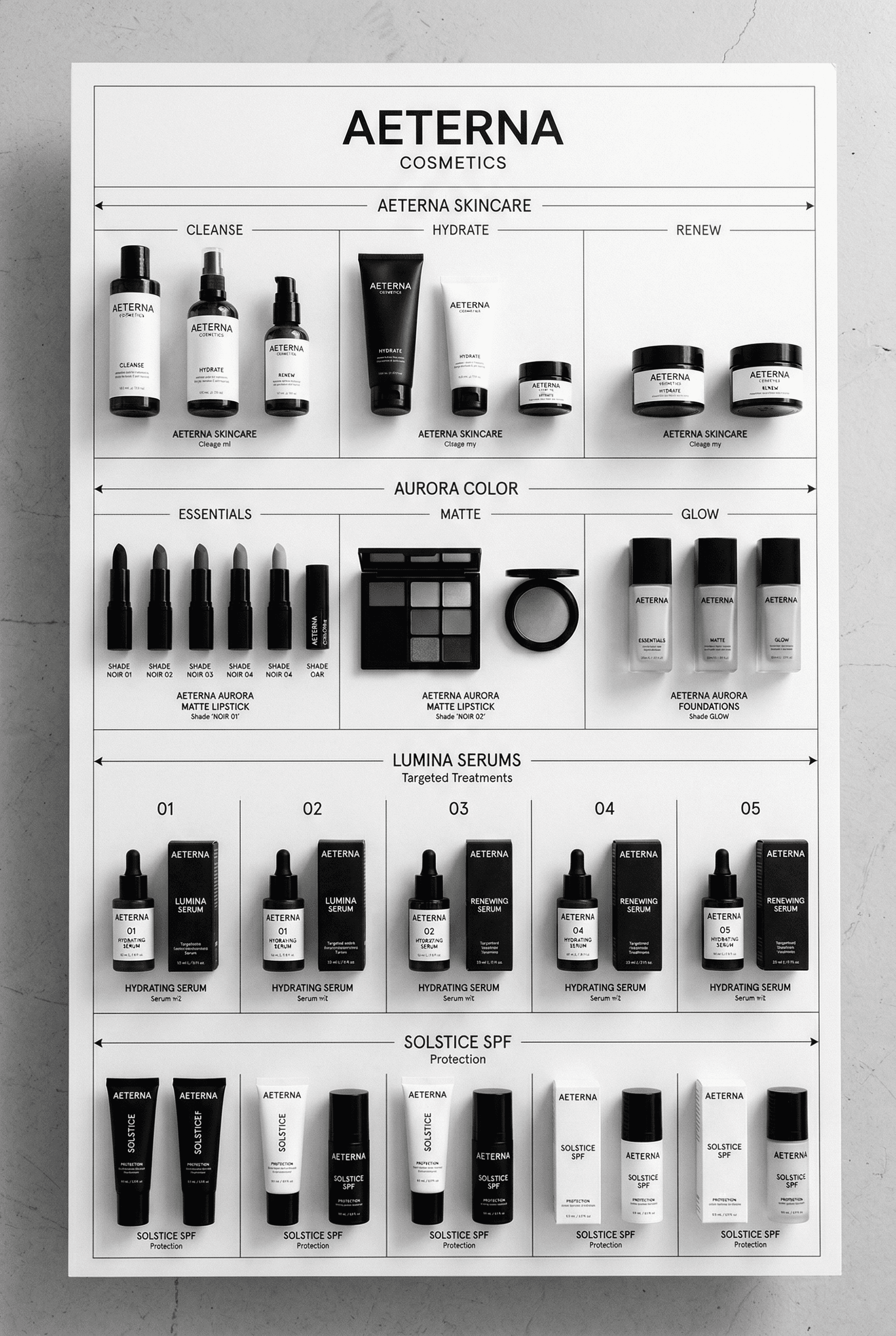
The solution is a naming architecture defined before SKU proliferation begins. A good cosmetics naming architecture answers: what is the parent family name for this product category, what are the allowed variant descriptors, and what order does the naming follow? For example: [Brand] [Line Name] [Product Category] [Variant Descriptor]. This structure means that every new SKU fits into an existing naming logic rather than requiring a new creative decision.
According to Nielsen research on cosmetics retail, a clear product naming architecture reduces purchase confusion by up to 32% and increases cross-category trial by 19%. These are significant commercial benefits that come entirely from naming clarity, with no change to the products themselves.
Managing Sub-Brands Within a Cosmetics Portfolio
Sub-brands are a powerful tool for giving specific product lines more positioning flexibility without launching fully independent brands. A sub-brand carries its own name and potentially its own visual identity but is visibly connected to the parent brand through consistent endorsement, shared design elements, or co-branding.
The key discipline with cosmetics sub-brands is defining the endorsement level clearly. A high endorsement sub-brand uses the parent brand name prominently alongside the sub-brand name. A low endorsement sub-brand uses the parent brand only in a small secondary position, often described as a "masterbrand lockup." The endorsement level you choose should reflect how much you want the sub-brand to borrow from the parent brand's equity versus build its own. High endorsement makes launches faster and cheaper because you leverage existing brand trust. Low endorsement gives the sub-brand more freedom to build a distinct positioning over time.
I worked with a cosmetics brand that had three distinct product lines: a core skincare range, a clinical treatment range, and a wellness supplement range. Each range needed different positioning (daily beauty, clinical efficacy, inner health), different price points, and different retail channels. We built an endorsed architecture where the parent brand appeared as a small endorser on all three ranges, with each range carrying its own distinct name and visual identity. This gave each range the freedom to compete in its specific market while allowing consumers who loved one range to discover the others.
Visual Identity Systems for Multi-SKU Cosmetics
A brand architecture is only effective if the visual identity system can express it clearly. This means designing a visual system that distinguishes between parent brand, sub-brand, and product variant levels, while maintaining enough coherence that all products feel like they belong to the same family.
The most effective cosmetics visual identity systems for multi-SKU portfolios use a small number of consistent structural elements, with controlled variation at the product line level. Consistent elements might include: the parent brand logo treatment, the typography system, the structural layout of packaging. Variable elements might include: packaging color, texture, finish, or photography style, which change by product line to create clear differentiation while maintaining family resemblance.
The error I most often see is applying too much variation too early. When every product line has a completely different color palette, typography, photography style, and layout, the portfolio loses coherence and the parent brand loses equity. The rule I follow: the more variation you introduce at the product line level, the more important it is to maintain rigidly consistent structural elements that anchor everything back to the parent brand.
Comparison Table: The Three Brand Architecture Models
Factor | Monolithic | Endorsed | House of Brands |
|---|---|---|---|
Brand equity concentration | Highest | Medium | Lowest (per brand) |
Positioning flexibility | Lowest | Medium | Highest |
Launch cost for new products | Lowest | Medium | Highest |
Price point range | Narrow | Medium | Wide |
Consumer navigation | Simplest | Medium | Most complex |
Best for | Single audience, single channel | Multiple lines, shared values | Independent categories, full price spectrum |
Marketing budget efficiency | Highest | Medium | Lowest |
Long-term scalability | Limited by parent brand | Good | Excellent |
Ingredient-Led Naming and Architecture in Cosmetics
One trend in cosmetics brand architecture is ingredient-led naming, where sub-brands or product lines are named after their hero ingredient rather than carrying a brand name. Brands like The Ordinary pioneered this approach at scale, and many cosmetics brands have followed.
Ingredient-led naming has a specific architecture implication: it works best within a monolithic or endorsed architecture, where the parent brand provides the positioning context and the ingredient names serve as clear variant descriptors. Without a strong parent brand anchoring the range, ingredient-led naming can confuse consumers about what the brand actually stands for beyond its ingredients.
If you are considering ingredient-led naming, I recommend treating the ingredient names as product descriptors within your architecture, not as sub-brand names. The distinction matters: product descriptors change with the portfolio without disrupting brand architecture. Sub-brand names, if abandoned or changed, damage the brand equity built in those names.
Retail Channel Considerations in Architecture
Brand architecture decisions are inseparable from retail channel decisions in cosmetics. The same brand positioned the same way can succeed in one retail channel and fail in another. A clinical, science-forward positioning works in pharmacy but may feel cold in lifestyle boutiques. A sensorial, luxury positioning works in department stores but may feel overpriced in mass market grocery.
When you have products across multiple retail channels, your architecture needs to give each channel-specific range enough visual and naming distance to fit its channel without confusing the parent brand. This often means that price point is not the only consideration: channel is also a consideration. A brand that sells in both Sephora and Costco needs more architectural separation between those ranges than just different packaging colors.
According to the International Cosmetics Industry Report 2024, 61% of multi-channel cosmetics brands report that their biggest brand architecture challenge is maintaining premium positioning in high-end channels while competing on value in mass market channels. Architecture is the solution to this challenge, but only if the architectural separation is meaningful enough to create genuine positioning distance.
The Internal Brand Management Implications
Brand architecture is not just a consumer-facing decision. It has significant internal management implications that many cosmetics founders overlook. A clear architecture defines who owns each brand and sub-brand within your organization, which teams are responsible for which positioning decisions, and how conflicts between different parts of the portfolio are resolved.
Without this internal clarity, cosmetics companies with multiple product lines often face internal competition: teams managing different lines competing for the same consumer, the same retail shelf space, and the same marketing budget. This internal competition can actually damage the parent brand because consumers observe inconsistency and incoherence in how different lines are presented.
I recommend that every cosmetics brand with more than two product lines have a documented brand architecture policy that defines: which decisions are made at the parent brand level, which decisions can be made independently by product line teams, and what review processes exist for decisions that affect the relationship between lines. This is internal governance, but it is what makes a brand architecture decision stick over time.
Internal Links
For cosmetics brands that are setting up their architecture and also need to formalize their visual rules, my guide to cosmetics brand strategy covers how to translate architecture decisions into positioning frameworks. If you are also developing product naming for a skincare range within your architecture, skincare brand naming walks through naming methodology in detail. Brands building multiple lines at different price points will also find luxury skincare branding useful for understanding how premium positioning works within a broader portfolio.
FAQ: Brand Architecture for Cosmetics
Q: When does a cosmetics brand need a formal brand architecture?
A: As soon as you are planning a second distinct product line, especially if that line will be positioned differently, priced differently, or sold through different channels than your first. Many brands wait until they have confusion to solve, which is the more expensive time to solve it. Define your architecture model before launch and your subsequent decisions become much easier.
Q: Can a small indie cosmetics brand afford an endorsed or house of brands architecture?
A: Architecture model and marketing budget are separate considerations. An endorsed architecture does not require a bigger budget than a monolithic architecture. It requires clearer thinking about how the sub-brand name, the parent endorsement, and the visual relationship work together. A small brand can build an endorsed architecture with a thoughtful designer and a clear brief. Budget determines how much reach you build for each brand. Architecture determines whether the building blocks are in the right places.
Q: What happens when architecture decisions are made wrong?
A: Consumer confusion is the most immediate symptom: people cannot tell which products belong together, which products are the upgrade from which, and what the brand actually stands for. Longer term, diluted brand equity makes every new product launch harder and more expensive because you are not accumulating trust in a coherent brand. Rebranding to fix architecture mistakes is one of the most expensive exercises in cosmetics, both financially and in terms of consumer relationship.
Q: How do ingredient-forward brands like The Ordinary handle architecture?
A: The Ordinary's architecture is essentially monolithic with ingredient-based product descriptors. The parent brand is the primary brand. The products are named by ingredient. This works because the parent brand has an extremely clear, distinct positioning (clinical efficacy at accessible prices) that gives consumers a reason to navigate the large and complex ingredient-named range. Without that strong parent brand positioning, the ingredient naming alone would not be sufficient to build a coherent brand.
Q: Should a cosmetics brand's retail packaging and e-commerce presence follow the same architecture?
A: Yes, with adaptations for how each channel communicates. The structural architecture, the naming logic, and the visual hierarchy should be the same across channels. What changes is how you explain the architecture: e-commerce can use filters, comparison tools, and detailed descriptions to help consumers navigate. Retail packaging has to do that work entirely through the physical design.
Q: How do you handle brand architecture when acquiring another cosmetics brand?
A: Acquisition is one of the most common and most disruptive sources of brand architecture decisions. When you acquire another brand, you need to decide immediately: does this brand become part of your existing architecture, does it operate as an independent brand within a house of brands, or does it get absorbed into the parent brand? Each answer has significant strategic and operational implications. I recommend deciding the architecture position of an acquisition before the acquisition closes, not after. The architecture decision should be part of the deal evaluation.
Q: How many SKUs is too many under one brand name?
A: There is no universal number, but the practical limit is determined by how well consumers can navigate the range. If your customers cannot reasonably understand what each product does and how it relates to the other products, you have too many undifferentiated SKUs. The solution is usually better naming architecture within the range, clearer product family organization, and possibly retiring or combining products that are too similar. A well-structured range of forty SKUs can be more navigable than a poorly structured range of ten.
I am Tambi Haşpak, a brand strategist and creative director with an unfair advantage: I am a pharmacist. I run a creative studio for cosmetics, supplements and beyond. Seventeen years building brands in this category. Exclusively.