
A fragrance brand is not selling a scent. It is selling a world that the scent inhabits, and the brand identity is the entire architecture of that world made visible.
The Unique Branding Challenge of Fragrance
No other product category asks a brand to do what fragrance branding must do: communicate a sensory experience through entirely non-sensory channels until the moment of first use. A skincare brand can show skin outcomes. A supplement brand can cite ingredient science. A food brand can use appetite-triggering photography. A fragrance brand must convince a consumer to part with their money for an experience they cannot verify until after the transaction.
According to the Fragrance Foundation's 2024 Global Consumer Survey, 61% of fragrance consumers say the bottle, packaging, and brand visual world are the primary factors in their purchase decision when they cannot sample the scent first. Online sales, gifting, and subscription formats have made scent-before-purchase increasingly impossible, which means the brand identity is doing more commercial work than it has ever done in this category.
This commercial reality makes fragrance brand identity one of the most strategically demanding exercises in brand development. Every visual, textual, and structural element must convey a specific sensory world, an emotional promise, and a distinct personality that makes the consumer willing to believe in the scent before they experience it.
The Architecture of a Fragrance Brand World
The most successful fragrance brand identities are built around what I call a brand world: a coherent sensory and narrative universe that gives every element of the brand a meaningful context. The brand world includes: a defined emotional territory, a characteristic sensory language (not just olfactory, but visual and tactile), a naming philosophy, and a narrative mythology.
The emotional territory is the core of the brand world. Is this a brand about intimacy? About freedom? About memory? About power? About comfort? The emotional territory should be specific enough to be distinctive and broad enough to accommodate a full range of products. A fragrance brand that is about "luxury" as an emotional territory is not specific enough. A fragrance brand that is about "the sensation of rare moments when time slows down" has a specific emotional territory that can guide every creative decision.
The sensory language is how the emotional territory is expressed visually. Fragrance brands with high emotional specificity tend to have the most distinctive visual languages, because the visual language is the translation of the emotional territory into visual terms. A brand about intimacy might use close, tactile photography, warm light, and organic forms. A brand about freedom might use expansive outdoor imagery, clean lines, and cool light. The visual language is not arbitrary. It is the emotional territory made visible.
Naming Strategy for Fragrance Brands
Fragrance naming operates at two levels: the brand name and the individual fragrance names. Both require careful strategic thinking and both contribute to the brand world.
The brand name should function as a universe-opening statement. The best fragrance brand names are evocative without being specific, distinctive without being arbitrary, and memorable without being gimmicky. Names that work well in fragrance tend to have sonic quality as well as meaning. They sound like what they promise. Names that fail in fragrance tend to be either too descriptive (limiting future range expansion), too generic (indistinguishable in a crowded market), or too trendy (they will feel dated in five years).
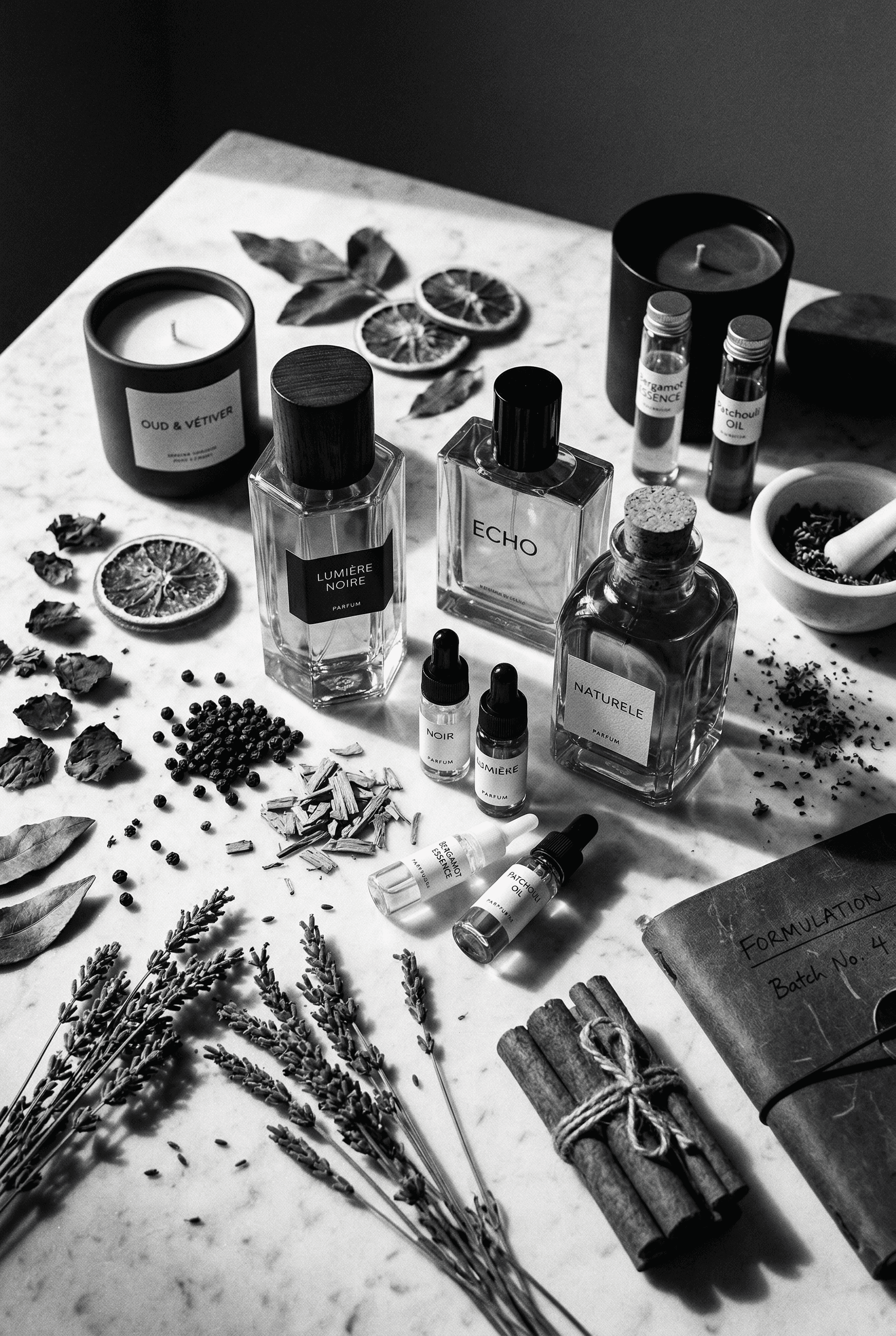
Individual fragrance naming is where brand storytelling operates at its most creative level. A fragrance name is a compressed poem: it must evoke a specific sensory world in a few words, stand as a distinct personality within the brand family, and be memorable enough to be requested by name at retail. The three main naming approaches are abstract/invented names (Infini, Lumière, Nyx), place-referencing names (Capri, Kyoto Rain, Sahara Dust), and narrative names (The Library at Midnight, First Light in the Garden, After the Storm).
Each approach has different brand implications. Abstract names are the hardest to build associations for but are the most distinctive when they succeed. Place names borrow cultural associations but risk being generic. Narrative names build strong emotional associations quickly but can become dated as cultural references shift.
According to the Fragrance Research Council, fragrance names that include a specific sensory or place reference are recalled 34% more accurately by consumers than abstract or invented names, but abstract names are rated as 28% more aspirational and premium. The choice between memorability and aspiration depends on your brand's specific market position.
Packaging Design for Fragrance: Making the Invisible Tangible
Fragrance packaging is the most powerful brand identity tool in the category because it is the primary tangible manifestation of the invisible scent. The bottle, the cap, the box, and the retail presentation must collectively communicate the entire brand world before a single drop is experienced.
Bottle design in fragrance has moved far beyond purely functional considerations. The bottle is an object to be owned, displayed, and gifted. Its form, weight, material, and surface treatment are all brand communications. Heavy glass signals substance and permanence. Light, geometric forms signal modernity and restraint. Curved, sensuous forms signal intimacy and sensory pleasure. The bottle shape should be the three-dimensional expression of the brand's emotional territory.
Cap design deserves as much attention as bottle design. The cap is the first tactile experience of the brand, and in gifting contexts (which represent a large portion of fragrance sales) it is one of the first elements the recipient touches. The material, weight, and mechanism of the cap communicate quality, intention, and luxury calibration as clearly as any visual element.
Box design for fragrance is the complete brand story in a rectangular format. The outer box communicates at shelf or on an e-commerce product page before the consumer ever touches the product. The interior experience of opening the box is a designed sensory ritual. The materials, printing techniques, and structural choices of the box are all brand communications. Brands that treat the box as a necessary cost rather than a brand investment leave significant commercial value unrealized.
Candle Brand Identity as a Subcategory
Candle brands occupy a specific subcategory of fragrance branding with distinct commercial dynamics. The candle category has grown dramatically alongside home fragrance, driven by lifestyle trends and the expansion of home as a primary living and entertaining space. According to Grand View Research, the global candle market reached $13.5 billion in 2023 and is projected to grow at 8.3% annually through 2030.
Candle brand identity shares many principles with perfume branding: the invisible-made-tangible challenge, the importance of naming and narrative, and the central role of packaging. Where candle branding differs is in the context of use: candles are display objects in the home as much as they are sensory products. The vessel, the label, and the brand presentation must work not just at point of purchase but for the weeks or months the candle sits on a shelf or table in the consumer's home.
This context has important brand implications. Candle packaging should be beautiful enough to be kept as a display object, which means vessel design, label quality, and material choices must meet an aesthetic standard beyond purely functional. Many premium candle brands design their vessels to be repurposed after the candle is consumed, which extends the brand's physical presence in the consumer's home well beyond the product's lifespan.
The DTC Fragrance Opportunity
The direct-to-consumer channel has opened significant opportunities for independent fragrance brands that would previously have been unable to compete with heritage houses for retail shelf space. DTC fragrance brands can build direct consumer relationships, test new fragrances rapidly, build loyal subscriber communities, and achieve profitability at unit volumes that would be commercially unviable in traditional retail.
The brand identity challenges for DTC fragrance are different from retail fragrance. DTC fragrance brand identity must perform primarily in digital contexts: product photography must replace the retail shelf experience, brand storytelling must replace the in-store sales associate, and packaging unboxing must replace the retail sampling experience.
This means DTC fragrance brand identity is fundamentally a content and experience design problem as much as it is a visual identity problem. The brand world must be buildable in photography, video, social media, and email contexts. The packaging unboxing experience must be intentionally designed to create the "this is worth sharing" moment that drives organic social amplification. The storytelling must be specific enough to create a real brand world rather than generic luxury aspiration.
Comparison Table: Retail vs. DTC Fragrance Brand Identity Priorities
Element | Retail Fragrance | DTC Fragrance |
|---|---|---|
Primary brand touchpoint | Retail shelf presence | Product photography and website |
Sampling strategy | In-store testers | Sample programs, subscription trials |
Packaging priority | Shelf standout and display quality | Unboxing experience and photography appeal |
Naming reach | Must work across demographics | Can target specific community |
Brand story depth | Brief (shelf space limits) | Extended (website, email, social) |
Discovery mechanism | Browsing at retail | Social, influencer, SEO |
Trust building | Retailer endorsement, heritage | Community, reviews, transparency |
Sustainability in Fragrance Branding
Sustainability has become a significant purchase driver in the fragrance category, particularly among under-35 consumers. According to a 2024 Euromonitor survey, 47% of fragrance consumers under 35 say they actively look for fragrance brands with credible sustainability practices, and 31% say they have switched brands based on sustainability considerations.
The brand implications are significant. Fragrance brands with genuine sustainability practices (refillable vessels, sustainable ingredient sourcing, reduced packaging materials, certified sustainable supply chains) have a powerful story to tell. Fragrance brands that make sustainability claims without substance are increasingly exposed by informed consumers and by regulatory bodies addressing greenwashing.
For fragrance brands building a sustainability narrative, the brand identity work is to make the sustainability practices visible and credible without compromising the sensory luxury of the brand world. The most successful sustainable fragrance brands integrate sustainability as a quality signal rather than a compromise signal. Refillable vessels are positioned as heirloom quality, not as cost reduction. Transparent ingredient sourcing is positioned as artisan craft, not as regulatory compliance.
Building a Fragrance Brand Community
The most commercially durable fragrance brands build genuine communities around their brand worlds rather than relying solely on product marketing. A fragrance community is a group of consumers who share the emotional territory of the brand, who create content about it, who introduce it to their networks, and who return not just for repeat purchases but for the brand experience itself.
Community-building in fragrance is driven by the brand world's depth and specificity. Generic luxury fragrance brands find community-building difficult because there is nothing specific enough about the brand world to give consumers something to rally around. Fragrance brands with specific, distinctive, deeply built brand worlds create natural community because consumers who resonate with that world find each other through the brand.
The brand identity work that supports community is: brand storytelling rich enough to explore over time, naming and narrative that invites consumer participation and interpretation, and social and content channels that give the brand world room to expand and develop beyond the product itself.
Internal Links
Fragrance brands expanding into complementary categories like skincare or bodycare will find how to brand a skincare line useful for understanding how to extend the brand world into adjacent product categories. For brands building a luxury fragrance positioning, luxury skincare branding covers the visual and strategic principles that apply across premium beauty categories. Brands developing a multi-product fragrance range will find brand architecture for cosmetics relevant for structuring their range architecture.
FAQ: Fragrance Brand Identity
Q: How different does a candle brand identity need to be from a perfume brand identity?
A: If they share the same parent brand, the candle and perfume identities should share the same core visual language, naming philosophy, and emotional territory. The adaptations for candle are primarily about the vessel design, label treatment for cylindrical versus rectangular surfaces, and the home display context. If they are separate brands, they should each be developed as complete brand worlds in their own right, without assumption that what works for one automatically works for the other.
Q: How do you name a fragrance range without it feeling generic?
A: The key is specificity within the brand world. The most powerful fragrance names reference something specific: a specific place, a specific moment, a specific sensory combination. The specificity should be surprising, which is what makes the name memorable. "Rose" is generic. "The Garden After Rain" is specific. "Spring Floral" is generic. "Capri, August 1994" is specific. The surprise in specificity is what creates the name's power.
Q: What makes a fragrance bottle design timeless versus trendy?
A: Timeless bottle design has clarity of intent: the form expresses one primary idea with precision and removes everything that is not essential to that idea. Trendy bottle design borrows from current fashion references that will look dated as fashion moves on. The practical indicator is whether the bottle design could appear in a decade and still feel contemporary rather than era-specific.
Q: How important is the box for fragrance if the product will be sold online?
A: Critically important, perhaps more so than for retail, because in online sales the unboxing experience is the consumer's first encounter with the physical brand world. The box is the brand's gift to the consumer. It communicates quality, intentionality, and care before the fragrance is ever experienced. For fragrance brands building a DTC business, the unboxing experience is a primary brand investment because it is the moment most likely to generate sharing on social media and word-of-mouth recommendation.
Q: Should a new fragrance brand launch with one fragrance or a range?
A: One hero fragrance, developed to its full expression, is almost always the right launch strategy. A range launch requires the brand world to be built across multiple scents simultaneously, which dilutes the creative focus and increases the commercial risk. A single hero fragrance that perfectly embodies the brand world gives consumers a clear entry point, concentrates marketing investment, and allows the brand story to develop fully around one product before expanding.
Q: How do small independent fragrance brands compete with heritage houses?
A: On specificity and story. Heritage houses have scale, distribution, and recognition that independent brands cannot match. What independent brands can do that heritage houses often cannot is build a genuinely specific, intimate brand world with a real story and real human personality behind it. Consumers in the independent fragrance market actively prefer this specificity to the scale of heritage houses. The competitive advantage of an independent fragrance brand is its ability to be genuinely different, genuinely specific, and genuinely human.
I am Tambi Haşpak, a brand strategist and creative director with an unfair advantage: I am a pharmacist. I run a creative studio for cosmetics, supplements and beyond. Seventeen years in this category. Exclusively.