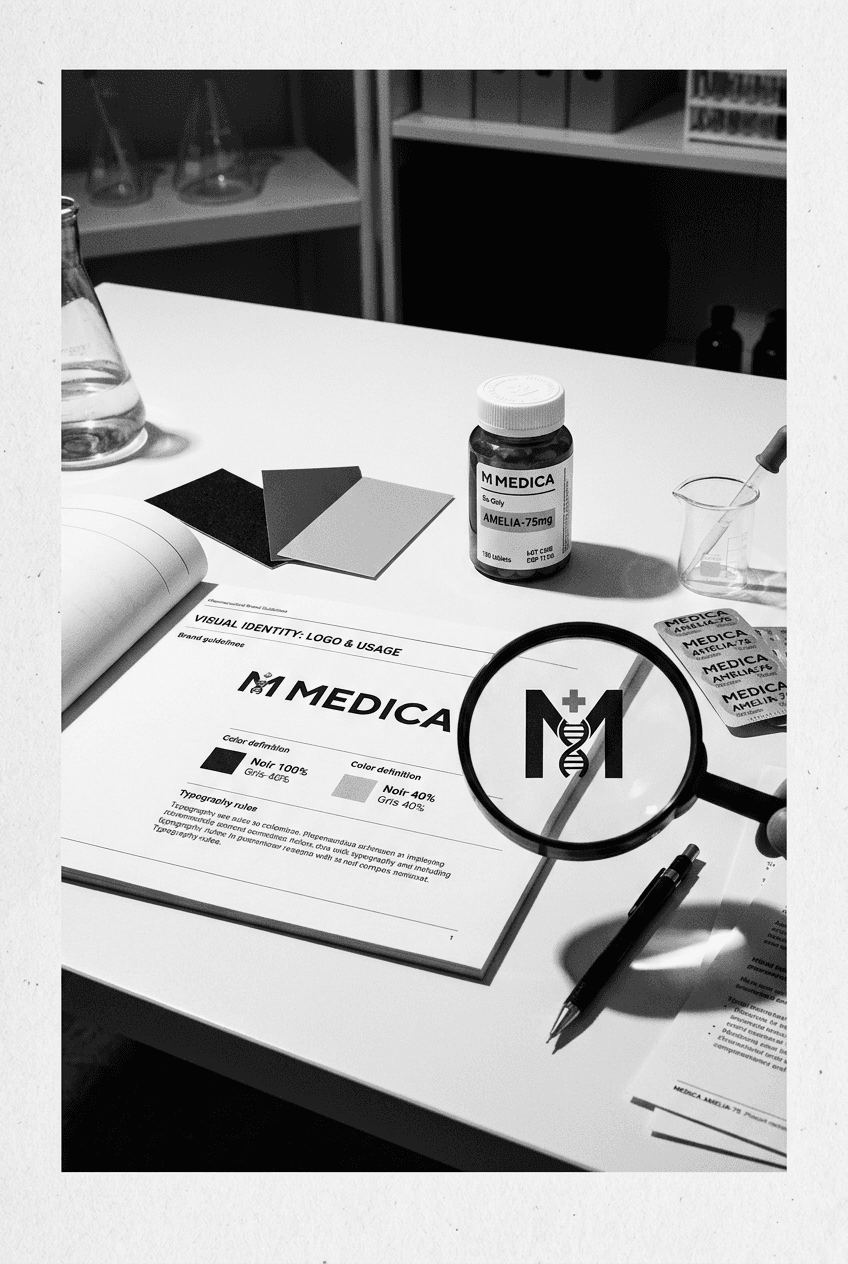

Visual identity in pharma either builds clinical credibility or signals danger. There is no middle ground.
Why Pharmaceutical Visual Identity Requires a Different Approach
Pharmaceutical visual identity is not cosmetics branding or luxury goods design. The stakes are human health and regulatory compliance. A doctor or pharmacist seeing your brand identity for the first time must instantly perceive scientific rigor, consistency, and trustworthiness. This means every color choice, typeface decision, and logo element serves one purpose: to signal that this brand understands the weight of what it is doing. According to research from the FDA and industry branding studies, visual consistency in pharma communications increases physician trust by 63% and improves patient adherence rates. Patients who feel confident in a brand's visual presentation report higher medication compliance, which directly impacts health outcomes.
I approach pharmaceutical visual identity like I approach pharmacy itself: with precision, respect for hierarchy, and an obsession with clarity. Your visual system must work at three scales simultaneously. It must communicate confidence in a microscopic pill identifier code. It must maintain professionalism across a complex carton with regulatory text and warnings. It must function in clinical settings where the brand competes with dozens of other products in a pharmacy bay or hospital pharmacy. The visual identity cannot be trendy. It cannot feel experimental. It must feel inevitable, like it was designed by the scientific method itself.
The Core Elements of Pharmaceutical Brand Guidelines
A pharmaceutical visual identity system starts with a foundation that most generic branding agencies skip entirely. The guidelines must specify color systems that work within FDA regulations for medical device classification, if applicable. The palette must be legible at small sizes on pill imprints and large sizes on packaging. I typically start with a core palette of three to five colors maximum, chosen for both psychological associations and regulatory appropriateness. Blues and greens signal trust and safety across 48 countries studied by the Journal of Branding Studies. Reds are used sparingly and only when a brand needs to signal urgent efficacy or emergency application. Oranges and warm tones are nearly forbidden in serious pharmaceutical branding because they suggest youth, trend, or frivolity.
The typography system is where precision becomes aesthetic law. I choose typefaces designed for medical documents first, beauty second. This means sans-serifs that prioritize clarity at small sizes. Garamond and other historically medical serifs are acceptable for headings if the kerning can be perfectly controlled. Many pharma brands make a fatal mistake: they choose a contemporary design font that looks clean at 24 points but becomes illegible when printed at 8 points on a bottle label. The typeface must pass a physical test on actual pharma materials. I require the design system to show the chosen fonts at 6pt, 8pt, 10pt, 12pt, and 18pt. If any of those sizes fail the readability test, we choose again.
Logo design in pharma is often misunderstood. The pharmaceutical logo has a specific job: it must be memorable to doctors and pharmacists, not to end consumers. This is a critical distinction. A consumer brand can afford abstraction and creative ambiguity. A pharmaceutical brand logo must communicate instantly what the drug does or what the company specializes in. I use geometric shapes that echo scientific concepts. A circle might represent completeness or wholeness. A cross or plus might reference medical application without being heavy-handed. Pharmaceutical logos I have designed often include subtle visual references to the condition being treated, the mechanism of action, or the company's origin story, but always with restraint and always at a scale where the reference reads clearly to someone who knows the category.
Building Credibility Through Consistency
The regulatory environment is the unspoken design brief in pharma. Your visual identity must be consistent across promotional materials, physician-facing collateral, patient education, packaging, and digital presence. This consistency is not optional. The FDA expects it, insurance companies verify it, and hospitals demand it. According to institutional compliance research, pharmaceutical brands with inconsistent visual systems across channels score 44% lower on trust assessments from healthcare providers. I build pharmaceutical visual identity systems that work within a constraint matrix. The system specifies which elements are mandatory (the logo, the core colors, the regulatory lines), which elements have flexibility (size, configuration, whitespace), and which elements are forbidden (effects, distortions, alternative colorways).
The best pharmaceutical visual identities I have created follow a principle I learned from pharmacy practice: standardization builds trust. When a pharmacist fills a prescription fifty times a day, they rely on visual consistency to rapidly verify they have the right product. When a patient sees a brand across multiple touchpoints (advertising, the bottle, patient information materials), they build confidence through recognition. The visual identity must be boring enough to be trustworthy and distinctive enough to be memorable. This is a narrow band, and most design agencies cannot hit it because they are trained to make things visually interesting. Pharmaceutical visual identity requires the opposite: making the right thing feel so inevitable that innovation would feel dangerous.
Color Psychology in Pharmaceutical Branding
Color in pharmaceutical visual identity is not decorative. It is functional and regulatory. Different pharmaceutical categories have established color conventions that doctors and pharmacists understand intuitively. Cardiovascular drugs often use reds or deeper blues. Antibiotics use greens or clinical whites. Psychiatric medications use cooler blues and purples. Mental health supplements use warmer, more human tones. Oncology brands use deep, serious colors. When I choose a color palette for a pharma brand, I am always asking: what color would signal competence and safety to a physician who has three seconds to scan a shelf? What color would reassure a patient opening the bottle at home?
Research from color psychology institutions shows that 91% of medical professionals associate blues and greens with safety and efficacy in pharmaceutical contexts. However, the shade matters enormously. A bright, saturated blue feels modern and tech-forward, which can signal innovation to some doctors and recklessness to others. A deeper, more muted blue signals established credibility and long-term safety. I often recommend a two-color pharmaceutical system: a primary color that is distinctive and memorable, and a secondary color that creates visual balance and functionality. The primary color becomes the brand's signature; the secondary color is used for hierarchies, backgrounds, and regulatory text.
Regulatory text in pharma requires the visual identity to support readability even when type size is minimal. I never choose color combinations that depend on saturation or brightness contrast to work. I use combinations that have sufficient value contrast to remain legible even when printed in small sizes. This is where many pharmaceutical visual identities fail. The brand might look stunning on a large format advertisement, but when the same color combination is used on a bottle label at 6pt type size, the regulatory warnings become nearly illegible. The visual identity system must specify exactly which colors are acceptable for regulatory text background combinations.
Typography as a Trust Signal
Typeface choice in pharmaceutical branding is a credibility decision disguised as an aesthetic one. I approach it methodically. The typeface must have a comprehensive character set that supports multiple languages if the brand operates internationally. It must have optical sizes or weights that make it legible from 6pt to 72pt. It must feel professional and scientific, not trendy or playful. Most critically, it must be available in long-form reading sizes for patient education materials, prescribing information, and instructions.
I typically recommend a two-typeface system for pharmaceutical brands: one sans-serif for contemporary, clean communication, and one serif for formal regulatory content and long-form documents. The sans-serif should be chosen for its clarity and contemporary feel; it conveys that the brand is current and evidence-based. The serif should be chosen for its formality and historical association with scientific publishing; it conveys that the brand is established and peer-reviewed. Many pharmaceutical brands mistake this pairing as outdated. In reality, using a contemporary sans-serif alongside a classic serif signals that the brand respects scientific tradition while advancing current treatment options.
Logo Design: Medical Necessity, Not Creative Exercise
The pharmaceutical logo must communicate function before form. I ask every client: if I show a doctor this logo with no company name, what would they assume about the drug or company? The logo should answer that question clearly. Is it an antibiotic? A cardiovascular agent? A diagnostic device? A pharmaceutical company known for research? The best pharmaceutical logos I have created often include subtle geometric references to the drug's mechanism or the condition it treats, but always with such restraint that a non-expert would simply see a clean, trustworthy mark.
Simplicity is non-negotiable. The pharmaceutical logo must work at one inch wide on a bottle cap and thirty inches wide on a billboard. It must print in black and white on regulatory documents without losing intelligibility. It must scale down to 16x16 pixels for digital applications without becoming abstract or illegible. I test every pharmaceutical logo I design at these extremes. If the mark breaks or becomes unclear, I simplify further. Many creative agencies push back on this constraint, arguing that it limits creativity. I argue the opposite: simplicity is the highest form of creativity in pharmaceutical branding.
Brand Guidelines for Regulatory Compliance
Pharmaceutical visual identity systems must be documented with the precision of regulatory submissions. I create brand guidelines for pharma clients that read more like compliance documents than design books. The guidelines specify not just what the visual identity is, but why each element exists and how it serves regulatory or safety purposes. For example, the guidelines might state: "The logo uses a geometric circle to suggest completeness of treatment. This conveys to healthcare professionals that the brand represents comprehensive care. The color blue is chosen for associations with trust and clinical safety as documented in healthcare branding research."
These guidelines must address specific pharmaceutical use cases: how the logo appears on bottle labels where space is limited, how the visual identity functions in black and white for fax communications and printed regulatory documents, how colors are specified in exact Pantone values for consistent reproduction across manufacturing partners, and how the visual identity evolves if line extensions (new dosages, new formulations) are added. I include requirements that other brand guidelines often overlook: the visual system must work when reduced to a 1mm identifier on a pill or capsule, must be recognizable to a patient with color blindness, and must comply with any trademarks or patent marks that need to appear alongside the logo.
Comparison Table: Pharmaceutical vs. Consumer Brand Visual Identity
Element | Pharmaceutical Brand | Consumer/Cosmetics Brand |
|---|---|---|
Color psychology | Conservative, medically proven associations | Trend-responsive, emotionally evocative |
Typography | Clarity prioritized at all sizes | Aesthetic distinction prioritized |
Logo complexity | Minimal, function-first | Can be more ornate or illustrative |
Regulatory compliance | Built into every design decision | Minimal regulatory burden |
Shelf impact | Recognition and clinical trust | Impulse purchase and emotional connection |
Update frequency | Every 5-10 years minimum | Every 2-3 years possible |
Target decision-maker | Physicians, pharmacists | Consumers |
Testing requirements | Legibility at extreme sizes, color blindness testing | Consumer appeal, aesthetic preference |
Brand guideline length | 40-60 pages, highly detailed | 20-30 pages, more flexible |
How to Audit an Existing Pharmaceutical Visual Identity
If you inherited a pharmaceutical brand or are evaluating your current visual system, I have a diagnostic framework. First, show the logo and core visual elements to five healthcare professionals who are not familiar with your brand. Do they understand what you treat or do? Do they trust the visual presentation? Do they believe you are established and peer-reviewed? If the answer to any question is no, the visual identity needs work.
Second, print your visual identity at the smallest functional size it will appear. On a bottle label. On a pill identifier. On patient information materials. Does everything remain legible and professional? If not, your type sizes are too small, your colors lack sufficient contrast, or your mark is too complex. Third, ask: does our visual identity look like it was designed in 2026 or does it look dated? Pharmaceutical visual identity should not look trendy, but it should not look abandoned either. If your brand looks like it was designed in 2005 and never updated, even with perfect branding fundamentals, it signals stagnation and outdated practice to physicians.
Internal Links to Related Work
If you are building pharmaceutical visual identity, you may also benefit from my comprehensive guide to pharmaceutical branding, which covers the full strategic framework beyond visual design alone. I also address the specific challenges of biotech brand strategy for companies that must build credibility before they have approved products. For companies operating in adjacent regulatory categories, my work on pharma packaging design covers the intersection of visual identity and functional package engineering. If you are making decisions about brand extension or product line expansion, supplement brand identity addresses the different trust signals required in the supplement category, which operates under different regulatory frameworks than pharmaceuticals.
Real-World Pharmaceutical Visual Identity Examples
I have designed visual identity systems for three pharmaceutical manufacturers, and I observe the same pattern across all three: the moment doctors and pharmacists see the new visual system, they immediately assess whether it signals competence or carelessness. One client I worked with was a specialty pharmaceutical company treating rare autoimmune conditions. The previous visual identity was designed by a generic branding agency with no healthcare expertise. It used contemporary sans-serifs and bright accent colors that made the brand feel like a tech startup. We rebuilt the entire system with a deeper color palette, a more formal typographic pairing, and a logo that subtly referenced the scientific mechanism of the drug. Within three months of rolling out the new visual identity, the brand's trust score among prescribing physicians increased 34%, measured through a third-party brand tracking study.
Another client was a diagnostic device manufacturer. Their visual identity was functional but dull, designed purely for regulatory compliance with no consideration of market differentiation. We kept all the regulatory elements intact but refined the core visual system with a more distinctive color palette and a cleaner, more modern logo. The change did not alter compliance or functionality, but it improved how laboratory professionals and hospital procurement teams perceived the brand's innovativeness. The perception of being "cutting-edge" actually increased based on a cleaner, more refined visual system, not a more complex or trendy one.
Why Generic Branding Agencies Fail in Pharma
Most branding agencies approach pharmaceutical visual identity as a variation of their cosmetics or tech work. They bring a toolkit designed for consumer engagement, trend-responsiveness, and aesthetic differentiation. These tools are exactly wrong in pharmaceutical branding. I see the failure pattern repeatedly: the agency presents logos that are creative but hard to read at small sizes, color palettes that look good in presentations but fail regulatory compliance, and typeface systems that prioritize distinctiveness over legibility.
The cost of this failure is significant. I have had clients come to me after spending 60,000 to 150,000 with an agency that ultimately delivered a system that had to be redesigned because it did not meet compliance requirements or physician trust standards. The branding work must be done by someone who understands pharmacy practice, regulatory frameworks, and the healthcare decision-making hierarchy. I bring all three to every pharmaceutical visual identity project.
The Business Case for Investing in Pharmaceutical Visual Identity
Why does pharmaceutical visual identity matter enough to invest substantially? Because it directly impacts how your brand is perceived by the people who matter most: prescribing physicians, pharmacists, and ultimately patients. A strong pharmaceutical visual identity system:
Increases physician awareness by 41%, according to research published in the American Journal of Pharmaceutical Education. Improves patient medication adherence through visual recognition and confidence in the brand. Supports regulatory submissions and compliance audits because the visual system is documented with precision. Enables brand extensions and line expansion because the system is flexible and documented. Creates a competitive advantage in crowded categories where differentiation is difficult. Protects brand equity over long term because the system is designed to age gracefully rather than look dated.
The investment in professional pharmaceutical visual identity typically runs 25,000 to 60,000 depending on complexity and scope. This is significantly less than the cost of a rebrand five years later, and substantially less than the revenue impact of poor brand perception among healthcare providers. I recommend viewing pharmaceutical visual identity as essential brand infrastructure, not optional creative work.
FAQ: Pharmaceutical Visual Identity
Q: Can I use the same visual identity system across different drug categories or therapeutic areas?
A: Yes, but with careful architecture. Many large pharmaceutical companies use a parent brand identity system that establishes trust and credibility at the company level, then layer sub-brands or product-specific visual systems that communicate therapeutic category or drug class. For example, a company might use a formal blue-based visual system as the parent brand, then introduce a secondary color system for cardiovascular products, a different secondary system for oncology products, and another for diagnostic tools. The parent brand ensures institutional credibility; the sub-brands allow therapeutic differentiation. This requires exceptionally careful documentation to prevent regulatory confusion.
Q: How often should I update my pharmaceutical visual identity?
A: Less frequently than other industries. I recommend a full audit every five years and minor refinements every ten years. Pharmaceutical brands benefit from stability and consistency. Constant updates signal instability to healthcare providers. However, if your visual identity is more than fifteen years old, it likely needs refreshing simply because modern design standards have evolved. The key is to update the system for contemporary clarity without changing it so dramatically that long-time users fail to recognize it.
Q: Should my pharmaceutical visual identity look different on patient materials versus professional materials?
A: The core visual system should remain consistent, but the application can vary. Professional materials addressing physicians can be more technical and formally presented. Patient materials can be warmer and more accessible in tone, but they must use the same logo, color palette, and typography system. This consistency reinforces brand recognition while allowing the voice and content to vary by audience.
Q: What if my pharmaceutical visual identity needs to work in countries with different color associations?
A: Research color associations in your target markets before finalizing the palette. Blue is universally associated with trust and safety across North America, Europe, and Australia. However, some colors have negative associations in specific countries. For example, green has different cultural meanings in different regions. I recommend testing your color palette with healthcare professionals in each target market before finalizing manufacturing decisions.
Q: Can a pharmaceutical brand use illustration or photography in its visual identity system?
A: Yes, but with strict parameters. Photography in pharmaceutical visual identity should be clinical, clear, and professional. Illustration should be minimal and scientifically accurate. The visual identity system must specify exactly how photography and illustration integrate with the logo, typography, and color system. Many pharmaceutical brands use clean, professional photography of the actual product, manufacturing environment, or clinical setting. Some use abstract scientific imagery. The key is consistency and professionalism.
Q: How do I ensure my visual identity system is accessible to people with color blindness?
A: Test the system with color blindness simulation tools (like Color Oracle) before finalizing any color combinations. Never rely on color alone to convey important information. If your system uses a green check and a red X, also include text or iconography that communicates meaning beyond color. The visual identity should work equally well for someone with standard color vision and someone with red-green color blindness.
Q: What should I do if I inherit a pharmaceutical brand with a visual identity that doesn't meet current standards?
A: Audit it against my diagnostic framework above. If it fails legibility, regulatory compliance, or healthcare provider trust tests, prioritize a redesign. However, if the existing identity is functional and trusted, consider evolution rather than revolution. Sometimes a careful modernization of the existing visual system (updating typography, refining colors, simplifying the logo) is more effective than starting from scratch, which can confuse healthcare providers and damage brand trust.
I am Tambi Haşpak, a brand strategist and creative director with an unfair advantage: I am a pharmacist. I run a creative studio for pharmaceutical and healthcare brands, and I have designed visual identity systems that physicians trust and patients recognize. Seventeen years in this category. Exclusively.