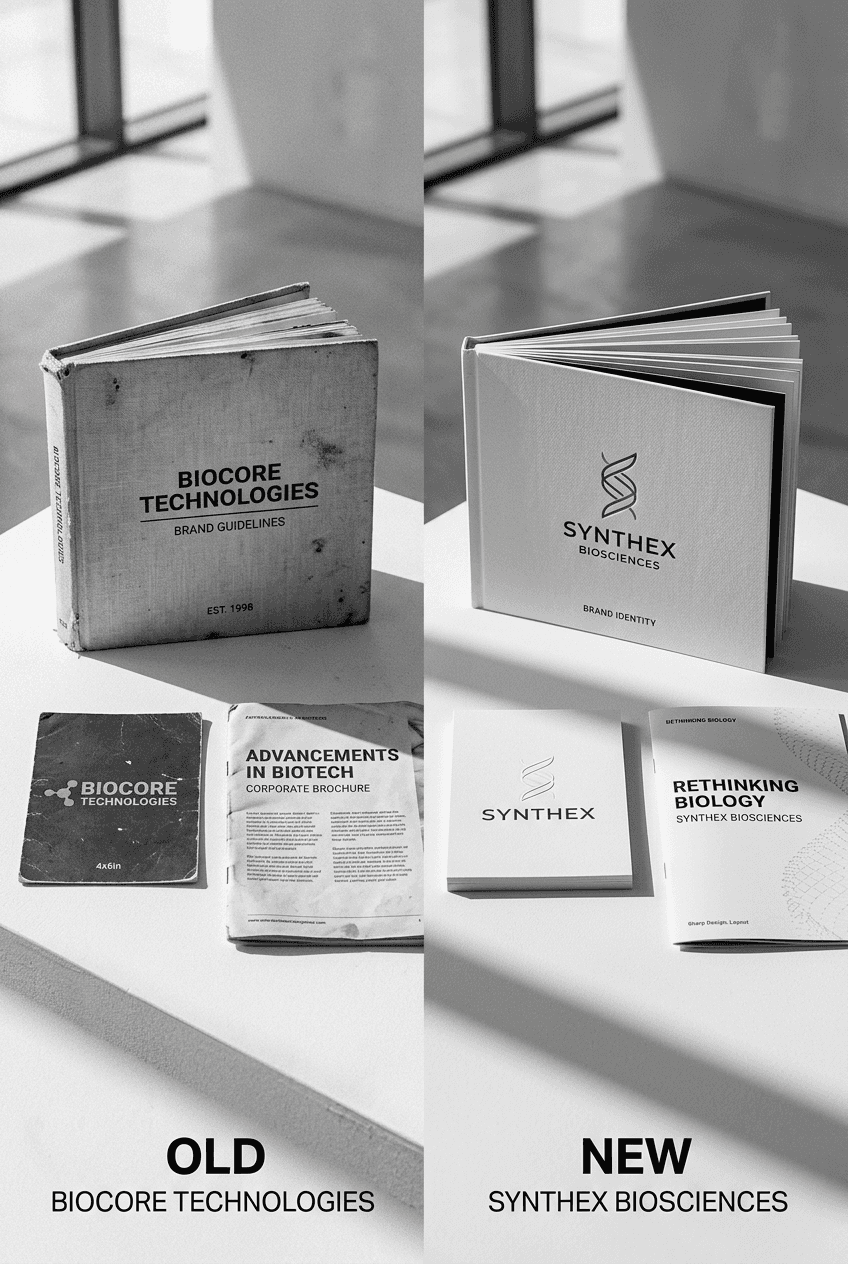

The biotech company that is afraid to rebrand because it might lose credibility is already losing credibility every day it presents a brand that no longer matches what it actually is.
The Case for Biotech Rebranding
Biotech companies resist rebranding for two reasons. The first is legitimate: in a category where consistency signals stability, a rebrand can raise questions from investors and partners about what changed and why. The second is not legitimate: the company has become attached to its existing identity regardless of whether it is still serving the business. The strategic question is whether the existing brand is an asset or a liability. When the brand is preventing the company from communicating its current reality accurately and compellingly, it has become a liability regardless of how much equity it appears to carry.
According to a 2024 analysis of biotech company brand transitions by BioPharma Dive, companies that rebranded at key strategic inflection points (pipeline pivot, new therapeutic area, merger or acquisition, major funding round) showed an average 18% improvement in investor communication quality scores and a 24% increase in inbound partnership inquiries in the twelve months following the rebrand. The rebrand, done correctly and timed strategically, signals organizational maturity and forward momentum rather than instability.
The key phrase is "done correctly and timed strategically." A poorly executed biotech rebrand, or one done at the wrong moment, can damage credibility rather than build it. This guide covers both: when to rebrand and how to execute the transition without disrupting the trust the company has built.
The Seven Signals That a Biotech Rebrand Is Needed
Not every biotech company needs to rebrand. The decision should be driven by specific, observable signals rather than general dissatisfaction with the current look. These are the seven signals I have observed most reliably in life sciences companies that needed to rebrand.
The pipeline has pivoted significantly. A biotech company that started in oncology and has shifted to rare disease, or that has moved from small molecules to biologics, often carries a brand that signals the wrong category to sophisticated audiences. When the visual identity, name, or positioning language was built around the original scientific focus and that focus has changed materially, the brand misrepresents the company. A major funding event has changed the company's scale and ambition. A pre-seed brand built on a budget of several thousand dollars rarely survives Series B intact. The brand built to get the company into investor conversations is often not the brand that communicates a company operating at the scale required to take a therapy through clinical development. The funding milestone that transforms the company's capabilities and ambitions is often the right moment for a brand transformation. The company has merged, acquired, or been restructured. Corporate transactions almost always require brand work. The question is whether the combined entity continues under one of the existing brands, creates a new combined brand, or adopts a fundamentally new identity. Each scenario requires strategic brand thinking rather than default assumptions. The name or identity creates confusion with competitors. The biotech naming landscape has become crowded. Companies that launched with names similar to competitors, or that have watched competitors emerge with confusingly similar identities, face ongoing brand friction that accumulates cost over time. Every conference presentation where an audience member asks "are you related to [competitor]?" is brand equity leaking through a gap that a rebrand would close. The brand was built without strategic intent. Many early-stage biotech companies build their initial brand through default choices: a name that was available, a logo that a founding team member designed, a color palette selected without strategic rationale. These brands may have served the early stage, but they were never built to carry the company through clinical development and into commercial conversations. A rebrand that replaces accidental brand choices with intentional ones is not vanity. It is strategic infrastructure. Key audiences are misreading the company's positioning. When investors consistently position the company differently than the founding team intends, or when talent applications consistently come from the wrong profile, or when partnerships develop in directions not aligned with the strategic roadmap, the brand is communicating something that does not match the reality. A rebrand corrects the signal. The visual identity has aged past functional viability. Brand aesthetics age. A visual identity designed in 2015 may have been appropriate then and look dated now in a way that undermines the company's claim to being at the frontier of science. Visual aging is a real phenomenon and a real cost, and there is no shame in refreshing an identity because the world has moved and the brand has not.
The Biotech Rebrand Spectrum: Refresh vs. Full Rebrand
Not every rebranding situation requires a full brand overhaul. Understanding the spectrum of intervention helps biotech companies apply the right level of brand change without unnecessary disruption.
A brand refresh updates specific elements of the brand (visual identity, website, messaging tone) without changing the fundamental brand architecture. The name stays the same, the core positioning remains, and the strategic relationships and associations the brand has built continue under an updated visual and language system. A refresh is appropriate when the science and strategy are consistent but the execution has aged or has accumulated inconsistencies that need correction. A brand evolution changes the strategic brand architecture while maintaining continuity with the existing identity. The name may change moderately, the positioning may shift, and the visual identity may be substantially redesigned, but the transition communicates progression from the existing brand rather than departure from it. An evolution is appropriate for companies at significant inflection points: major funding rounds, pipeline pivots, or the transition from single-program to platform companies. A full rebrand creates a new brand identity with minimal reference to the existing one. This is appropriate for merger or acquisition situations where a new combined identity is strategically correct, for companies whose existing brand carries associations that actively impede progress, or for companies whose founding identity was so provisional that there is nothing worth carrying forward.
Comparison Table: Refresh, Evolution, and Full Rebrand
Dimension | Brand Refresh | Brand Evolution | Full Rebrand |
|---|---|---|---|
Name change | No | Possible | Usually yes |
Visual identity | Updated | Substantially redesigned | Completely new |
Messaging | Refined | Repositioned | New architecture |
Continuity communicated | High | Moderate | Low |
Disruption risk | Low | Medium | High |
Best timing | Annually or as needed | Major milestones | Transactions, pivots |
Typical investment | $15K to $40K | $40K to $120K | $80K to $250K+ |
How to Execute a Biotech Rebrand Without Losing Credibility
The credibility concern in biotech rebranding is real but manageable. The company's scientific reputation is attached to its publications, its regulatory filings, its clinical data, and its team, not to its logo or color palette. Audiences who have followed the company's scientific progress understand this. The risk is not that they will stop believing in the science because the logo changed. The risk is that the transition is communicated poorly, creating uncertainty about what else has changed.
Announce the rebrand proactively and explain the rationale. Investors, partners, and the broader community should hear about the rebrand before they encounter the new identity unexpectedly. The announcement should explain why the company is rebranding now (a strategic rationale that connects the rebrand to the company's evolution) and what is staying the same (the science, the team, the mission, the regulatory relationships). Manage the transition on all materials simultaneously. The biggest credibility risk in a rebrand is inconsistency: the website reflects the new identity while the investor deck still uses the old logo, or conference materials use a mix of old and new. Biotech rebrands require a comprehensive materials audit before launch and a coordinated transition plan that updates all primary materials on a defined timeline. Maintain scientific publication and regulatory records continuity. Publications and regulatory filings create a public record attached to the company's previous name and identity. The rebrand communication should explicitly address how the company's historical work will be attributed and how the connection to previous filings and publications will be maintained. This is particularly important for companies changing their legal name. Brief key relationships personally before the public launch. Lead investors, key scientific advisors, regulatory consultants, and major partners should receive a personal briefing before the rebrand is announced publicly. This shows respect for the relationship, gives them the context to explain the change to their networks, and prevents the "what happened to [old company]?" questions that erode confidence.
Internal Links
Biotech companies considering a rebrand alongside product line expansion should review biotech company branding for the foundational brand strategy framework. Companies rebranding at the point of entering pharmaceutical development should also consult pharmaceutical branding for the specific requirements of pharmaceutical brand positioning. The visual identity considerations applicable to all life sciences rebrand projects are covered in biotechnology brand identity.
FAQ: Biotech Rebranding
Q: Will rebranding confuse existing investors?
A: Only if it is communicated poorly. Existing investors who are properly briefed on the rationale and the specifics of the rebrand typically respond positively, interpreting the rebrand as evidence of strategic clarity and organizational maturity. The rebrand that confuses investors is the one that happens without explanation or that appears to signal a pivot the investors did not know was coming.
Q: How long does a biotech rebrand take?
A: A brand refresh takes six to ten weeks. A brand evolution takes three to five months. A full rebrand takes four to eight months, depending on whether a name change requiring legal clearance and regulatory notification is involved. The timing should be planned around the company's calendar of major investor interactions, conference presentations, and clinical milestones to avoid rebranding in the middle of critical visibility moments.
Q: Should a biotech company rebrand before or after a major funding round?
A: Before, if the rebrand is part of the narrative being presented in the round. After, if the rebrand is being funded by the round. Never during: the middle of a funding process is the worst time to change the brand because it creates uncertainty at the moment when investor confidence is most critical. If the rebrand cannot be completed cleanly before the round begins, wait until the round closes.
Q: What happens to existing scientific publications and patents under a company name change?
A: They remain valid and attributed to the original company name. The standard practice is to include a note in the company's communications and website explaining the prior name and clarifying that the companies are the same entity. Most biotech companies that change their names maintain a clear record of the prior name in their regulatory and publication histories for exactly this reason.
Q: How do you handle the rebrand on LinkedIn and other professional networks?
A: Update the company page simultaneously with the website and investor materials launch. Inform employees personally before the public launch so that individual profiles can be updated consistently. For companies with significant LinkedIn followings, consider a post from the CEO explaining the rebrand directly in the company voice.
I am Tambi Haşpak, a brand strategist and creative director with an unfair advantage: I am a pharmacist. I run a creative studio for cosmetics, supplements and beyond. Seventeen years in this category. Exclusively.