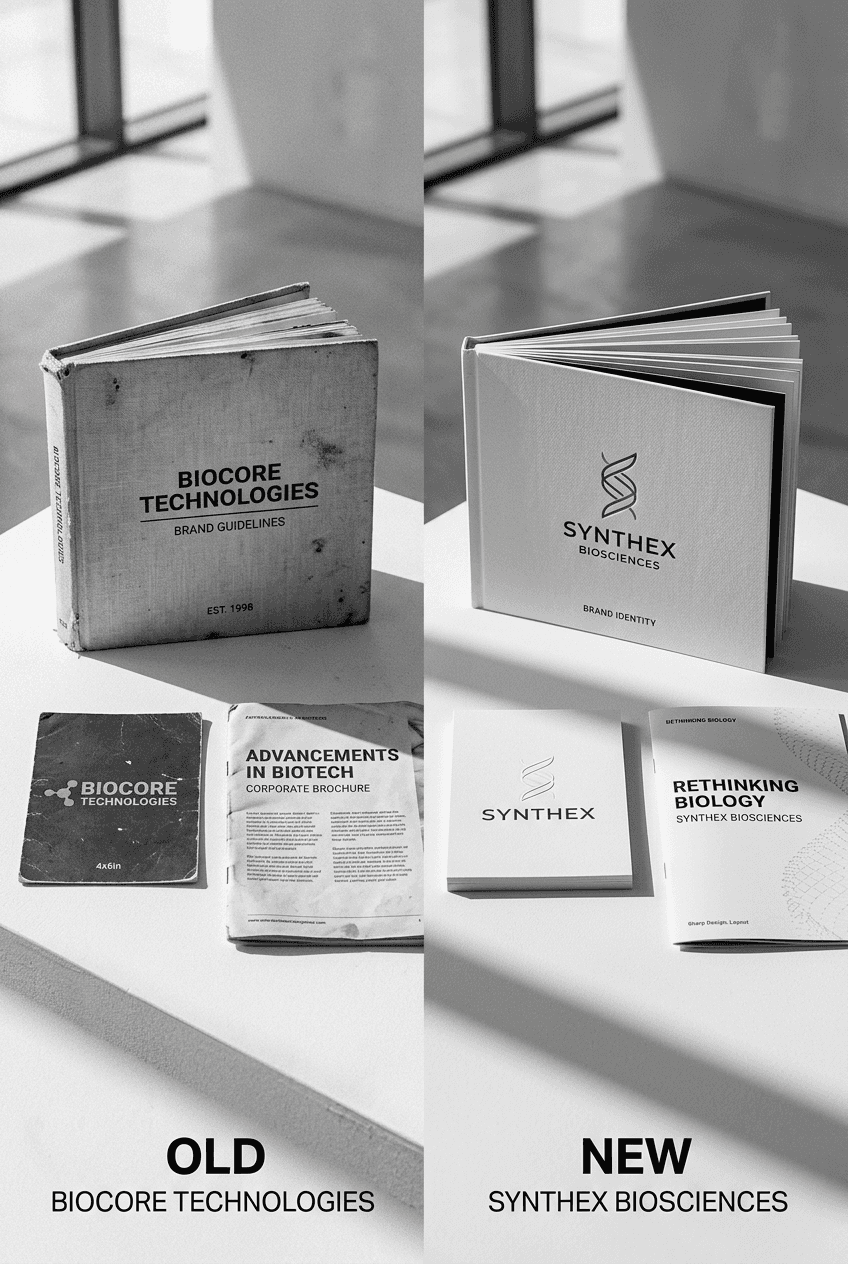

In biotech, your brand is not what you show after you have a product. It is what earns you the room, the round, and the right to keep working before you have one.
Why Biotech Branding Is Different From Every Other Industry
Biotech company branding operates under a constraint that no other industry faces: the product either does not exist yet, or cannot be promoted directly to consumers due to regulatory requirements. A skincare brand can show its product. A supplement brand can describe its benefits. A biotech company building a novel oncology therapy cannot do either of those things while in development. What it can do is build a brand that makes investors, regulators, partners, and talent believe the company is worth trusting with their capital, their time, and their careers.
According to a 2024 report by Silicon Valley Bank on biotech funding trends, 73% of Series A and Series B biotech investors say they evaluate the founding team's credibility and communication clarity as a primary factor in investment decisions alongside the science itself. A brand that communicates poorly, inconsistently, or without conviction actively undermines the scientific credibility of the company it represents. The best science in the world, presented through a brand that looks like it was assembled by a first-year design student, loses rounds it should have won.
The unique challenge of biotech company branding is communicating certainty about the future while being honest about present uncertainty. That is not a contradiction. It means building a brand that conveys conviction about the mission, the team, and the approach while being transparent about what is known, what is in development, and what remains to be proven.
The Three Audiences Every Biotech Brand Must Serve
A biotech company brand must work simultaneously for three distinct audiences, each with fundamentally different needs.
Investors need to believe the company can execute. They evaluate the team's credibility, the clarity of the strategic vision, and the company's ability to communicate complex science in terms that connect to commercial and financial outcomes. A brand that communicates clearly to investors demonstrates the organizational intelligence and communication discipline that predicts execution capability. Investors who cannot understand what a company does from its website and deck will not invest in it, no matter how good the science. Regulatory and scientific partners need to believe the company has scientific integrity. Partners including universities, contract research organizations, regulatory consultants, and potential licensing partners evaluate whether a company's public positioning is consistent with the science, whether claims are appropriately qualified, and whether the organization presents itself with the professional credibility expected in serious scientific work. A brand that overclaims, oversimplifies, or presents science in ways that do not match the actual state of the research will not earn the trust of sophisticated scientific partners. Talent needs to believe the company is worth joining. The biotech talent market is highly competitive, and the most sought-after scientists, clinical development experts, and regulatory specialists have choices. They evaluate whether a company has a compelling mission, whether it is credibly led, and whether it looks like a place where serious work is done and recognized. A brand that communicates conviction about its mission and clarity about its culture attracts talent that weaker-branded companies of identical scientific quality cannot.
The Four Elements of Effective Biotech Company Branding
Building a biotech brand that works for all three audiences simultaneously requires getting four elements right.
Mission clarity is the foundation. The biotech company's mission statement must pass a single test: can a sophisticated non-specialist understand exactly what you are trying to accomplish, why it matters, and why you are the team to do it? The trap that most biotech missions fall into is either extreme technical specificity (accurate but incomprehensible to non-specialists) or vague aspiration ("improving human health through science"). The best biotech mission statements are specific about the problem being addressed, clear about the mechanism or approach, and honest about the ambition. According to a 2023 Deloitte analysis of biotech company communications, companies with clear, specific mission statements secured funding 31% faster than companies with generic mission language. Visual identity must balance scientific credibility with human purpose. The visual language of biotech has historically defaulted to blue, molecules, and clinical sterility. This default exists for a reason: it communicates seriousness and scientific rigor. But it also means that most biotech brands look identical to each other, which is a significant competitive disadvantage in a market where differentiation drives investor attention, talent attraction, and partner interest. The most effective biotech visual identities use the credibility signals of the category (precision, clarity, sophistication) while introducing a distinctive visual language that sets the company apart. The goal is to look like a serious scientific company that has a specific identity, not like every other serious scientific company. Messaging architecture is the system of language that translates the company's science and strategy into communications appropriate for each audience. The same underlying scientific work must be described in the language of commercial outcomes for investors, in the language of scientific rigor for regulatory and academic partners, and in the language of meaningful mission for talent. A well-built biotech messaging architecture has a single source of truth at the core and audience-specific translations at each layer. Companies that fail to build this architecture end up with inconsistent communications that confuse audiences who encounter the brand through multiple channels. Digital presence is the brand's primary interface with all three audiences. For most biotech companies, the website is where investors do their initial due diligence, where talent evaluates whether to apply, and where partners assess scientific credibility. A biotech website that fails to communicate the company's mission, team, and science clearly in the first thirty seconds of a visit is a brand failure with direct financial consequences.
What Biotech Brands Get Wrong Most Often
Having worked with multiple life sciences companies across branding and brand strategy projects, I have observed the same mistakes appearing consistently in biotech company branding.
Over-relying on the science to do the brand's work. The science may be genuinely exceptional, but it cannot communicate itself. A biotech brand that puts the scientific detail front and center without translating it into accessible narrative is asking investors, partners, and talent to do work that the brand should be doing for them. The science earns you the room. The brand determines what happens after you are in it. Waiting until a milestone to invest in branding. The most common timeline I encounter: "We will invest in our brand after Series B" or "We will sort out our identity when we get to Phase 2." The brand is doing work at every stage. The deck you send before Series B is your brand. The website a potential partner visits to decide whether to respond to your email is your brand. Underbrand during the critical early years and you are silently losing rounds, recruits, and partners to companies with identical science and stronger identities. Choosing between credibility and personality. This is a false choice. A biotech brand does not have to choose between looking scientifically credible and having a distinctive personality. The brands that do this best understand that credibility is established through the precision and consistency of every element, not through making everything blue and clinical. Personality is established through the specificity of the language, the distinctiveness of the visual system, and the clarity of the culture communicated.
Comparison Table: Weak vs. Strong Biotech Brand Identity
Dimension | Weak Biotech Brand | Strong Biotech Brand |
|---|---|---|
Mission statement | "Improving human health through innovative science" | Specific problem, specific approach, specific ambition |
Visual identity | Generic blue/molecular, indistinct | Distinctive visual language, credibility maintained |
Website | Science-first, narrative-absent | Mission clear in 30 seconds, audience-specific navigation |
Messaging | Single version for all audiences | Architecture with core truth + audience translations |
Investor materials | Dense scientific detail | Scientific rigor plus commercial clarity |
Talent communication | Job description only | Mission, culture, and career case communicated |
Estimated brand investment | Minimal, deferred | 2-4% of annual operating budget, ongoing |
The Relationship Between Brand and Funding
The relationship between biotech company brand quality and funding success is not coincidental. Investors in early-stage biotech are making decisions under conditions of extreme uncertainty. They cannot yet evaluate the product (it does not exist), they cannot yet assess clinical outcomes (they have not occurred), and they cannot yet judge commercial viability (too early). What they can evaluate is the quality of the team and the quality of the communication.
A strong brand is evidence of the same organizational qualities that predict execution success: clarity of thinking, attention to detail, ability to communicate complex ideas simply, and commitment to doing things properly even before it is required. Investors who fund early-stage biotech understand this, whether they articulate it in these terms or not.
According to analysis of 2024 STAT News biotech funding data, biotech companies with professional brand identities (assessed by brand quality scoring across website, deck, and materials) secured initial funding rounds that were on average 23% larger than companies with equivalent scientific profiles and significantly weaker brand presentations. The brand signals something about the company that the science alone cannot signal.
Building a Biotech Brand: Where to Start
For a biotech company building its brand from scratch, the sequence matters.
Start with the mission statement and get it right before designing anything. The mission statement drives the visual identity, the messaging architecture, and the website narrative. A mission statement that has not yet been refined to the point where a sophisticated non-specialist can understand and be moved by it will generate brand executions that also fall short. This work often takes longer than expected, and it is worth every hour.
Move to the messaging architecture before touching visual identity. The language of the brand must be defined before the visual language. Too many biotech companies reverse this and end up with a beautiful visual identity attached to messaging that does not work, which requires expensive rework.
Build the visual identity from the messaging. The visual identity should express the character of the brand that has been established in the messaging work. The personality of the language, the precision of the scientific approach, the ambition of the mission, all of these should have visual equivalents.
Launch the website as the brand's primary statement. The website, not the deck, not the one-pager, is the permanent, accessible, always-on expression of the brand. Build it to communicate mission, team, science, and stage clearly to all three primary audiences.
Internal Links
For biotech companies also developing supplement or nutraceutical products alongside therapeutic pipelines, the specific brand considerations are covered in nutraceutical branding and supplement brand identity. Companies developing pharmaceutical candidates with OTC applications should also review pharmaceutical branding for the specific considerations at the pharmaceutical category level. The visual identity foundation applicable to all life sciences companies is covered in biotechnology brand identity.
FAQ: Biotech Company Branding
Q: When should a biotech startup invest in professional branding?
A: Before your first serious investor meeting. If you are sending decks, responding to partner inquiries, or recruiting scientific talent, your brand is already working. The question is whether it is working for you or against you. Pre-seed and seed-stage companies that invest in professional brand identity consistently report higher-quality investor conversations and faster talent acquisition. The cost of early branding is a fraction of the cost of lost rounds and delayed hiring.
Q: How much should a biotech company budget for branding?
A: Early-stage (pre-Series A) biotech companies typically invest between $20,000 and $60,000 in a professional brand identity, website, and core materials package. This range covers strategy, visual identity, messaging architecture, website design and build, and core investor materials. Post-Series A companies with broader communications needs typically invest $80,000 to $200,000. These figures represent a small fraction of total capital raised and deliver returns through better funding outcomes, faster recruiting, and stronger partner interest.
Q: Should a biotech brand change as the company moves through clinical stages?
A: The brand should evolve but not be rebuilt at every stage. The core identity, including the mission, the visual language, and the brand personality, should be built to endure the company's full development arc. What changes at each stage is the emphasis: pre-clinical companies lead with team and mission, Phase 1 and 2 companies lead with data and progress, Phase 3 and beyond companies begin introducing commercial narrative. Build the brand foundation to support this evolution rather than requiring reinvention.
Q: How do you communicate scientific credibility without losing a general audience?
A: Through layered communication. The headline-level narrative communicates mission and purpose in accessible language that any intelligent non-specialist can follow. The detail layers, including scientific background sections, pipeline pages, and data summaries, serve the audiences who want depth. Every biotech website should be designed so that an investor who knows nothing about the science can understand what you do and why it matters in the first scroll, while a scientific partner who wants depth can find it immediately.
Q: What is the biggest brand mistake biotech companies make with their websites?
A: Leading with the science instead of the mission. The website opens with a molecular diagram or a pipeline table and never explains in plain language what the company is trying to accomplish and why it matters. The investor or talent visitor who does not immediately understand what the company does will not stay long enough to find the explanation buried in the About page. Mission first, always, with science available for those who want it.
Q: How important is a biotech company's name to its brand?
A: Critically important, and significantly underestimated by most founding teams. The company name is the most persistent element of the brand. It appears in every investor communication, every paper, every regulatory filing, and every public announcement for the lifetime of the company. A name that is difficult to pronounce, impossible to remember, easily confused with existing entities, or meaningless in multiple languages creates friction in every brand interaction. The naming process deserves dedicated strategic attention, not a last-minute decision made to meet a filing deadline.
I am Tambi Haşpak, a brand strategist and creative director with an unfair advantage: I am a pharmacist. I run a creative studio for cosmetics, supplements and beyond. Seventeen years in this category. Exclusively.