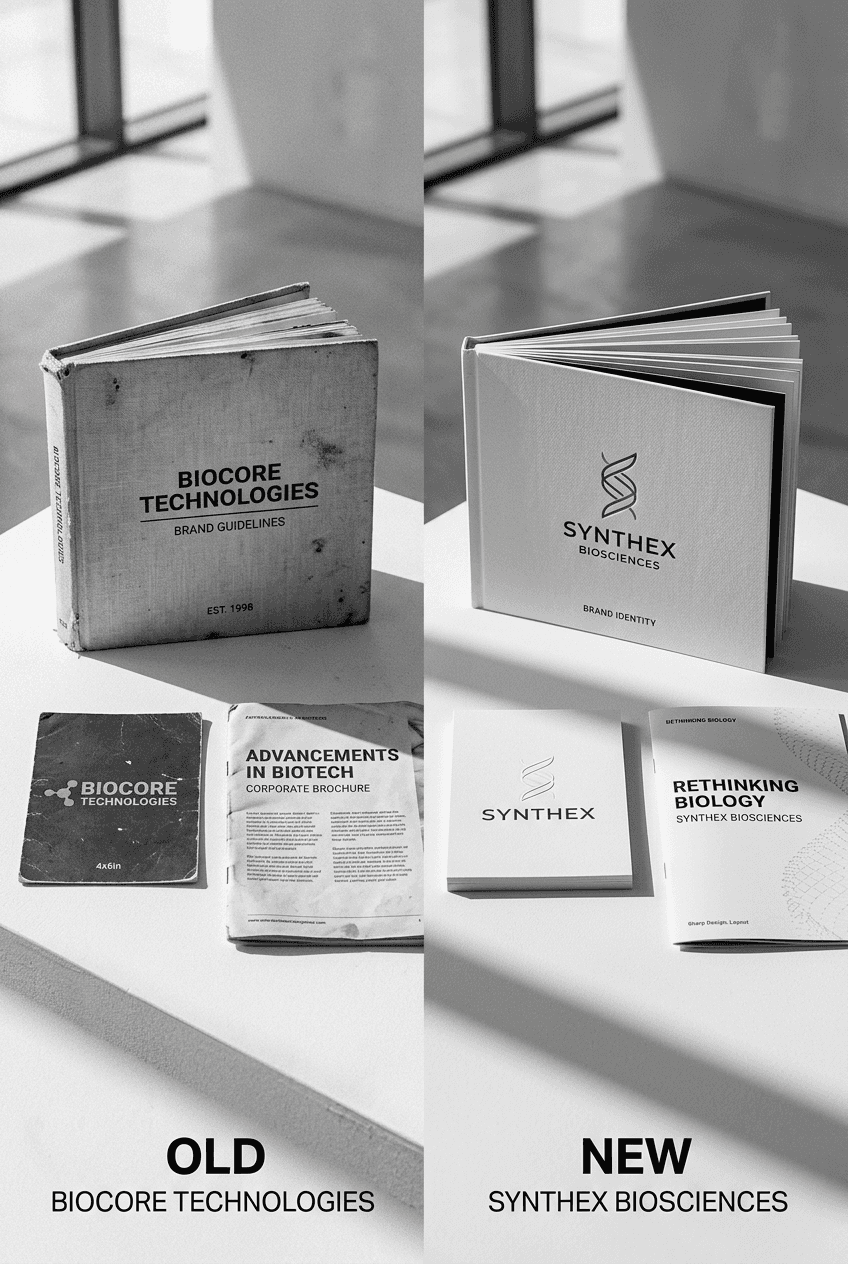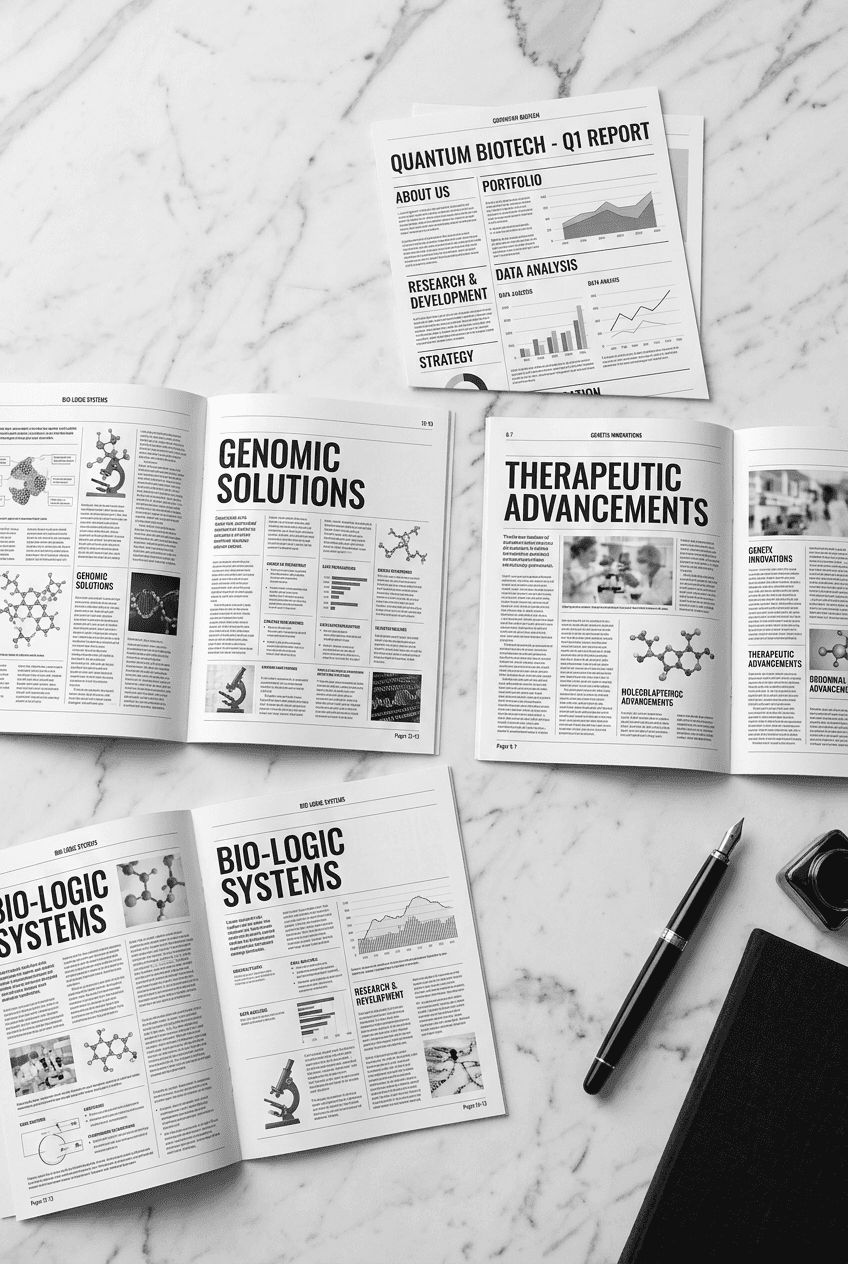

A biotech brochure that requires a PhD to read has failed its primary job: making the person who picks it up want to keep the conversation going.
The Purpose Problem in Biotech Brochure Design
Before designing a biotech brochure, you need to answer one question with brutal honesty: what do you want the person who picks this up to do next? Most biotech brochure projects skip this question entirely. The brief is "we need a brochure," the science team provides content, the design team formats it, and the result is a document that describes the company comprehensively but persuades no one of anything.
A biotech brochure is a persuasion instrument. It operates in high-competition environments (conferences, partner meetings, investor events) where the audience has many other demands on their attention and no obligation to read yours. The brochure's job is to create enough clarity and conviction in sixty seconds that the reader either takes a next action (schedules a call, visits the website, follows up by email) or retains enough of the message that when the company contacts them later, the brand is already familiar.
According to research by the Content Marketing Institute's 2024 B2B Content study, 71% of B2B decision-makers in the healthcare and life sciences sector say they rarely or never read print collateral they receive at conferences beyond the first page. The design implication is significant: your entire message must function in the first page, with deeper layers available for the rare reader who goes further.
The Four Most Common Biotech Brochure Mistakes
Leading with the pipeline table. The pipeline table is a tool for scientific and investor audiences who already understand the company and want a status update. As an opening element of a brochure received by someone encountering the company for the first time, it communicates nothing to a non-specialist. It signals "this document is for someone else." The brochure that opens with the pipeline table has already lost the conference attendee who picked it up out of curiosity. Using regulatory-compliant language as the primary communication style. Regulatory-compliant language is precise, qualified, and defensible. It is also often impenetrable to anyone outside the regulatory and scientific community. Brochures written primarily in regulatory-compliance style communicate scientific rigor but not mission, purpose, or commercial vision. The solution is not to be less accurate. It is to lead with the accessible narrative and reserve the regulatory-compliant language for the supporting detail. Designing for completeness rather than impact. The impulse to include everything the company knows and does in a single brochure produces documents that are comprehensive and unreadable. A biotech brochure that covers the founding story, the science platform, all active programs, the leadership team, the advisory board, the manufacturing partnerships, and the company's values in a six-page document has created a reference document, not a communication tool. Choose one message per brochure format. Treating print as a smaller version of the website. The website can accommodate unlimited depth because readers navigate it interactively. The brochure must function as a single designed experience that communicates its message in a fixed sequence. Content that works on a website, where readers navigate to what interests them, often fails in a brochure, where the reader encounters everything in the order it was placed.
Designing for the Sixty-Second Reader
The design principle that should govern biotech brochure design is the sixty-second test: a reader who spends sixty seconds with this document should be able to answer three questions. What does this company do? Why does it matter? What should I do next?
The visual hierarchy of the brochure must make these three answers immediately accessible before any detail layer is encountered. This means:
The cover communicates identity and purpose in a single sentence. Not the tagline from 2019 that no one outside the marketing team understands. A plain-language statement of what the company is doing and why.
The opening spread (pages two and three in a standard six-page brochure, or pages one and two in a four-page format) communicates the scientific rationale and the commercial opportunity in language a sophisticated non-specialist can follow. This is where the mission statement lives, the problem being addressed, and the approach being taken.
The mid-section provides the evidence layer: pipeline status, key data readouts, platform summary, or partnership highlights depending on the company's stage and the brochure's audience.
The close communicates the next action: website address, contact information, upcoming events or presentations, or a clear invitation to continue the conversation.
Comparison Table: Low-Performance vs. High-Performance Biotech Brochure
Element | Low-Performance | High-Performance |
|---|---|---|
Cover message | Company name and logo only | Name plus one-sentence mission |
Opening content | Pipeline table or founding story | Problem-approach-why us in 150 words |
Language register | Regulatory-compliant throughout | Accessible narrative with technical detail layer |
Page count | 8 to 12 pages | 4 to 6 pages |
Visual design | Dense, text-heavy | Clean hierarchy, significant white space |
Call to action | Absent or buried | Explicit, prominent, single action |
Audience specificity | Generic | One version per primary audience |
Biotech Brochure Formats and When to Use Each
Not all biotech print collateral serves the same purpose, and trying to produce a single document that serves every audience creates a document that serves none of them well.
The company overview brochure is the primary identity piece. It communicates mission, platform, pipeline, team, and next steps. This is the document for general conference distribution and initial partner conversations. It should be designed for a non-specialist who is encountering the company for the first time. Four to six pages. The science platform one-pager is a single-page summary of the company's core scientific platform or mechanism of action. It is designed for scientific audiences who want the technical substance quickly: academic partners, potential clinical collaborators, and scientific advisory board candidates. Dense with correct detail but still structured for rapid comprehension. One page, front and back. The investor leave-behind is the physical companion to the investor meeting. It reinforces the key messages from the pitch, provides a reference document the investor can review after the meeting, and includes the contact information and next steps discussed. Two to four pages. The program-specific data sheet covers a single pipeline program: the indication, the mechanism, the clinical status, the key data, and the regulatory pathway. It is designed for clinical and regulatory partners and for investor due diligence conversations. One to two pages per program.
Print Quality as a Brand Signal in Biotech
In biotech, the physical quality of print collateral is a brand signal that is read consciously and unconsciously by sophisticated audiences. A company that distributes poorly printed materials on light stock is communicating something about its organizational standards that is separate from the content of the materials.
The print quality standard for biotech brochures should be: professional commercial printing (offset rather than digital for runs above 500 units), paper weight of 130gsm or above for text pages, cover stock of 350gsm minimum, and finishing (soft-touch lamination, spot UV, or uncoated artisan finishes) appropriate to the brand positioning. For companies with premium positioning, foil accents or embossing on the company name or key graphic elements add a tactile quality signal that reinforces the brand's premium character.
According to a 2023 print quality study by Two Sides North America focused on professional services and life sciences, 62% of B2B decision-makers say print collateral quality is a significant factor in their assessment of a company's professionalism and attention to detail. In biotech, where every signal about organizational quality matters, print quality is not a discretionary investment.
The Regulatory Review Process for Biotech Brochures
Every piece of biotech marketing collateral, including brochures, must go through an appropriate regulatory review process. The scope of review depends on the content.
For pre-clinical and early clinical stage companies, the primary compliance considerations are: accuracy of scientific claims (no statements unsupported by current data), appropriate qualification of clinical claims ("currently in Phase 1 clinical trials," not "in clinical trials"), and ABPI or PhRMA code compliance for any communications that could be characterized as promotional.
For companies with therapies in late-stage development or approaching commercialization, the regulatory review requirements expand significantly. All promotional materials must comply with applicable promotional materials regulations in each jurisdiction where they will be distributed. The regulatory team must be involved in the review of all print collateral before production.
The practical implication for brochure design: build the regulatory review timeline into the production schedule. A brochure that needs three rounds of regulatory review before it can be printed cannot be designed in two weeks. Plan for six to ten weeks from brief to delivery for any life sciences print collateral.
Internal Links
Biotech companies designing brochures alongside a broader brand identity development should start with biotech company branding for the foundational strategic work that precedes collateral design. Companies preparing for investor conferences should also review biotech pitch deck design for the complementary digital presentation materials. The visual identity foundation that should underpin all biotech print collateral is covered in biotechnology brand identity.
FAQ: Biotech Brochure Design
Q: How many pages should a biotech company brochure be?
A: Four to six pages for a general company overview. Most biotech companies overestimate how much content their audience will read and produce brochures that are two to three times longer than necessary. A six-page brochure that covers mission, platform, key programs, team, and next steps comprehensively is the maximum for general distribution. Audience-specific materials like investor leave-behinds or program data sheets can be shorter.
Q: Should a biotech company have one brochure or multiple versions?
A: Multiple versions for different audiences is significantly more effective than one document designed for everyone. A non-specialist conference brochure, a scientific platform one-pager, and an investor leave-behind serve their respective audiences far better than a single document trying to do all three jobs simultaneously. The shared elements (visual identity, brand language, contact information) maintain consistency across all versions.
Q: When should a biotech company update its brochures?
A: At minimum annually and at every significant data readout, clinical milestone, or pipeline update. Brochures that describe the company's status as of eighteen months ago are often worse than no brochure because they create confusion about the current state of the pipeline. For active conference-attending companies, a quarterly review of all print collateral against current pipeline and messaging is good practice.
Q: Is print collateral still relevant in a digital-first world?
A: Yes, specifically in the contexts where biotech companies most need it: conferences, investor meetings, and partner conversations. These are high-stakes face-to-face interactions where a physical document serves a different function than a digital one. It gives the conversation a tangible artifact. It is something the investor or partner takes away from the interaction. It occupies physical space in their office or bag in a way that an emailed PDF does not. The investment in quality print collateral for these specific contexts remains high-return.
Q: How do you brief a designer on a biotech brochure?
A: With a written strategy document before any design work begins. The brief should specify: the primary audience, the single most important message, the secondary messages in priority order, the call to action, the content that must be included (and the content that must not be), the regulatory requirements, the brand standards to be followed, and the production specifications and timeline. A designer who begins a biotech brochure without a written brief will produce something that needs multiple rounds of structural revision, which is expensive and slow.
I am Tambi Haşpak, a brand strategist and creative director with an unfair advantage: I am a pharmacist. I run a creative studio for cosmetics, supplements and beyond. Seventeen years in this category. Exclusively.