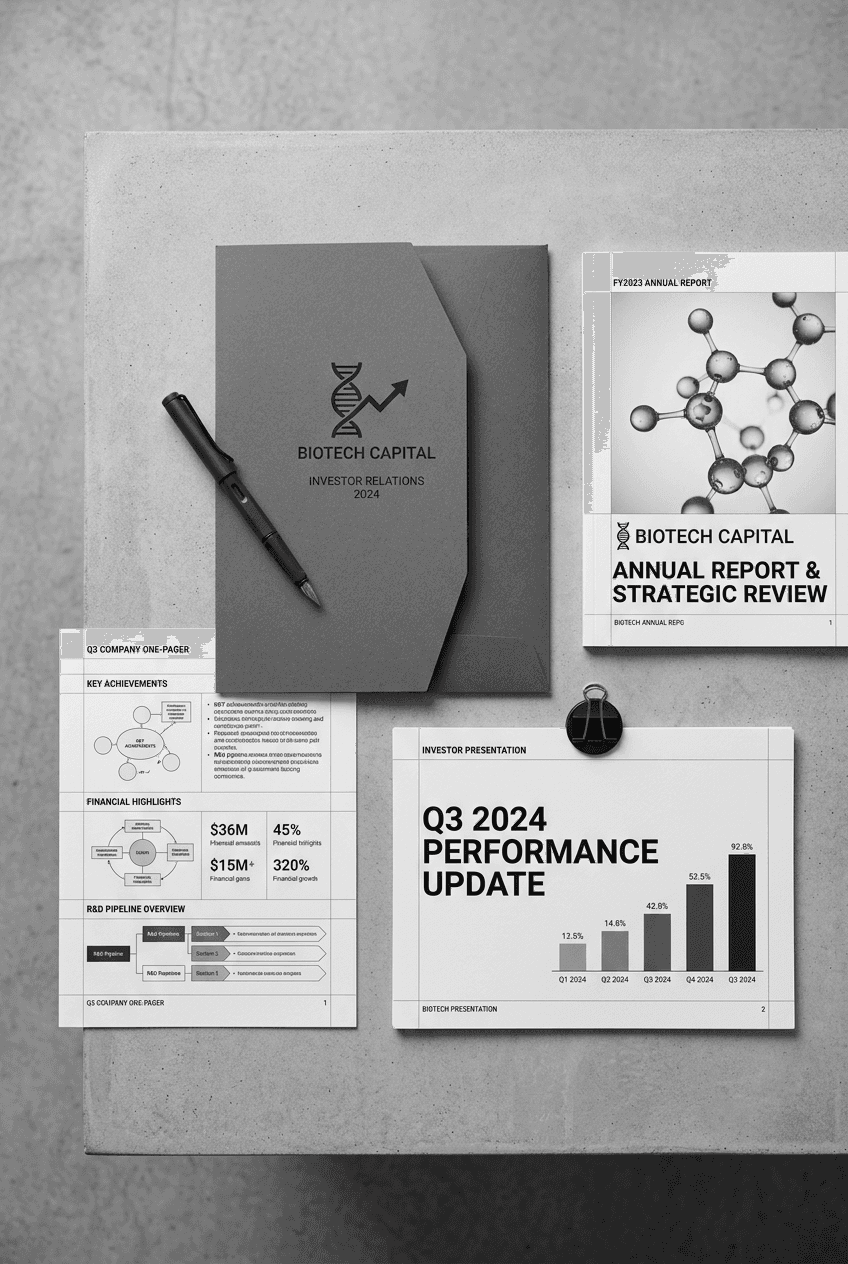

The pitch deck gets you the first meeting. The investor communications ecosystem is what closes the round. Every material in that ecosystem is either building conviction or leaking it.
The Full Investor Communications Ecosystem
Biotech investor communications extend well beyond the pitch deck. A biotech company in active fundraising will use a suite of investor-facing materials, each serving a specific function in the fundraising conversation. Understanding the full suite and designing it as a cohesive system is the difference between investor communications that build cumulative conviction and materials that leave the investor doing organizational work that the company should be doing for them.
According to a 2024 analysis of biotech Series A fundraising by Wilson Sonsini, the most common reason cited by investors for declining to proceed past initial meetings was "insufficient clarity in the company's materials about the development path and use of proceeds." This finding directly implicates the quality of investor communications design: clarity is a design outcome, not just a content outcome. Materials that contain the right information but present it in a way that requires the investor to synthesize it are failing the clarity standard.
The biotech investor communications ecosystem includes: the teaser or executive summary (the first material sent in cold outreach), the pitch deck (the primary meeting presentation), the data room (the full due diligence package), the one-pager (the leave-behind or digital summary), the corporate fact sheet (the persistent reference document), and investor update materials (for existing investors between reporting periods).
The Teaser or Executive Summary
The teaser is often the first piece of written communication an investor receives from a biotech company. Its job is to communicate enough about the company, the science, and the opportunity to generate a response to the meeting request.
An effective biotech teaser covers four things in one page: the unmet medical need and its scale, the company's approach and why it is differentiated, the team's key credentials, and the current stage with the funding ask. It should be a designed document, not a dense text email. The visual quality of the teaser signals the quality of the team's communication standards before the investor has seen any other materials.
The teaser should be sent as a PDF, not in the body of an email, so that it can be forwarded by the investor to colleagues without losing its design quality. The file should be under 5MB, optimized for quick email download, and should not require a password to open.
The One-Pager
The one-pager is the physical or digital leave-behind from an investor meeting. Its purpose is different from the pitch deck: while the deck is designed to be presented and spoken to, the one-pager is designed to be read independently by someone who was not in the room and needs to understand the investment case from the document alone.
A well-designed biotech one-pager covers: company overview, the problem and the approach, pipeline stage, key data highlights, team summary, funding ask and use of proceeds, and contact information, all on a single designed page. The design must balance information density with readability: every element on the page earns its place, and the visual hierarchy guides the reader through the key messages in the intended order.
The one-pager is often the document that gets shared internally at investment firms: the analyst who was in the meeting shares it with the partner who was not. It must be able to make the investment case without the verbal presentation that accompanied the deck.
The Corporate Fact Sheet
The corporate fact sheet is the persistent reference document for the company's key information: company overview, pipeline, team, key milestones, funding history, and contact information. Unlike the teaser (which is designed for outreach) or the one-pager (which is designed for post-meeting follow-up), the fact sheet is designed to be the always-accurate, always-current summary of what the company is and where it is.
The fact sheet should be updated at every significant milestone and should be the document a company sends when an investor asks for "a brief summary" or "something to share with my partner." It should be two to four pages, professionally designed, and immediately recognizable as belonging to the company's visual identity system.
Comparison Table: Biotech Investor Communications Materials
Material | Primary Purpose | Length | Primary Audience | Update Frequency |
|---|---|---|---|---|
Teaser | Generate meeting request | 1 page | New investor prospects | Per fundraising round |
Pitch deck | First and subsequent meetings | 12-15 slides | Active investor pipeline | Per funding round |
One-pager | Post-meeting leave-behind | 1 page | Investor + internal sharing | Per significant update |
Corporate fact sheet | Reference document | 2-4 pages | All investor interactions | Per significant milestone |
Data room | Due diligence | Comprehensive | Investors proceeding to term | Per round close |
Investor update | Portfolio management | 1-2 pages | Existing investors | Quarterly |
The Data Room as a Brand Asset
The data room is the comprehensive due diligence package that investors in advanced conversations receive. Most biotech companies treat the data room as a functional document repository rather than a brand expression, and the result is a package of inconsistently formatted, poorly organized documents that communicate the opposite of the organizational precision the brand is trying to project.
A well-organized data room is itself a brand statement. A data room with a clear organizational structure, consistently formatted documents, a logical navigation system, and materials that are current, complete, and professionally presented communicates that the company has the organizational discipline and attention to detail that predicts execution quality.
The minimum standards for a biotech data room: all documents in consistent format with the company's brand identity applied, a clear organizational structure with a labeled index, all materials dated and version-controlled, and a data room overview document that explains the structure and guides the investor through the due diligence process.
Investor Update Communications
After a funding round closes, the investor communications job does not end. Existing investors need regular updates on the company's progress, and the quality of those updates shapes their confidence in the management team and their willingness to participate in future rounds.
Quarterly investor updates should cover: progress against the milestones committed in the funding round, key scientific, clinical, and operational achievements, team updates, financial summary, and forward-looking milestones for the next quarter. They should be designed as branded documents, not plain-text emails, and should be sent as PDFs with the company's brand identity applied consistently.
According to research by Osage Venture Partners (2023) on biotech investor relations best practices, companies that sent quarterly branded investor updates with structured reporting closed their next funding rounds in an average of 4.2 months, compared to 7.8 months for companies with inconsistent or informal investor communications. The quality and consistency of ongoing investor communications builds the trust that makes the next conversation easier.
Internal Links
Biotech companies building a complete investor communications package should start with the pitch deck, covered in biotech pitch deck design. The brand identity foundation that all investor materials should express consistently is covered in biotech company branding and life sciences brand identity. Companies also preparing conference materials should review biotech conference materials design.
FAQ: Biotech Investor Communications Design
Q: How different should investor materials look from general company communications?
A: The design language should be consistent with the company's overall brand identity, but investor materials should apply the identity with particular precision and formality. Investor audiences have high standards for communications quality and will notice inconsistencies, outdated information, or design quality below the standard they expect from a company seeking their capital.
Q: Should all investor materials be in the same visual style?
A: Yes. Visual consistency across all investor-facing materials creates a cumulative brand impression that builds confidence in the organization's consistency and attention to detail. An investor who encounters the teaser, the deck, and the one-pager in three different visual styles is receiving a signal of organizational inconsistency. All materials should belong visibly to the same brand system.
Q: How do you handle confidential information in investor materials?
A: Through a tiered approach: public materials (teaser, one-pager, fact sheet) contain only publicly disclosed information. The pitch deck may contain information disclosed under NDA. The data room contains full due diligence information for investors who have signed a comprehensive NDA. This tiered approach ensures that the most sensitive information is protected while enabling the earlier-stage materials to be shared broadly in the fundraising process.
Q: Is it worth hiring a specialist design firm for investor communications?
A: Yes for the core materials (pitch deck, one-pager, fact sheet) that will be used repeatedly across an entire funding round. General design studios without life sciences experience often produce visually polished materials that fail the scientific credibility test with sophisticated investors. Life sciences specialist studios understand both the design standards and the content requirements of biotech investor communications and produce materials that work on both dimensions.
Q: How often should investor materials be refreshed?
A: The pitch deck should be refreshed at every significant data readout, pipeline update, or strategic development. The one-pager and fact sheet should be updated at each significant milestone. The investor update should be produced quarterly. Materials that are known to be out of date should not be distributed: an investor who discovers that materials they were sent contain outdated pipeline information will question the accuracy of everything else.
I am Tambi Haşpak, a brand strategist and creative director with an unfair advantage: I am a pharmacist. I run a creative studio for cosmetics, supplements and beyond. Seventeen years in this category. Exclusively.