
At JPM, everyone is wearing a badge and carrying a pitch. What makes a company memorable after a three-day conference is not the scientific detail. It is the clarity and quality of how it showed up.
The Conference as a Brand Moment
Major biotech conferences are not just networking events. They are concentrated brand exposure moments where the quality of a company's physical and digital presence is evaluated by the same investors, partners, and competitors who will be making decisions about the company over the following twelve to twenty-four months. The impression made at a conference compounds in both directions: a strong brand presence generates follow-up conversations and ongoing positive associations, and a weak brand presence creates associations that subsequent communications have to overcome.
According to a 2024 survey by EY of biotech investor behavior at major life sciences conferences, 67% of investors report that their initial impression of a company's brand and materials quality influences their assessment of the management team's execution capability. A team that shows up at BIO International with poorly designed materials is implicitly communicating something about how seriously they approach organizational quality. Sophisticated investors notice.
The specific conferences that matter most for biotech brand presence are: the JP Morgan Healthcare Conference (investor-focused, high concentration of healthcare investment decision-makers), BIO International Convention (partnership and deal-focused, broad industry audience), ASCO Annual Meeting (oncology-focused, scientific and clinical audience), ASH (hematology), ESMO (European oncology), and EHA (European hematology). Each conference has a slightly different primary audience, which influences the materials priority and the messages that should be emphasized.
The Conference Materials Stack
A fully equipped biotech conference presence requires a defined set of materials, each serving a specific function in the conference environment.
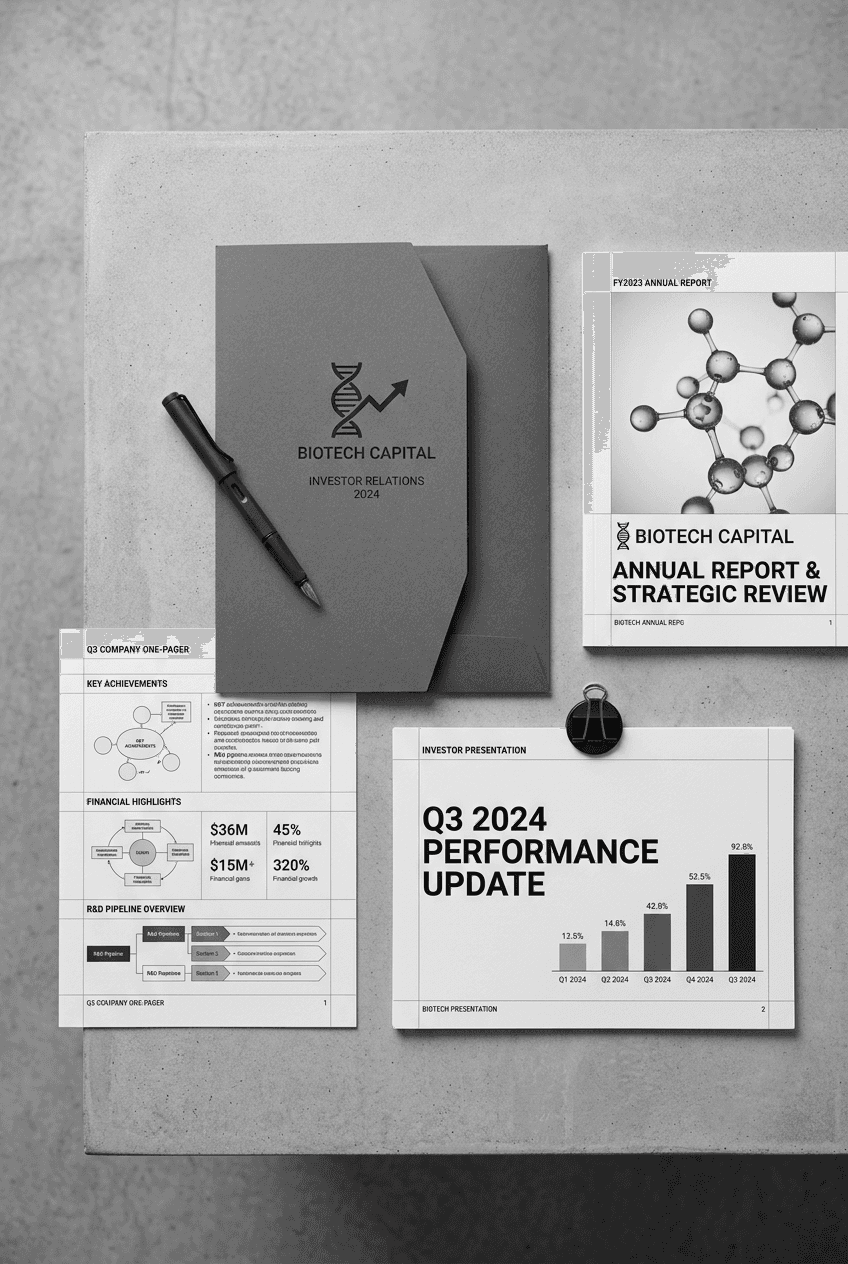
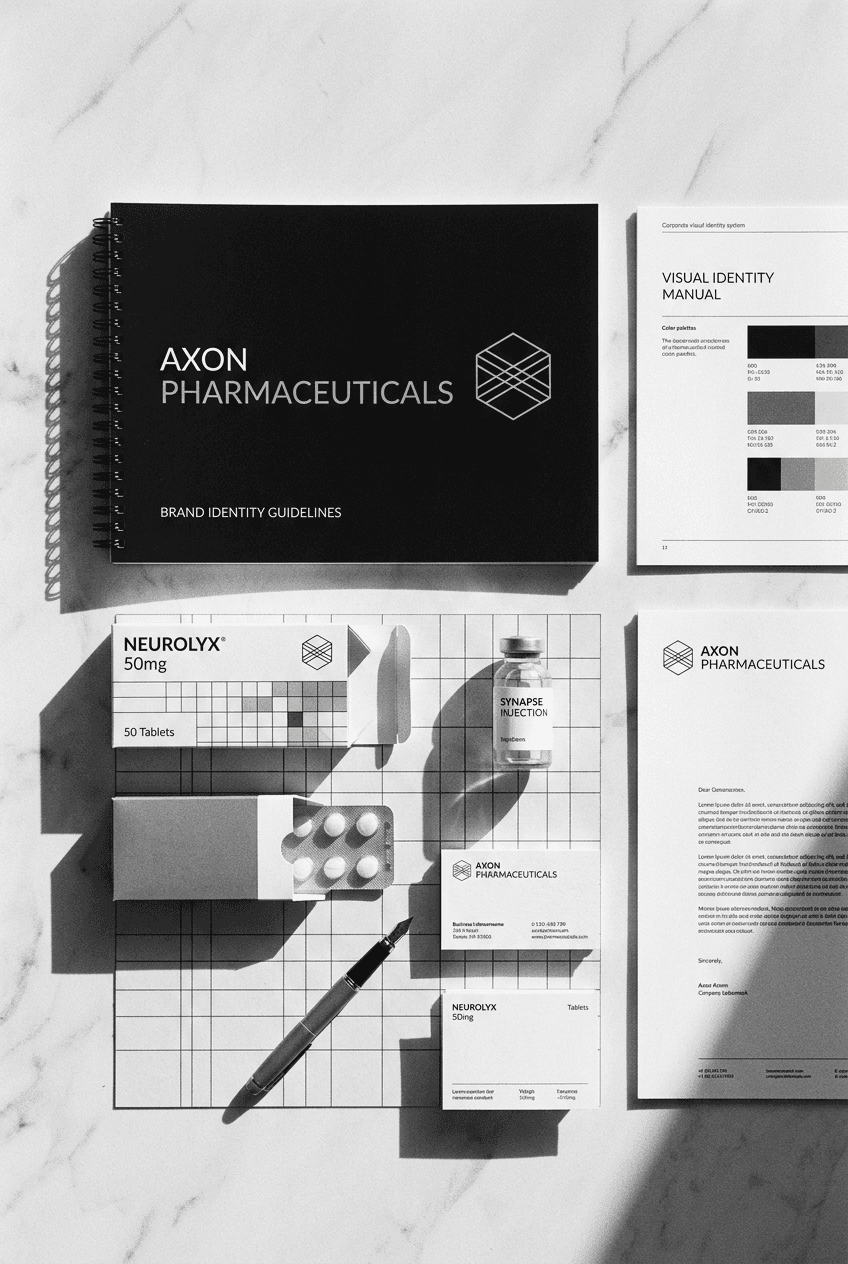
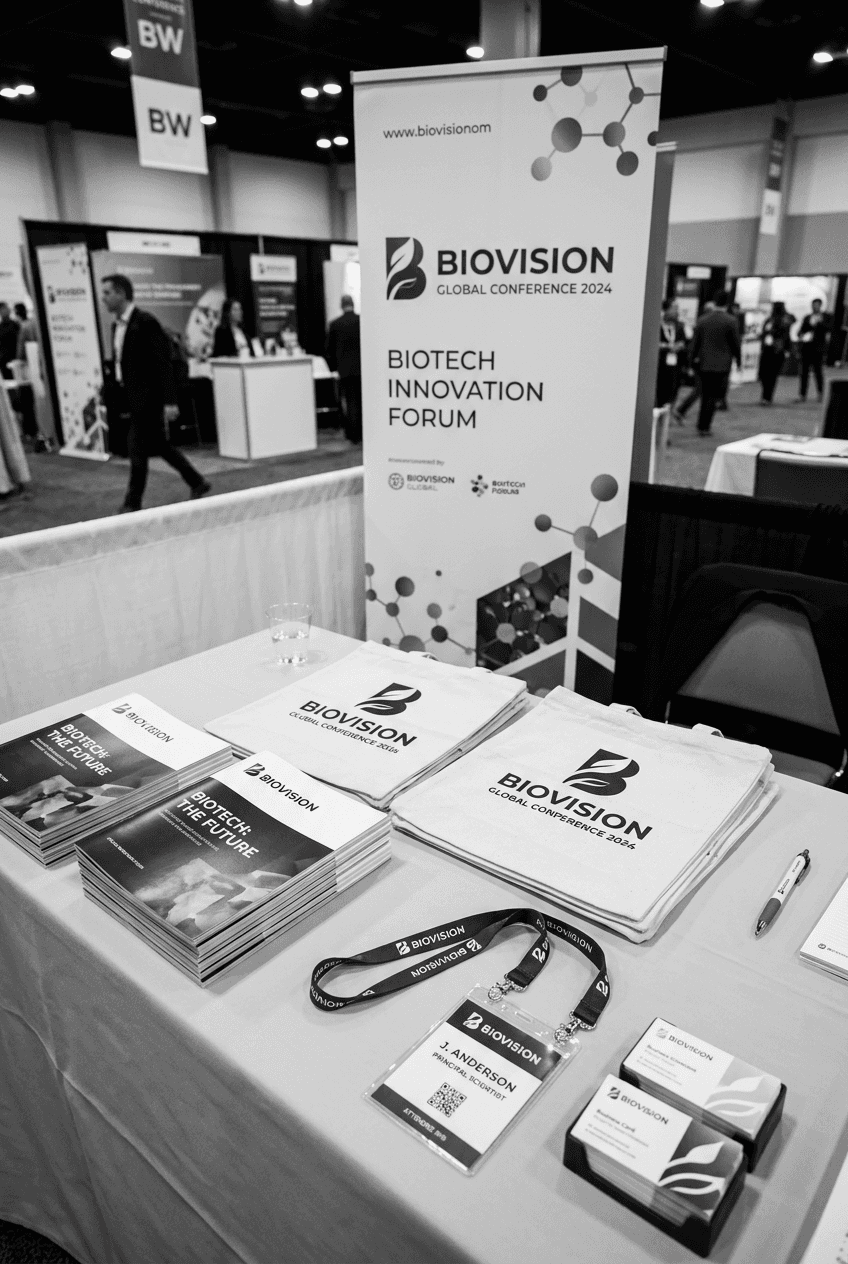
The booth or table presence is the physical brand anchor at a conference. For companies with booth space, this includes: a branded backdrop or banner, a table cover or display surface, and any display systems (monitor, stand-alone displays, tablet stands) that present the company's content. The visual design of the booth presence must communicate the brand identity immediately at the viewing distance relevant to the conference environment, which for most conference booth setups is ten to twenty feet. The brochure is the leave-behind that conference contacts take away from the interaction. Conference brochures must be designed for the brief, distracted reading that happens in a hotel lobby or evening after the conference. The four-page format with one message per page and an invitation to follow up on the back cover is the most reliable format for conference contexts. The one-pager is a faster, more focused version of the brochure designed for investors who want a specific summary rather than a company overview. The investment thesis, pipeline stage, and funding ask should be immediately legible. One page, front only, designed for reading on a plane. The digital presentation is the laptop or tablet content used during booth interactions. Unlike the pitch deck designed for a meeting room presentation, the conference digital presentation should function as an interactive conversation tool: a visual background to the in-person conversation rather than a formal presentation to be worked through sequentially. The conference bag insert is the material placed in conference tote bags, where it exists. Given the competition for attention in conference bags, this material must have a strong reason for a distracted conference attendee to pick it up and read it. A provocative question or bold statement on the front, with a brief company overview and contact on the back, outperforms generic company overviews in bag insert contexts.
Designing for the Conference Environment
Conference environments impose specific design constraints that differ from other contexts. The light is often mixed and unflattering for print materials. The viewing conditions are distracted: people are standing, carrying bags, engaged in conversation. The competition for visual attention is intense. The materials must work in these conditions, not in the controlled conditions of a design studio.
Contrast and legibility. Conference materials must have higher visual contrast than materials designed for desktop or controlled reading environments. Text on white backgrounds with standard body text sizes becomes difficult to read in conference lighting conditions. Use sufficient contrast ratios (WCAG AA minimum for accessibility, higher for conference environments) and larger text sizes than you would for materials designed for focused reading. Hierarchy that works at multiple distances. The headline message of a banner or poster should be readable at twenty feet. The section headers should be readable at five feet. The body text is read at arm's length and does not need to be legible at a distance, but should never be below 9pt even in print. Color performance in print. Not all colors perform equally well in print. Neon or highly saturated screen colors can appear muddied or shift significantly when converted to CMYK for print production. Conference materials should be designed in CMYK from the start or converted carefully from RGB with proof review before production.
Comparison Table: Minimal vs. Full Conference Materials Stack
Material | Minimal Presence | Full Presence |
|---|---|---|
Booth presence | Pull-up banner | Backwall, table, display system |
Brochure | None or photocopied | Professionally printed, 4-6 pages |
One-pager | Simple fact sheet | Professionally designed, investor-ready |
Digital content | Deck repurposed | Conference-specific interactive presentation |
Business cards | Standard printed | Branded, premium stock |
Leave-behind item | None | Branded, useful, specific to conference context |
Bag insert | None | Designed for distracted reading |
Production Planning for Conference Materials
Conference materials have non-negotiable deadlines: the conference date. Production planning must account for design, approval, print production, and shipping lead times, all of which are longer than most teams assume.
Design timeline: three to four weeks for new materials, one to two weeks for updates to existing materials. Print production timeline: five to ten business days for standard materials, two to three weeks for specialty printing (soft-touch lamination, spot UV, foil). Shipping timeline: three to five business days domestic, ten to fifteen days international. The total lead time from brief to conference arrival is typically six to eight weeks for new materials.
The most common conference materials disaster is a production crisis in the final week before the conference because the design timeline was not started early enough. The regulatory and scientific review process required for biotech conference materials adds additional time to the production cycle that must be planned for, not discovered at the last moment.
Conference-Specific Messaging Adaptation
Different conferences have different primary audiences, and the messaging of conference materials should be adapted accordingly. The materials designed for JP Morgan Healthcare should emphasize the investment thesis and financing milestone story. The materials designed for BIO International should emphasize partnership opportunities and platform breadth. The materials designed for ASCO should emphasize clinical data and patient impact.
This does not require producing entirely different materials for every conference. It requires a modular design approach where the core brand elements remain consistent while the lead messaging and content emphasis can be updated for each conference context. A well-designed modular materials system allows conference-specific updates to be made efficiently without rebuilding materials from scratch.
Internal Links
Biotech companies building a complete communications materials system for conferences and beyond should review biotech investor communications design for the investor-facing materials that complement conference presence, and biotech brochure design for the detailed print collateral strategy. The brand identity foundation that all conference materials should express is covered in life sciences brand identity.
FAQ: Biotech Conference Materials Design
Q: How much should a biotech company budget for a major conference like BIO or JPM?
A: For a company attending as an exhibitor at a major biotech conference, the total materials budget typically ranges from $8,000 to $25,000 depending on the extent of the booth presence and the number of materials pieces needed. This covers design, print production, and shipping. For companies attending in a meeting-only capacity without a booth, the materials budget is $2,000 to $6,000 for professionally designed and printed one-pagers, brochures, and business cards.
Q: Should conference materials be the same at every conference?
A: The brand identity and core design should be consistent across all conferences. The messaging emphasis should be adapted to the primary audience at each event. The pipeline stage information must be current at each conference, which means materials should be reviewed and updated before every major conference to ensure the pipeline page reflects the current status.
Q: What is the most important single piece of conference material?
A: The one-pager for investor-focused conferences like JPM, and the brochure for scientific and partnership-focused conferences like BIO and ASCO. The one-pager wins the investor context because investors at JPM are conducting rapid triage across dozens of companies and need a single clear document that makes the investment case quickly. The brochure wins the partnership context because scientific and commercial partners want enough substance to understand whether a conversation is worth having.
Q: How do you prevent materials from looking outdated at a conference?
A: By treating conference attendance as a scheduled materials review trigger. Every confirmed conference attendance should initiate a review of all materials planned for that conference, checking pipeline status, team composition, funding history, and messaging against the current reality of the company. Materials that cannot be updated in time for the conference should be reprinted with current information rather than distributed with known inaccuracies.
Q: What digital conference presence matters beyond the physical booth?
A: The conference website profile (if the conference publishes an attendee directory), the company's LinkedIn activity before and during the conference, and the preparedness of the team to share digital versions of materials immediately by email or sharing link during or after in-person conversations. An investor who receives a beautifully designed PDF of the one-pager by email within an hour of meeting the team at a conference is receiving a follow-through signal that reinforces the quality impression made in person.
I am Tambi Haşpak, a brand strategist and creative director with an unfair advantage: I am a pharmacist. I run a creative studio for cosmetics, supplements and beyond. Seventeen years in this category. Exclusively.