
Packaging cost is not a single number; it is a calculation based on material, format, complexity, manufacturing region, and volume. Get these variables wrong and your packaging budget will either be too high or you will compromise quality.
The Real Cost of Cosmetics Packaging: The Nine Variables
Cosmetics packaging cost is driven by nine primary variables. Understanding each variable is how you allocate your budget intelligently and avoid surprises. The first variable is material choice. Are you using plastic, glass, aluminum, or laminate? Glass costs more than plastic. Opaque glass costs more than clear glass. High-grade glass costs more than commodity glass. Material choice is the first major cost decision, and it flows through the entire budget.
The second variable is format. Are you packaging a cream in a 30ml jar, a 50ml bottle, or a 100ml tube? Volume directly impacts cost. A 30ml jar typically costs between forty cents and one dollar depending on material and finish. A 50ml bottle might cost between thirty-five cents and ninety cents. A 100ml tube might cost between twenty cents and seventy cents. The ratio is not linear; as volume increases, per-unit cost typically decreases, but this depends entirely on the specific packaging selected.
The third variable is minimum order quantity (MOQ). MOQ is the minimum number of units a supplier will manufacture in a single run. MOQ ranges from 5,000 units for some suppliers to 50,000 units for others. Lower MOQ typically means higher per-unit cost because manufacturing runs are expensive regardless of volume. Higher MOQ typically means lower per-unit cost because the fixed manufacturing costs are spread across more units. This is the most misunderstood variable in cosmetics packaging cost, and it accounts for dramatic price variation.
The fourth variable is manufacturing region and supplier relationship. Packaging manufactured in China costs significantly less than packaging manufactured in Europe or North America. However, lower cost often comes with longer lead times (typically eight to twelve weeks for international manufacturing), minimum order quantities (typically 10,000 to 50,000 units), and quality consistency issues. Local manufacturing costs more per unit but may offer faster turnaround and smaller MOQ. The decision between international and local manufacturing is partly about cost and partly about timeline and quality control.
The fifth variable is label and printing complexity. A simple one-color printed label costs less than a multi-color label. A simple printed label costs less than a label with die-cuts, foiling, or embossing. A label printed on standard materials costs less than labels on specialized materials like metallic or textured stock. If you are printing directly onto packaging (not using a separate label), this directly impacts the packaging cost. A basic offset printed jar might cost thirty cents more than the blank jar. A jar with multi-color direct printing might cost forty to sixty cents more.
The sixth variable is finish and specialty effects. Are you using standard finishes like matte or glossy? Or are you using specialty finishes like soft-touch coating, metallic finishes, or special textures? Soft-touch coating adds typically fifteen to thirty cents per unit. Foiling (metallic accents) adds typically ten to twenty-five cents per unit depending on coverage. Textured surfaces add ten to twenty cents per unit. These finishes are what make packaging stand out visually, but they carry real cost implications.
The seventh variable is closure and hardware. A simple plastic cap might cost five to ten cents. A luxury pump dispenser might cost fifty cents to one dollar. A magnetic closure might cost thirty to sixty cents. A custom closure designed specifically for your brand might cost significantly more depending on mold costs. The closure is an easily overlooked cost driver that can dramatically impact your per-unit packaging cost.
The eighth variable is customization and mold costs. If you are using standard, existing packaging formats, you have no mold costs. If you are creating a custom shape or custom features, you pay for mold creation, which typically ranges from 1,500 dollars to 15,000 dollars depending on complexity. This mold cost is then amortized across your production volume. If your MOQ is 5,000 units and mold cost is five thousand dollars, you are adding one dollar per unit just for the mold. If your MOQ is 50,000 units, you are adding ten cents per unit. This is why custom packaging is more viable at scale.
The ninth variable is quantity discounts and supplier terms. Most packaging suppliers offer volume discounts. Your cost for 5,000 units might be one dollar per unit. Your cost for 10,000 units might be eighty cents per unit. Your cost for 25,000 units might be sixty cents per unit. These discounts are cumulative and substantial. Additionally, your supplier relationship and payment terms affect cost. Paying cash or deposit might get you a discount. Negotiating payment terms might be possible if you are ordering volume.
Packaging Cost By Material: The Comparison Table
Material | Typical Cost Range Per Unit | Best For | Durability | Premium Feel | Sustainability |
|---|---|---|---|---|---|
Plastic (standard) | 20 cents to 50 cents | Mass market, low budget, lightweight | Medium | Low | Poor |
Plastic (specialty) | 40 cents to 80 cents | Value brands, lightweight | Medium | Medium | Medium |
Glass (standard) | 40 cents to 1.20 dollars | Mid-market and premium | High | High | Good |
Glass (colored/opaque) | 60 cents to 1.50 dollars | Premium, light-sensitive formulas | High | High | Good |
Aluminum | 50 cents to 1.50 dollars | Premium, sustainability positioning | Very High | Very High | Excellent |
Laminate/Tube | 15 cents to 50 cents | Creams, ointments, value brands | Medium | Low to Medium | Medium |
Breaking Down a Real Packaging Budget: Five Examples at Different Brand Tiers
Let me show you five realistic packaging cost scenarios at different brand tiers. These are based on actual projects I have quoted and executed.
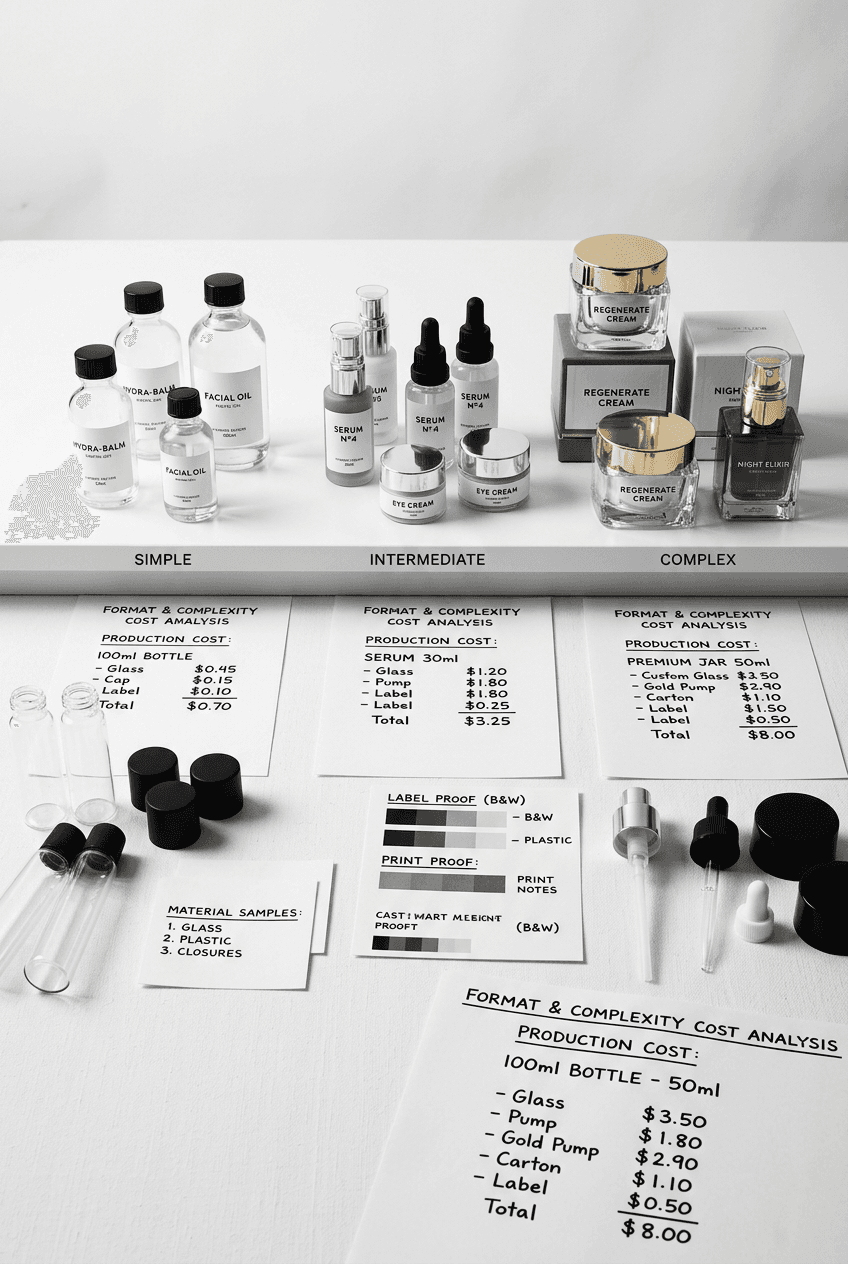
Example One: Mass-Market Cleanser. 100ml plastic bottle with basic one-color label, plastic cap, MOQ 10,000 units, manufacturing in China. Bottle cost: thirty cents. Label: eight cents. Cap: seven cents. Shipping and overhead: five cents. Total per-unit cost: fifty cents at 10,000 units. This is typical for mass-market drugstore brands.
Example Two: Mid-Market Moisturizer. 50ml glass jar with two-color label and soft-touch coating, plastic cap with ring, MOQ 5,000 units, manufactured locally. Jar cost: sixty cents. Label and printing: twelve cents. Soft-touch coating: twenty cents. Cap with ring: twenty cents. Mold cost amortized (one-time five thousand dollar custom jar): one dollar per unit. Shipping and overhead: fifteen cents. Total per-unit cost: 2.27 dollars at 5,000 units. This is typical for direct-to-consumer and indie brands.
Example Three: Premium Serum. 30ml glass bottle with foil and multi-color printing, luxury dropper with glass rod, MOQ 3,000 units, manufactured in Europe. Bottle cost: eighty cents. Label and foil: thirty cents. Dropper assembly: sixty cents. Mold cost amortized (one-time eight thousand dollar custom bottle): 2.67 dollars per unit. Shipping and overhead: thirty cents. Total per-unit cost: 4.57 dollars at 3,000 units. This is typical for premium indie and luxury brands.
Example Four: Luxury Cream. 50ml bespoke glass jar with textured finish and custom closure, two-color foil-stamped label, MOQ 2,000 units, manufactured in Europe. Jar cost: 1.50 dollars. Textured finish: twenty cents. Custom closure: eighty cents. Label and foiling: forty cents. Mold cost amortized (one-time twelve thousand dollar custom jar): six dollars per unit. Shipping and overhead: forty cents. Total per-unit cost: 9.30 dollars at 2,000 units. This is typical for luxury and high-end indie brands.
Example Five: Sustainable, Refillable Format. 100ml refillable glass bottle with aluminum cap, one-color printed label on recycled paper, MOQ 15,000 units, manufactured in Europe with carbon offset shipping. Bottle cost: seventy cents. Aluminum cap: forty cents. Label on recycled paper: ten cents. No mold cost (standard refillable format). Shipping and carbon offset: twelve cents. Total per-unit cost: 1.32 dollars at 15,000 units. This is typical for brands positioning sustainability.
These five examples show why the answer to "how much does packaging cost?" is always: it depends. The per-unit cost ranges from fifty cents to nine dollars thirty cents depending on format, material, finish, and volume. The same skincare brand might use fifty-cent packaging for a product line and nine-dollar packaging for a premium line.
How to Allocate Your Total Packaging Budget
When you are planning your product launch, you need to allocate your total packaging budget across multiple decisions. First, decide what percentage of your product cost should be packaging. For mass-market products, packaging is typically ten to fifteen percent of product cost. For mid-market products, packaging is typically fifteen to twenty-five percent. For premium products, packaging is typically thirty to forty percent. This is your budget constraint.
If your target product cost is ten dollars and you want packaging to be twenty-five percent of cost, you have a 2.50-dollar packaging budget per unit. This needs to cover bottle, label, cap, and shipping. This budget constraint now forces you to make decisions. Can you afford glass? Probably not at this budget; you need to choose plastic or laminate. Can you afford custom closures? Not at this budget; you need to choose standard closures. Can you afford complex printing? Limited to two colors, possibly. Can you afford specialty finishes? Typically not.
Alternatively, if your target product cost is thirty dollars and you want packaging to be thirty-five percent of cost, you have a 10.50-dollar packaging budget per unit. At this budget, you can afford high-quality glass, a custom closure, foiling, specialty finishes, and complex printing. Your packaging choices are dramatically different based on this budget constraint.
The second allocation decision is: what percentage of packaging budget goes to each element? Typical allocation might be: container sixty percent, closure twenty percent, label fifteen percent, and shipping and overhead five percent. At a 2.50-dollar budget: container 1.50 dollars, closure 0.50 dollars, label 0.37 dollars, overhead 0.13 dollars. At a 10.50-dollar budget: container 6.30 dollars, closure 2.10 dollars, label 1.57 dollars, overhead 0.53 dollars. This allocation framework helps you make proportional decisions.
The MOQ Trap: How Minimum Order Quantities Distort Your Budget
Minimum order quantity is where many founders make expensive mistakes. A supplier quotes you fifty cents per unit for 10,000 units, and you think: great, I will order 10,000. Then you realize that 10,000 units is far more than you need. You wanted 3,000 units. Now you have 7,000 extra units sitting in your warehouse, and your packaging cost budget has exploded.
Here is the reality: many suppliers have MOQ of 5,000 to 10,000 units. Some suppliers have MOQ of 25,000 or 50,000 units for custom work. Before you commit to a supplier, you need to understand their MOQ and whether your sales volume supports that MOQ. If you sell 500 units a month, an MOQ of 10,000 units means you have six months of inventory sitting in your warehouse. This ties up cash and creates storage costs.
The strategy to manage MOQ is threefold. First, research suppliers with lower MOQ if you are launching small. Many local suppliers or boutique manufacturers have MOQ of 2,000 to 3,000 units. Your per-unit cost will be higher, but you will not have excess inventory. Second, as you scale, you can move to suppliers with higher MOQ and lower per-unit cost. This is a strategic phased approach. Third, consider shared manufacturing or shared mold investment if multiple brands are using the same custom packaging. Some packaging manufacturers will split mold costs across multiple customers.
Regional Manufacturing: Cost vs. Timeline vs. Quality
The decision between international and local manufacturing has direct cost implications. Manufacturing in China typically costs thirty to fifty percent less than manufacturing in Europe or North America. However, this cost savings comes with trade-offs. International manufacturing typically requires eight to twelve-week lead times. Minimum order quantities are typically higher (10,000 to 50,000 units). Quality consistency requires significant oversight and possibly travel for quality checks.
Local manufacturing costs more per unit but offers faster turnaround (two to four weeks typically), lower MOQ (2,000 to 5,000 units typically), and easier quality control. For brands launching their first product or scaling volume unpredictably, local manufacturing often makes more financial sense despite higher per-unit cost, because the cost savings from higher volume with international manufacturing are offset by excess inventory carrying costs.
I recommend that new brands start with local or regional manufacturing at a slightly higher per-unit cost. This allows you to launch faster, test the market with lower inventory risk, and scale to international manufacturing once you have validated demand and established stable volume. Some brands reverse this and source internationally from day one, which can work if you have strong sales projections and capital to support inventory.
Hidden Costs That Surprise Founders
Beyond per-unit packaging cost, there are several hidden costs that founders often overlook. First is freight and logistics. If you are manufacturing internationally, freight is a major cost. Ocean freight from China might be four to eight cents per unit. Air freight might be forty to eighty cents per unit. For 10,000 units, the difference between ocean and air freight is significant.
Second is storage and warehousing. If you manufacture 10,000 units but only sell 300 units per month, you need warehouse space for six to eight months of inventory. Warehouse space typically costs one to three cents per unit per month depending on location. Over six months, this is six to eighteen cents per unit in storage costs.
Third is quality control and inspection. If you are sourcing internationally, you should budget for third-party inspection or quality control visits. This might be one thousand dollars to five thousand dollars per production run, which amortizes to ten to twenty cents per unit depending on volume.
Fourth is packaging design and artwork files. If you are working with a designer or design agency to create your packaging artwork, this is typically one thousand to three thousand dollars for initial design. If you are making changes to the design, additional revisions are typically two hundred to five hundred dollars each. These design costs should be factored into your overall packaging budget, though they are typically separate from per-unit manufacturing cost.
When Custom Packaging Makes Sense vs. When Standard Packaging Is Smarter
Custom packaging makes sense when your brand identity is distinctive enough to justify the extra cost and complexity. Custom packaging typically requires one-time mold or tooling costs of two thousand to fifteen thousand dollars depending on complexity. At your first manufacturing run, this is a significant per-unit cost. You need high enough volume to amortize this cost reasonably.
Custom packaging typically makes sense if: you are a premium brand where packaging is a core differentiator, you have strong sales projections and will sell 20,000 plus units within the first year, you have secured funding or capital to support the upfront investment, or you are creating a unique brand experience that cannot be replicated with standard packaging.
Standard packaging makes sense if: you are launching with limited capital or with unpredictable sales projections, you want to test market fit before investing in custom tooling, your brand positioning does not require bespoke packaging, or you need fast turnaround time. Many successful brands start with high-quality standard packaging and move to custom packaging once they have validated the market and achieved scale. This is a financially smarter approach for most founders.
Comparison Table: Standard vs. Custom Packaging Decision Framework
Factor | Standard Packaging | Custom Packaging |
|---|---|---|
Upfront Mold Cost | None | 2,000 to 15,000 dollars |
Per-Unit Cost | Lower at scale | Higher initially, lower as volume increases |
Lead Time | 6 to 10 weeks | 10 to 14 weeks typically |
Minimum Order | 5,000 to 10,000 units | 2,000 to 5,000 units often lower |
Differentiation | Limited | High |
Design Flexibility | Limited to existing formats | Full customization |
Launch Speed | Fast | Moderate |
Best For | Testing, value brands | Premium brands, scale-ups |
Sustainability and Cost: The Unexpected Relationship
Sustainable packaging often costs more per unit than conventional packaging. Glass costs more than plastic. Aluminum costs more than plastic. Recycled materials cost more than virgin plastic. However, sustainable packaging can become a marketing advantage and can command premium pricing that offsets the higher production cost.
I recommend that brands committed to sustainability think of the higher packaging cost as part of their brand positioning, not as a cost disadvantage. When you position your brand explicitly around sustainability and transparency, the higher packaging cost becomes part of the story. Your customer understands that sustainable packaging costs more, and many are willing to pay for it. The brands that succeed with sustainable packaging are the ones that own the cost premium honestly rather than trying to hide it.
Internal Links to Related Work
If you are focused on the design aspects of your packaging cost management, my guide to cosmetic packaging design covers how design decisions impact cost. I also address the specific challenges of sustainable beauty packaging if environmental responsibility is part of your positioning. For founders working specifically with direct-to-consumer channels, skincare packaging brief covers how to brief packaging designers effectively and factor cost into your design decisions. If you are working with a contract manufacturer or considering co-packing, cosmetics contract manufacturer covers the relationship between manufacturing and packaging cost implications.
FAQ: Cosmetics Packaging Cost
Q: Is it cheaper to buy packaging and manufacture formula separately or use a contract manufacturer?
A: Contract manufacturers typically include packaging cost as part of their all-in quote, and they leverage volume purchasing to get packaging at lower per-unit cost than small brands can achieve independently. However, you have less control over packaging choices and less flexibility if you want to change packaging. Sourcing packaging independently gives you more control and potentially more options, but you have to manage multiple suppliers and may not achieve the same per-unit pricing. For most new brands, contract manufacturing is more cost-effective. As you scale, sourcing independently becomes viable.
Q: How much should I budget for packaging design?
A: Packaging design typically costs between fifteen hundred and five thousand dollars for a new product launch. This includes designing the label, specifying colors and finishes, creating artwork files, and managing the first production run. If you are hiring a designer, budget around two thousand dollars. If you are hiring an agency, budget three to five thousand dollars. These are separate from manufacturing costs and should be factored into your total product development budget.
Q: What is the typical lead time for packaging manufacturing?
A: Standard packaging typically requires eight to ten weeks lead time from order to delivery, including manufacturing and freight time. Custom packaging typically requires ten to fourteen weeks. Local manufacturing offers faster turnaround, typically two to four weeks. If you need packaging faster, you may need to pay premium pricing for expedited manufacturing or air freight, which can be expensive.
Q: Can I change my packaging design after I order?
A: Changes to packaging after manufacturing begins typically cost significant money and time. If you want to change colors, finishes, or text, the supplier may need to stop production, remake molds, and restart, which can cost hundreds or thousands of dollars. This is why design approval is critical before you place the order. Review your packaging design thoroughly with multiple stakeholders before committing to manufacturing.
Q: How do I negotiate better packaging pricing?
A: Negotiation levers include: committing to higher volume, placing multiple orders over time, paying cash upfront, ordering multiple SKUs from the same supplier, and building long-term supplier relationships. Most suppliers will negotiate on price if you are a reliable, long-term customer. However, do not negotiate price at the expense of quality. A cheaper supplier who delivers inconsistent quality will cost you far more in the long run through product damage and customer dissatisfaction.
Q: Is it worth investing in custom closures for my brand?
A: Custom closures can be a strong brand differentiator and can justify premium pricing. However, custom closure costs can be significant, typically ranging from fifty cents to one-fifty dollars per unit. This is a worthwhile investment if your target customer values the brand experience and if your pricing supports the cost. For value and mass-market brands, standard closures are typically sufficient.
Q: What percentage of my product cost should be packaging?
A: This varies significantly by brand tier. Mass-market products typically allocate ten to fifteen percent of product cost to packaging. Mid-market brands allocate fifteen to twenty-five percent. Premium brands allocate twenty-five to forty percent. Ultra-luxury brands may allocate forty percent or more. Your packaging budget should align with your brand positioning and target retail price.
I am Tambi Haşpak, a brand strategist and creative director with an unfair advantage: I am a pharmacist. I run a creative studio for cosmetics and beauty brands, and I have managed packaging projects across every price point and complexity level. I understand what costs what and why. Seventeen years in this category. Exclusively.