
Founders who conflate product and brand spend years wondering why their excellent formula is not generating the growth they expected. The formula is necessary. It is not sufficient.
The global skincare market was valued at $189 billion in 2023 and is projected to exceed $275 billion by 2030, according to Grand View Research. Entry barriers are low. Differentiation barriers are high. Private label manufacturing has made it easier than ever to launch a product. It has done nothing to make it easier to build a brand.
I work with skincare founders at the point where the formula is ready and the brand is not. This guide walks through the process of building a skincare brand, from positioning through visual identity, in a sequence that mirrors how the most durable brands in the industry are actually built.
Start With the Problem, Not the Product
The instinct of most skincare founders is to start with the formula. They have developed something they believe in, something that works, and they want the brand to reflect that product.
The stronger approach is to start with the person who has a problem the product solves. Not a demographic description, but a specific pain point at a specific moment. Not "women aged 25-40 interested in skincare" but "someone who has tried three different formulas for hormonal acne and is starting to believe nothing will work for her skin."
That specificity changes everything that follows. The voice, the claims, the packaging, the channel strategy, the price positioning: all of these become clearer and more defensible when they are grounded in a specific problem for a specific person.
The brand exists to solve that problem, in a way that only this formula, from this company, with this story, can solve it.
According to a 2023 Mintel study, 67% of skincare consumers say they feel more connected to brands that clearly understand their specific concern rather than offering broad, general solutions. Specificity is not a creative preference. It is a commercial strategy.
Define Your Positioning Before You Define Your Aesthetic
Positioning is the answer to one question: why would this person choose this product over everything else available to them?
In skincare, that answer usually lives in one of several territories.
Ingredient science: the formula uses actives at concentrations that competitors do not, delivered in a way that competitors cannot replicate. The positioning is built on the science. Formulation philosophy: the brand takes a specific stance on what belongs and what does not belong in a formula. The positioning is built on the editorial decision. Efficacy evidence: the brand has clinical testing or consumer trial data that demonstrates specific results. The positioning is built on proof. Ritual and experience: the brand creates a sensory and emotional experience that competitors ignore. The positioning is built on feeling. Transparency: the brand shows exactly what is in the formula, at what concentration, and why. The positioning is built on honesty.
Each of these positions requires different evidence, different packaging, different copy, and different channels to be credible. Choosing a position means choosing what not to claim. A brand positioned on ingredient science that also tries to own ritual and experience and transparency will own none of them. Specificity is not a limitation. It is the mechanism of differentiation.
Positioning Territory | Core Differentiator | Visual Language |
|---|---|---|
Ingredient science | Concentration and efficacy | Clinical, precise, minimal |
Formulation philosophy | Editorial stance | Clean, considered, editorial |
Efficacy evidence | Clinical or consumer data | Evidence-forward, specific |
Ritual and experience | Sensory and emotional | Warm, textural, experiential |
Transparency | Full ingredient disclosure | Open, honest, informational |
Build the Brand Narrative
The brand narrative is the story of why this brand exists, told in a way that the target consumer can recognize themselves in.
It is not the founder's biography. It is not the company's mission statement. It is the story that connects what the brand believes about skincare, what the formula does, and why that matters to the specific person the brand was built for.
A strong brand narrative has three elements.
The observation: something about the skincare market, the consumer's experience, or the conventional approach that the brand disagrees with or finds insufficient. This creates the tension that the brand resolves. The belief: what the brand holds to be true about skincare, beauty, or the person the product is for. This is the brand's point of view, the thing it would fight for. The proof: how the formula, the ingredients, the formulation philosophy, or the clinical evidence makes that belief real. This closes the loop between the story and the science.
This narrative should run through every piece of copy the brand produces: the website, the packaging, the social content, the paid advertising, the email sequences. Not word for word, but in spirit and in the consistency of the claims it makes and the problems it prioritizes.
My full guide to how to brand a skincare line covers the complete brand narrative process, including the Brand Foundation document that I build with every founder before any visual work begins.
Naming and Visual Identity
A skincare brand name must do several things simultaneously. It must be distinctive enough to remember, pronounceable enough to repeat, ownable enough to trademark, and expressive enough to signal something about the brand's positioning.
Generic names create positioning problems. A name like "Pure Skin" is forgettable, difficult to trademark in most markets, and communicates nothing specific. A name like "The Ordinary" is memorable precisely because it subverts the beauty industry's tendency toward premium-sounding abstraction. Whatever the name, it should be chosen with the target consumer and the trademark register in mind simultaneously.
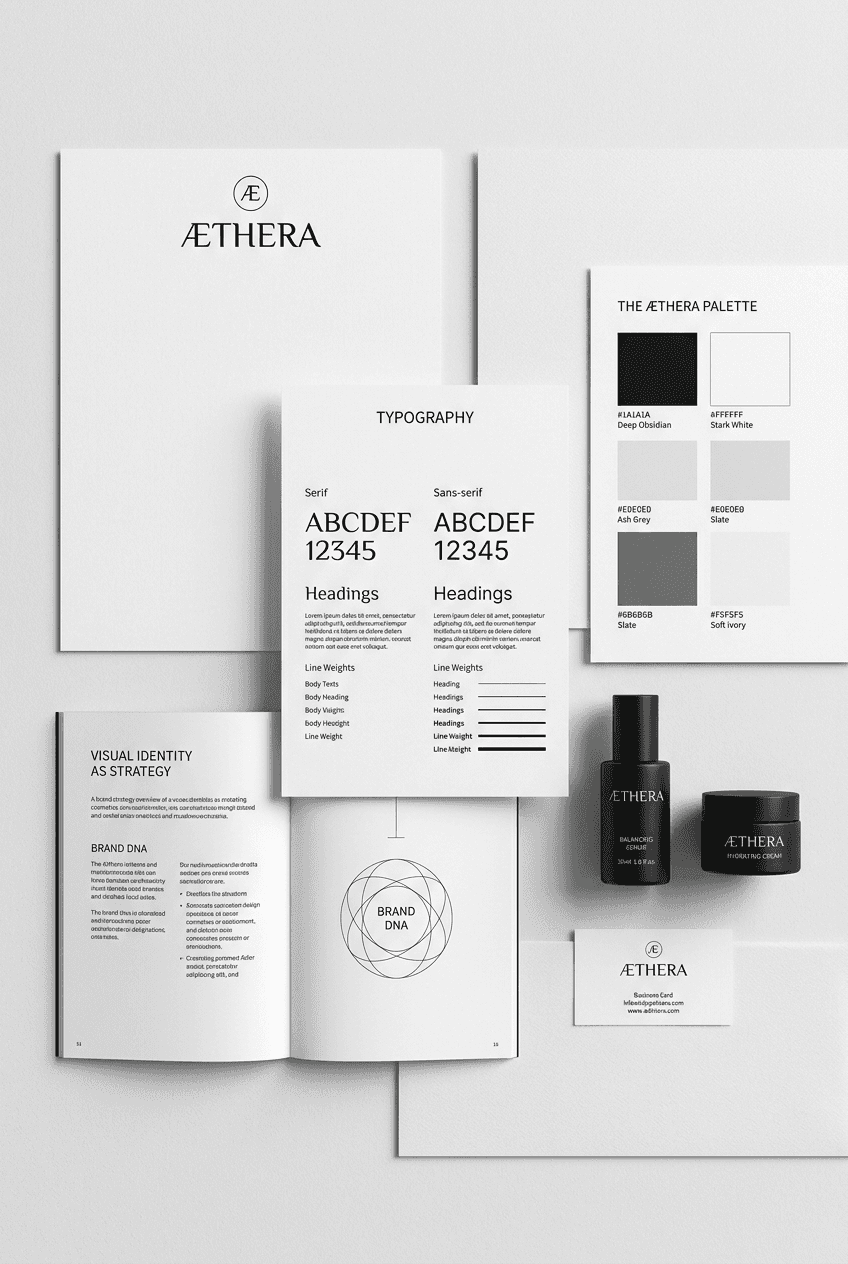
The visual identity is the name made visible. Color, typography, and packaging structure all communicate positioning before a word is read. In skincare specifically, the visual identity must also signal where the brand sits on the science-to-luxury spectrum.
Clinical and science-forward brands tend toward white, clinical typography, and minimalist design that communicates precision. Luxury and ritual-focused brands tend toward richer colors, refined typography, and materials that communicate craftsmanship. Naturals and wellness brands tend toward earth tones, organic shapes, and materials that communicate provenance and purity.
None of these is a rule. Each is a convention that the brand must either honor or deliberately break, with a strategic reason for the choice.
A 2024 study published in the Journal of Consumer Research found that packaging design consistency across digital and physical retail environments increases brand recognition by up to 40% compared to brands with fragmented visual systems. Building a visual identity as a system, rather than as a collection of design assets, is not optional.
Claims: Turning Science Into Language That Sells
Every claim on a skincare brand must satisfy three criteria: it must be true, it must be specific, and it must be legally compliant in the markets where the product is sold.
The challenge is making something true and specific also feel compelling. Clinical accuracy and consumer-facing copywriting pull in different directions. The phrase that is most accurate scientifically is rarely the phrase that converts best commercially. The translation between these two requires understanding both.
Good skincare copywriting starts with the mechanism. What does this ingredient actually do, at the concentration present in this formula? What evidence exists for that action? What is the consumer outcome that evidence supports? And what is the most specific, most sensory, most emotionally resonant way to communicate that consumer outcome without crossing into claims that regulatory frameworks prohibit?
This translation layer is where most skincare brands either leave money on the table by being too vague, or create regulatory risk by overclaiming. The sweet spot requires someone who understands both the formula and the copy.
I cover the specifics of claim compliance, including the cosmetic-drug boundary and how to navigate it across EU and US markets, in my guide to cosmetic label design.
The Role of Science in Skincare Branding
The skincare category is one of the most scientifically literate consumer categories in existence. A meaningful percentage of skincare consumers can read an ingredient list, understand INCI nomenclature, and evaluate a claim based on the evidence they know exists for a given ingredient.
This creates an opportunity that most brands mismanage. Educated consumers are not a threat to bold claims. They are the most receptive audience for honest, specific, evidence-based claims that most brands are too cautious to make.
A brand that can say "0.1% retinol, the clinical threshold for visible anti-aging effects, in an encapsulated delivery system that reduces irritation" is speaking directly to the consumer who knows exactly why each of those details matters. That consumer trusts the brand more, not less, for the specificity.
The barrier to this kind of communication is that most branding agencies do not understand the formulation science well enough to have those conversations. As a pharmacist, I read the formula before I open a design file. That sequence, science first, then strategy, then design, is what makes the claims both credible and compelling.
Building for the Long Term
Skincare brands built on a trend, a hero ingredient, or a viral moment face a recurring challenge: the trend ends, the ingredient cycles out of fashion, the moment passes. The brand has to rebuild from a diminished position.
Skincare brands built on a clear point of view, a specific consumer relationship, and a formulation philosophy that does not depend on any single ingredient have a different problem: they have too much content to create, because their positioning is rich enough to sustain dozens of product lines, years of content, and a loyal consumer base that grows because the brand genuinely serves them.
Building for the long term starts with the same question that starts any brand: who is this for, and what do they need from a skincare brand that they cannot currently get? Answer that question clearly enough, and every decision that follows becomes easier.
If you want to build a skincare brand that earns trust and holds position over time, reach out. That is the only work I do.
FAQ: Branding for Skincare
What is the first step in branding a skincare line?
Positioning. Before any logo is designed, before any name is tested, the brand's positioning must be defined: who is this for, what does it do for them specifically, and why should they believe it. Every creative decision that follows is an expression of those answers.
How important is it to be scientifically specific in skincare branding?
Extremely important, and increasingly so. A growing segment of skincare consumers can read an ingredient list and evaluate a claim based on the clinical evidence they know exists. Brands that make specific, substantiated claims earn deeper trust with this audience than brands that use vague aspirational language.
How do I choose a skincare brand name?
Evaluate any name against four criteria: is it distinctive enough to remember without context, pronounceable enough to recommend verbally, trademarkable in your key markets, and expressive enough to signal something about the brand's positioning. Generic names and descriptive names fail the first and third tests.
What visual identity works best for a skincare brand?
It depends on the positioning. Clinical and science-forward brands need precision, white space, and typography that communicates authority. Luxury brands need material quality and refined restraint. Naturals brands need provenance and organic warmth. The visual identity must match the positioning, not just the category convention.
How do I build skincare claims that are compelling and compliant?
Start with the mechanism of action. Translate it into the consumer's experienced outcome. Find the most specific and sensory way to communicate that outcome within the regulatory framework for cosmetics in your target markets. This requires understanding both the formulation science and the regulatory boundaries simultaneously.
How long does it take to build a skincare brand?
A rigorous process, from positioning through brand guidelines and packaging, typically takes twelve to twenty weeks depending on the complexity of the product range. Founders who rush this phase consistently spend more on rebrands within the first two years than they saved by compressing the original process.
Do skincare brands need brand guidelines?
Yes, always. Brand guidelines are the document that protects the investment in brand development over time. Without them, every new touchpoint, every new designer, every new marketing material drifts away from the original system, fragmenting the recognition equity the brand has built.
I am Tambi, a brand strategist and creative director with an unfair advantage: I am a pharmacist. I run a creative studio for cosmetics, supplements and beyond. 17+ years. Exclusively.
Sources: Grand View Research, Global Skincare Market Report (2024); Mintel Skincare Consumer Research (2023); Journal of Consumer Research, Brand Consistency and Recognition Study (2024)