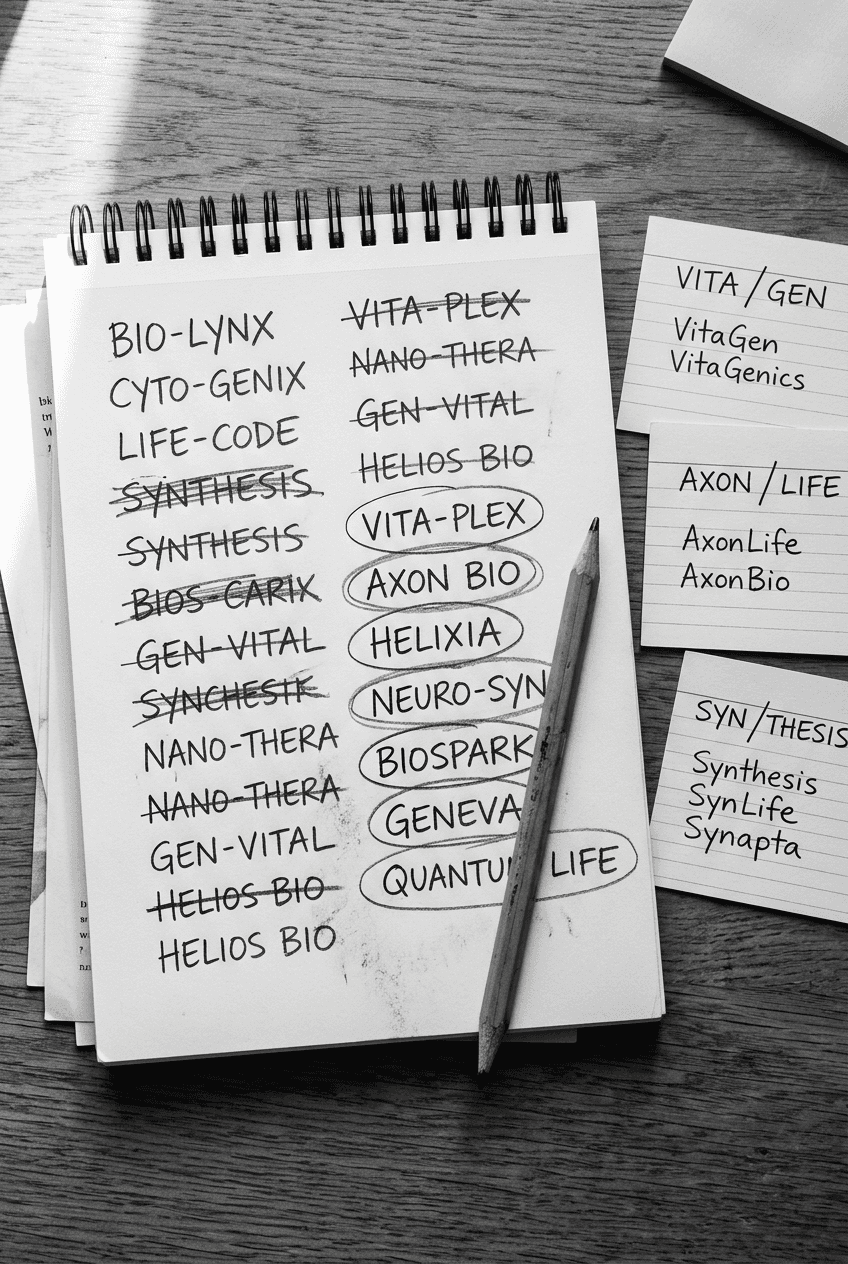

A biotech name that works in every room is one that a sophisticated investor can pronounce confidently, a regulatory official can file without ambiguity, and a talented scientist would be proud to add to their LinkedIn.
The Unique Naming Challenge in Biotech
Biotech company naming is more constrained than naming in almost any other sector. The name must work across a set of contexts that impose different, sometimes competing requirements. Understanding these requirements before generating name candidates is the difference between a naming process that produces excellent options and one that generates dozens of candidates that fail one test or another.
The investor context requires: a name that is memorable after a single hearing, that suggests scientific seriousness without being inaccessibly technical, and that can be said confidently in conversation at a conference or on a call. Investor-facing names often benefit from a degree of coined distinctiveness that makes them more memorable than descriptive names.
The regulatory context requires: a name that is unambiguous in written form, that does not closely resemble existing company names or registered product names (which could create confusion in regulatory submissions), and that translates without problematic meanings into the major languages of the regulatory jurisdictions where the company will operate.
The scientific community context requires: a name that can be cited in publications without awkwardness, that does not create confusion with existing academic or research institutions, and that suggests scientific legitimacy rather than commercial excess.
The talent context requires: a name that a highly qualified scientist would be comfortable putting on their CV, that suggests a serious and intellectually credible organization, and that does not carry cultural associations that would alienate candidates in key talent markets.
The Five Biotech Naming Archetypes
Biotech company names tend to cluster into five naming archetypes, each with distinct advantages and disadvantages.
Scientific etymology names are constructed from Greek and Latin roots related to the scientific domain. Novartis, Astellas, Regeneron. These names signal scientific seriousness and are culturally associated with established life sciences organizations. The advantage is immediate category recognition. The disadvantage is that the category is crowded with similar constructions, and new names in this style can feel derivative. Coined scientific names create new words from scientific or phonetic roots that suggest the scientific domain without being dictionary words. Genentech, Moderna, Biogen. These names have the distinctiveness advantage of coined words while maintaining a scientific register. The challenge is pronunciation: coined names must be tested extensively to ensure they are naturally pronounceable in the primary language markets. Descriptive or platform names describe what the company does directly. CRISPR Therapeutics, Blueprint Medicines. These names have the advantage of immediate comprehension at the cost of memorability: they are clear but not distinctive. They also require careful management as the company's platform evolves, because a name that accurately describes the current platform may become misleading if the platform changes. Founder or place names use the founders' names or the location of founding. These are less common in biotech than in consumer sectors. They can create strong personal brand associations when the founders are prominent scientists, but they create succession challenges and can feel limiting as the company grows beyond its founding context. Abstract or metaphorical names use language that suggests aspiration, transformation, or progression without direct scientific reference. Turning Point Therapeutics, Relay Therapeutics. These names have high distinctiveness and can communicate mission and aspiration effectively, but they require strong brand building to associate the abstract name with the specific scientific work.
The Naming Criteria Framework for Biotech Companies
Before generating name candidates, the naming team should align on the specific criteria the name must satisfy. These criteria will filter the candidate list more efficiently than evaluating each name against general impressions.
Pronounceability in primary markets. The name must be naturally pronounceable by native speakers of English (primary investor and partner market), and ideally in German, Japanese, and Chinese (major scientific and commercial markets). Test candidate names with native speakers from each market before advancing them to the shortlist. Trademark availability in key classes. Biotech company names must be available for trademark registration in the pharmaceutical, biological, and medical device classes (Nice Classification 5 and 44 are the primary biotech classes) in the primary operating jurisdictions. Pre-screening candidates through a trademark attorney before presenting them reduces wasted work on names that cannot be protected. Domain availability. The company's primary domain (name.com) should be available or acquirable at reasonable cost. The domain landscape has become crowded, and many scientifically compelling name constructions are already taken. Domain availability is a practical filter that should be applied early. Absence of problematic meanings. Cross-cultural linguistic screening should confirm that the name does not have problematic, embarrassing, or offensive meanings in major languages. This screen should cover at minimum English, Spanish, French, German, Japanese, Mandarin, and Arabic. Distinctiveness from existing companies. The name should not closely resemble existing biotech, pharmaceutical, or medical device companies. A close resemblance creates ongoing brand confusion, potential legal challenges, and confusion in regulatory databases.
Comparison Table: Biotech Naming Archetypes
Archetype | Examples | Memorability | Scientific Register | Distinctiveness | Risk |
|---|---|---|---|---|---|
Scientific etymology | Novartis, Astellas | Medium | High | Low | Generic |
Coined scientific | Moderna, Genentech | High | High | High | Pronunciation |
Descriptive platform | CRISPR Therapeutics | Medium | High | Low | Platform drift |
Founder or place | Named institutes | Low | Variable | Low | Succession |
Abstract metaphorical | Turning Point | High | Low | High | Brand building |
The Naming Process in Practice
A professionally managed biotech naming process follows a specific sequence that prevents the most common naming mistakes.
Brief development. Before generating names, develop a written naming brief that documents the criteria the name must satisfy, the archetypes being considered, the competitive landscape to differentiate from, and the emotional and functional territory the name should occupy. A brief that takes a morning to write saves weeks of directionless candidate generation. Candidate generation. Generate a large initial candidate pool (one hundred to two hundred names) that explores multiple archetypes, root combinations, and linguistic territories. The goal at this stage is breadth, not quality filtering. Generate without evaluating. Initial screening. Apply the criteria filters systematically: pronounceability, basic trademark and domain availability, absence of problematic meanings, distinctiveness from competitors. This typically reduces the candidate pool to fifteen to thirty viable options. Qualitative evaluation. Present the surviving candidates to the naming team and key stakeholders for qualitative assessment against the brief's criteria. Evaluate each candidate in the actual contexts where it will be used: spoken in a conference introduction, written in a publication citation, read on a business card. Context evaluation reveals issues that abstract list evaluation misses. Legal clearance. The shortlisted candidates (typically three to five) should undergo full trademark clearance searches in all relevant jurisdictions before the final selection. Trademark clearance for biotech naming typically takes two to three weeks and costs between $3,000 and $8,000 per candidate depending on the number of jurisdictions. Selection and registration. Select the name, register the trademark applications in all relevant jurisdictions immediately, and secure the primary domain. Do not announce or use the name publicly before trademark applications are filed.
Internal Links
Once the naming decision is made, the name becomes the foundation of the full brand identity system. The strategic work of building that system is covered in biotech company branding. Companies considering a name change as part of a broader strategic repositioning should review biotech rebranding for the specific considerations around transitioning an established name. The visual identity work that follows naming is covered in biotechnology brand identity.
FAQ: Biotech Company Naming
Q: How long should a biotech company name be?
A: One to three syllables for the primary name used in conversation. Two-syllable names perform best on the memorability and pronounceability dimensions that matter most for investor and conference contexts. Longer names can work but are typically abbreviated to informal short forms by the people who use them regularly, so it is worth anticipating what the informal short form will be and ensuring it is acceptable.
Q: Is it acceptable to use a founder's name as the company name in biotech?
A: It can work when the founder has established scientific prominence that adds genuine brand value. Genentech's success is in part due to the scientific reputation of its founders. For companies whose founders do not yet have prominent scientific profiles, a founder name adds the succession limitation of a personal name without the brand equity benefit of a prominent name.
Q: Should the company name change when the pipeline evolves?
A: Not unless the mismatch between the name and the current scientific focus is creating genuine confusion or competitive disadvantage. The rebranding cost (regulatory notifications, publication record updates, investor communications, employee transition) is high enough that it requires a compelling reason. A name that was built for an oncology-focused company but whose company has since evolved to rare disease is annoying but may not justify a full name change until a transaction or major milestone provides a natural transition point.
Q: How do you name a company with multiple programs or platforms?
A: Use an abstract or coined name that is not tied to a specific platform or indication, so the name does not become misleading as the pipeline evolves. Alternatively, use a name that references the underlying biological mechanism or target class broadly enough to accommodate program expansion. Names tied to a specific program (for example, a name that references a specific target) create future brand problems when additional programs in different target classes are added.
Q: What is the most common mistake in biotech company naming?
A: Making the decision too quickly and without adequate linguistic and trademark screening. Founders often fall in love with a name before it has been vetted and then resist the screening process because it threatens the name they have already mentally committed to. The names that cause the most lasting brand problems are the ones that were selected quickly, screened inadequately, and are now too embedded in regulatory and publication records to change without significant disruption.
I am Tambi Haşpak, a brand strategist and creative director with an unfair advantage: I am a pharmacist. I run a creative studio for cosmetics, supplements and beyond. Seventeen years in this category. Exclusively.