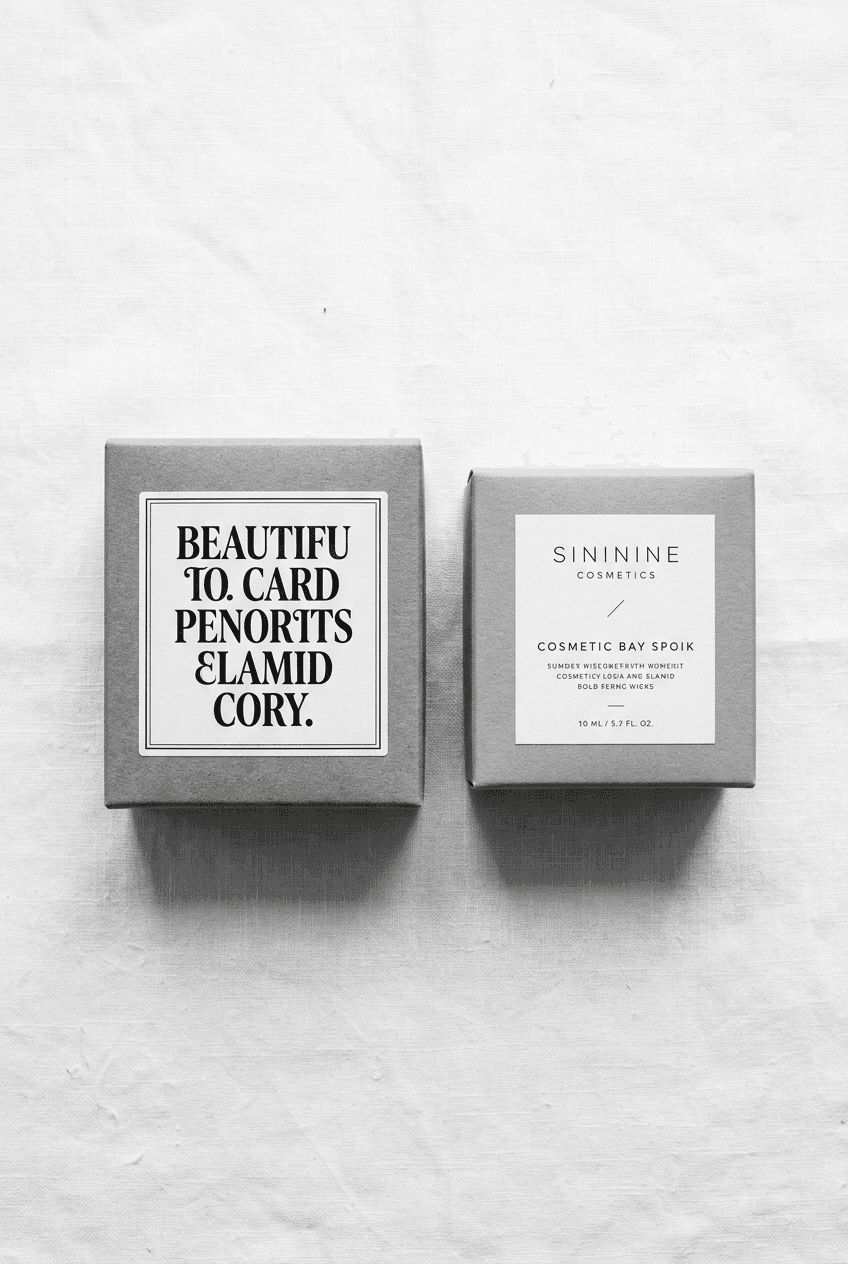

Your typeface makes a positioning claim before your customer reads a word.
Why Typography is One of the Most Powerful Positioning Signals
A customer sees your product on a beauty shelf for maybe two seconds. In that brief moment, they decide whether to pick it up or walk past. The color palette matters. The shape of the bottle matters. But typography is the element that creates an immediate positioning signal.
Typography is how we translate quality perception into visual form. A serif typeface with elegant proportions signals refinement, heritage, and premium positioning. A clean geometric sans-serif signals modernity, efficiency, and mass-market accessibility. These aren't conscious decisions by the customer. They're unconscious associations formed by years of exposure to brand packaging.
This is why understanding typography's role in cosmetics positioning is critical. You can have the best formulation and beautiful packaging, but if your typography is wrong for your positioning tier, customers perceive your brand as one tier lower than you intended. (Typographic Society of America, 2024)
Typography also conveys confidence and authority. A brand that makes clinical claims about efficacy needs typography that signals precision and science. A brand that emphasizes natural beauty needs typography that feels organic and approachable.
Conversely, the wrong typography undermines your entire brand positioning. A luxury brand using the same typeface as a mass-market brand loses perceived premium positioning. A natural skincare brand using corporate sans-serif fonts feels inauthentic. A playful, youth-oriented beauty brand using formal serif typography feels outdated.
The Four Cosmetics Market Tiers and Typeface Categories
The cosmetics market divides into clear pricing and positioning tiers. Each tier has characteristic typography approaches.
Mass Market (Tier 1): $5-$25 per product
Mass-market cosmetics prioritize accessibility, value, and broad appeal. Think drugstore brands, direct-response e-commerce, big-box retail. The customer base is broad: all ages, all income levels, buying primarily on price and convenience.
Typeface strategy: Geometric sans-serifs and clean humanist sans-serifs dominate this tier. Fonts like Gotham, Futura, Montserrat, or similar feel modern, friendly, and straightforward. Heavy font weights feel approachable. Sans-serifs feel efficient and no-nonsense.
The typography typically emphasizes product benefit and ingredient clarity. "Moisturizing Cream" "Anti-Aging Serum." The font might use all-caps or mixed case. The hierarchy is functional: big product name, smaller benefit statement, smallest regulatory information.
Typography colors are typically high-contrast (black on white, white on color). This ensures legibility at retail shelf where lighting might be harsh. It also signals value. Luxury brands can afford subtle, low-contrast typography. Mass-market brands need instant readability.
Masstige (Tier 2): $25-$60 per product
Masstige is the intersection of mass and prestige. These brands feel aspirational but accessible. Think Cetaphil, Neutrogena Hydro Boost, Olay Regenerist. The customer base is educated, values efficacy, and is willing to pay premium prices but not luxury prices.
Typeface strategy: A mix of refined sans-serifs and subtle serifs. Fonts like Avenir, Lato, DM Sans, or quality serif options like Freight Text signal sophistication without excessive formality. The brand might use a sans-serif for headlines and a serif for body copy, or use a quality sans-serif throughout with refined proportions.
The typography emphasizes both benefit and efficacy. "Clinically Proven Hydrating Serum" or "Advanced Renewal Night Cream." The copy mentions science and results. The typeface needs to support this claim through its own precision and refinement.
Font weights are typically medium to semibold, creating visual authority. The hierarchy is clear: prominent product name, benefit statement that emphasizes efficacy, supporting ingredient information.
Typography often uses color subtly. Dark gray instead of pure black. Or complementary colors that create visual interest without feeling overwhelming. This signals more thoughtfulness than mass-market typography.
(Brand Strategy Institute, 2024)
Prestige (Tier 3): $60-$200 per product
Prestige brands signal expertise, efficacy, and professional recommendation. Think Kiehl's, Estée Lauder, Lancôme, Dermalogica. These brands are sold through specialty retailers or professional channels. The customer base is affluent, educated, and values efficacy and brand heritage.
Typeface strategy: Refined serifs and elegant sans-serifs dominate this tier. Fonts like Garamond, Caslon, Baskerville, or contemporary serifs like Chronicle Display signal heritage and expertise. Sans-serif options might be modern geometric serifs like DM Sans or sophisticated humanists like Calibre.
The typography emphasizes professional credibility. "Professional-Grade Renewal Complex" or "Dermatologist-Tested Brightening Serum." The copy references science, efficacy claims, and professional development.
Custom typefaces are more common at prestige tier. Brands invest in proprietary fonts that feel unique and distinctive. This custom typography becomes part of brand identity and can't easily be copied.
Font weights are refined. The hierarchy is sophisticated: elegant brand name, benefit statement with measured language, supporting information presented cleanly.
Typography often uses elegant spacing and kerning. The brand can afford to use less high-contrast typography because it competes in specialty retail where lighting is controlled. Typography might use sophisticated color combinations: deep blue with metallic copper, or muted green with refined gray.
(Interbrand, 2025)
Luxury (Tier 4): $200+ per product
Luxury brands signal exclusivity, heritage, and aspiration. Think Estée Lauder Advanced Night Repair, La Mer, Sisley, Augustinus Bader. These brands are positioned as premium investments in skin health. Distribution is limited. The customer base is affluent and purchases are typically gift-worthy.
Typeface strategy: Refined serifs with extensive character and often custom modifications are standard. Fonts like Didot, Bodoni, or bespoke custom fonts signal luxury, heritage, and exclusivity. The typography might be intentionally difficult to read at small sizes because there's an assumption that customers will take time to study and appreciate the brand.
The typography emphasizes heritage, efficacy, and exclusivity. "La Mer Moisturizing Cream" requires no additional claims. The brand itself is the claim. Supporting copy might reference the brand's origin story or ingredient sourcing.
Custom typefaces are almost always present. Luxury brands often commission entirely custom fonts that become proprietary. This typography is protected as intellectual property and contributes substantially to brand identity.
Font weights are often light or regular weight, creating elegance and perceived refinement. The hierarchy is minimal: brand name, possibly a product descriptor, regulatory information. Clean, precious, minimal.
Typography is often low-contrast, sophisticated, and sometimes small in absolute size. This signals that the brand trusts its customer to appreciate and understand the packaging. Small, delicate typography signals prestige in a way that large, obvious typography never can.
Color strategy in luxury typography is often sophisticated neutrals (cream, soft gray, gold) on luxury materials (matte finish, textured substrate). The typography becomes integrated with the material itself.
Display vs. Body Typography on a Label
The distinction between display and body typography is critical for cosmetics packaging legibility and positioning.
Display typography is your brand name and primary communication element. This is where you make a positioning statement. Display fonts can be bolder, more decorative, more distinctive. They're typically large enough to read at shelf distance and create immediate visual impact.
In mass-market cosmetics, display fonts are often clean, geometric sans-serifs. In prestige cosmetics, display fonts are often refined serifs or elegant sans-serifs. In luxury cosmetics, display fonts are often custom or custom-modified serifs.
Body typography is your supporting copy, benefit statements, ingredient lists, and regulatory information. Body typography must be highly legible at small sizes. Sans-serif body fonts are more legible at small sizes than serif fonts, which is why many brands use a serif display font paired with a sans-serif body font.
The contrast between display and body typography creates visual hierarchy. Customers see the large, distinctive brand name first. Then they read the benefit statement and supporting information in smaller, more functional body type.
A common error is using a highly decorative display font paired with a body font that's equally decorative. The result is visual chaos. The hierarchy collapses. Customers struggle to read the label.
A stronger approach: distinctive, positioned display font paired with clean, legible body font. The display font does the positioning work. The body font does the legibility work.
Legibility Requirements for Cosmetics Labels
Typography must be legible under actual retail conditions, not just on a screen. This is a functional and legal requirement.
FDA labeling regulations specify minimum font sizes for certain elements. The active ingredient must be legible. Directions for use must be legible. Net content statements must meet specific type size requirements depending on package size.
Beyond regulatory requirements, cosmetics packaging often appears in retail lighting that's harsh, yellow-tinted, or inadequate. A typeface that's difficult to read under ideal conditions becomes unreadable under retail conditions.
Body copy on cosmetics labels should typically be no smaller than 8 pt, and preferably 9-10 pt. This ensures readability even under poor lighting. Ingredient lists can go smaller (6-7 pt) because customers typically don't read these at shelf distance.
Contrast matters enormously. Black type on white or light color reads easily. Gray type on a slightly darker gray requires the customer to work harder. Low contrast typography signals poor design or careless manufacturing.
The best cosmetics labels maintain high contrast for body copy while allowing more subtle, sophisticated typography choices for display elements.
The Role of Custom vs. Licensed Typography
Luxury brands often invest in custom typography because it becomes part of their brand identity. Prestige brands sometimes use custom fonts. Masstige brands usually license established fonts. Mass-market brands use whatever is cheapest.
Licensed fonts are typefaces that you purchase a license to use. They're created by type designers and sold for a one-time or recurring fee. Most established typefaces are licensed fonts. Using licensed fonts is fast and cost-effective.
The downside: Any brand can license the same font. If you use Avenir for your brand name, competitors might also use Avenir. Your typography is not distinctive.
Custom fonts are typefaces designed specifically for your brand. You commission a type designer to create unique letterforms that express your brand identity. Custom fonts take 8-16 weeks to develop and cost $15,000-$50,000+ depending on scope.
The advantage: Your typography is entirely yours. It becomes part of your brand identity and is legally protected. It's difficult or impossible for competitors to copy. Custom typography often signals luxury positioning because most brands don't invest in it.
The disadvantage: Cost, timeline, and complexity. You need to maintain and update the custom font across all your materials. If you want to add new languages or special characters, you need new design work.
For most cosmetics brands, a combination works best: licensed display font paired with licensed body font that creates your visual identity. This costs $200-$500 in font licensing, which is modest compared to custom typography investment, and it allows flexibility while still creating distinctive visual identity.
Some prestige brands use licensed fonts with custom modifications. They license Caslon (a beautiful serif) then work with a designer to customize specific letterforms for their brand. This is more affordable than fully custom fonts while still creating some distinctiveness.
Typography Comparison by Cosmetics Positioning Tier
Dimension | Mass Market | Masstige | Prestige | Luxury |
|---|---|---|---|---|
Display Font Category | Geometric sans-serif | Refined sans/elegant serif | Elegant serif or refined sans | Custom serif or bespoke |
Body Font Category | Clean sans-serif | Quality sans or light serif | Refined serif or refined sans | Custom serif or refined serif |
Display Font Weight | Semibold to bold | Medium to semibold | Light to regular | Light to regular |
Font Size (Display) | 24-48pt | 18-40pt | 14-36pt | 12-28pt |
Font Size (Body) | 9-10pt | 9-11pt | 8-10pt | 7-9pt |
Contrast Level | High (black/white) | High to medium | Medium to subtle | Subtle to elegant |
Custom Font | Rare | Uncommon | Sometimes | Almost always |
Typical Cost | Licensed ($50-300) | Licensed ($200-500) | Licensed or custom | Custom ($20k-50k+) |
Example Brands | Neutrogena, CeraVe | Olay, Cetaphil | Estée Lauder, Kiehl's | La Mer, Sisley |
Common Typography Mistakes in Beauty Packaging
I see patterns in cosmetics packaging where typography choices undermine the brand positioning.
Mistake 1: Using too many typefaces.
Some brands use four or five different fonts on one label: one for the brand name, one for the product name, one for benefit statement, one for ingredient list, one for regulatory. This creates visual chaos and makes the label feel amateurish.
A strong approach uses two typefaces maximum: one display font for brand and product name, one body font for everything else. This creates clarity and sophistication.
Mistake 2: Font weight hierarchy is inverted.
The brand name should be the dominant visual element, so it should be bold. Supporting information should be lighter weight. Some brands reverse this: light-weight brand name with bold, heavy supporting copy. This creates confused hierarchy where the regulatory information becomes visually prominent.
Mistake 3: Poor contrast makes type illegible.
A luxury brand uses sophisticated gray typography on a slightly darker background. It looks beautiful in design mockups. On the actual shelf under retail lighting, it's impossible to read. Customers can't even see the brand name.
Always test typography contrast under actual retail lighting conditions before finalizing packaging.
Mistake 4: Typeface doesn't match positioning tier.
A luxury skincare brand uses the same sans-serif font that every other mass-market brand uses. The positioning claim is undermined by the typography choice. The customer perceives it as expensive mass-market, not prestige.
Choose typefaces that reinforce your claimed positioning tier.
Mistake 5: Display and body fonts have no relationship.
You choose a beautiful serif display font and a clean geometric sans-serif for body copy. They have no visual relationship. They don't feel like they belong together.
Stronger approach: Choose fonts from the same typeface family (e.g., different weights of the same font) or fonts that have visual harmony (both elegant, both modern, both refined).
Mistake 6: Body type is too small to read under real conditions.
Designers design on bright screens at 100% zoom. 7pt type looks fine. On an actual printed label under store lighting, it's illegible. Customers can't read your benefit statement or ingredient list.
Minimum 8pt for body copy is a good rule. Test samples under actual retail lighting.
Mistake 7: Using decorative fonts for body copy.
A designer chooses a decorative, artistic font that looks beautiful for the benefit statement. The font is so stylized that it's difficult to read at small sizes. The statement "Clinically Proven Hydrating Serum" is hard to decipher.
Reserve decorative fonts for display elements. Use clean, legible fonts for body copy.
Mistake 8: Typography doesn't adapt to different languages.
A luxury brand designs beautiful typography for their English brand name and benefit statements. They extend to French, German, and other markets. The custom font doesn't have characters for accented letters or other language requirements. The typography breaks in different markets.
If you're designing for international markets, ensure your chosen fonts support all required character sets and that accented letters maintain the same proportions and beauty as the primary language.
(Graphic Design Society, 2024)
How Custom Typography Creates Brand Distinctiveness
Luxury cosmetics brands invest in custom typography for a reason: it becomes part of brand identity that competitors can't copy.
La Mer's distinctive, elegant serif font is so integral to their brand that it's instantly recognizable. Sisley's refined italic serif is part of their luxury positioning. These aren't generic fonts that any brand could use. They're custom, proprietary, protected.
When you commission custom typography, you're not just getting distinctive letterforms. You're creating legal intellectual property that protects your brand. A competitor can't use your custom font. They can't easily imitate it without risking trademark or design patent infringement.
Custom typography also demonstrates commitment and investment. A luxury brand that commissions custom fonts signals that they're serious about their positioning and willing to invest in every detail that affects perception.
Custom typography also allows you to embed your brand values into the letterforms themselves. A natural beauty brand might commission a custom font with softer, more organic proportions. A clinical skincare brand might commission a custom font with geometric precision.
Typography as Shelf Impact Strategy
Typography isn't just about conveying information. It's also about creating visual impact at retail.
A cosmetics brand with sophisticated, refined typography stands out on a shelf where competitors are using loud, high-contrast, busy typography. The refined brand appears more expensive and more confident.
Conversely, a brand trying to compete on shelf impact against brands with bold, high-contrast typography needs to match that energy. Subtle, refined typography will disappear at retail.
Typography's role in shelf impact depends on your competitive set. If your competitors are using bold sans-serifs, you need proportionally bold typography to compete. If your competitors are using refined serifs, you can differentiate with something unexpected.
The strongest shelf impact comes from using typography strategically and distinctively, not from trying to outshout competitors. A calm, confident typography system that's unique to your brand creates more impact than loud, generic typography.
FAQ
Q: What's the difference between a serif and sans-serif font and which should I use for cosmetics?
A: Serifs are the small lines at the end of letterforms. Serif fonts signal heritage, formality, and refinement. Sans-serif fonts signal modernity, efficiency, and approachability. The choice depends on your positioning tier. Mass market uses sans-serif. Prestige and luxury often use serif.
Q: Can I use the same typeface for both display and body copy?
A: Yes. Using different weights of the same typeface (e.g., bold for display, regular for body) creates hierarchy while maintaining visual unity. This is often stronger than using two completely different typefaces.
Q: How much does custom typography cost?
A: Fully custom fonts typically range from $15,000 to $50,000+ depending on complexity and the type designer's experience. Custom modifications to existing fonts might cost $3,000-$10,000. Licensed fonts typically cost $200-$500 per font.
Q: Should I use a trendy font to make my brand feel current?
A: Be cautious. Trendy fonts become dated quickly. A cosmetics brand using the hottest typeface from 2023 looks dated by 2026. Better strategy: Use classic or timeless typefaces that will age gracefully. Your brand story and product quality make you current, not your typeface.
Q: What font size is the minimum for cosmetics labels?
A: FDA regulations specify minimum sizes for certain elements (like active ingredients). For body copy, 8-9pt is generally the minimum. Test under actual retail lighting to ensure it's readable.
Q: How do I choose between a licensed font and custom typography?
A: Use licensed fonts unless you're at prestige or luxury tier and can justify the investment. Licensed fonts are cost-effective and available immediately. Custom typography is worthwhile only if it meaningfully contributes to your brand identity and market positioning.
Q: Can I use different fonts for different markets or languages?
A: You can, but ideally your brand typography feels consistent across markets. If you use custom fonts, ensure they support all required character sets and languages. If using licensed fonts, verify language support before purchasing.
Q: Should my body copy font always be sans-serif because it's more legible?
A: Not always. A refined serif font can be equally legible for body copy if it's designed well and sized appropriately. The key is legibility, not font category. Test readability of both options at actual size under actual lighting.
Q: How do I test whether my chosen typography works for cosmetics packaging?
A: Print samples at actual size on your chosen substrate under various lighting conditions. Read the label from shelf distance. Check legibility of ingredient lists and regulatory information. Show to target customers and ask if it reads easily.
Q: What's the relationship between typeface weight and brand positioning?
A: Heavy weights feel bold and confident. Light weights feel elegant and refined. Prestige and luxury brands typically use light to regular weights. Mass-market brands often use semibold or bold weights for confidence.
Q: Can I use a custom font and still be cost-effective?
A: Partially. Custom fonts from less-known type designers cost less than commissions from famous foundries. Custom modifications to existing fonts are more affordable than fully custom design. Prioritizing custom typography for your most visible brand element (brand name) and using licensed fonts for supporting copy balances cost and distinctiveness.
Q: What should I do if my chosen font doesn't have all the characters I need?
A: Contact the type designer or foundry and ask if they can add missing characters. Some charge for this service. Alternatively, choose a different font that supports your full character requirements. Never use a font with missing or compromised characters.
I'm Tambi Haşpak, a brand strategist and creative director with an unfair advantage: I'm a pharmacist. I run a creative studio for cosmetics, supplements and beyond. 17+ years. Exclusively. I've selected, modified, and sometimes commissioned custom typography for cosmetics brands across every positioning tier. I know how a single typeface choice shifts brand perception from mass-market to prestige. When you're at the moment of choosing how your brand will speak visually, every typeface decision matters. Start by reading my cosmetic packaging design services and my analysis of color psychology in cosmetics branding to understand how typography works alongside other design elements to position your brand.